I have a cardboard box on top of my fridge that holds five Commander decks. Last Tuesday I pulled them all down, sat on the kitchen floor, and tried to figure out what bracket each one actually belongs in. Not what I’d been telling people at the LGS. What it actually is.
Three of the five were one bracket higher than I’d been claiming.
Commander Brackets have been live for about a year now. Wizards and the Commander Format Panel rolled the beta out in February 2025, updated it twice, and pushed the most recent tweak in February 2026 with a small Game Changers addition and some hybrid-format clarifications. EDHREC just published a piece called “Are We Misrepresenting Power In Our Commander Decks?” that names the obvious thing. Most of us are. Some on purpose. Most of us by accident, which is the version I want to dig into.
The system, as it actually works right now
Quick recap, because the brackets keep shifting.
There are five brackets. Bracket 1 is Exhibition, where you can run anything if your pod agrees, including unsanctioned cards. Bracket 2 is Core, the chill-precon-feeling pod. Bracket 3 is Upgraded, where most “real” Commander decks sit. Bracket 4 is Optimized, and Bracket 5 is cEDH.
Brackets 1 and 2 don’t run Game Changers. Bracket 3 runs up to three. Brackets 4 and 5 are unrestricted.
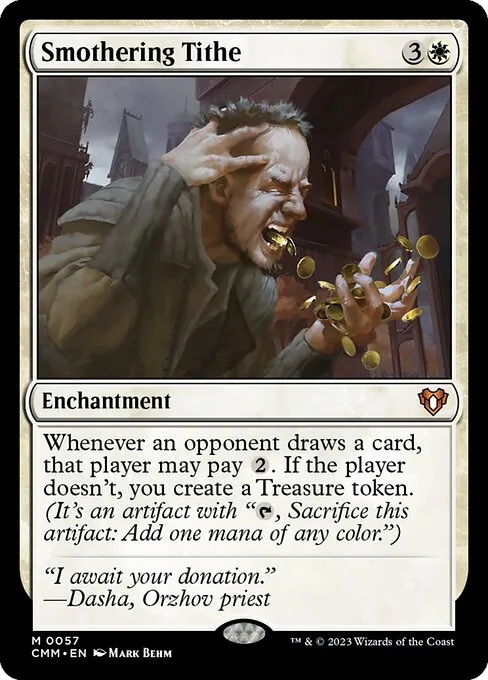
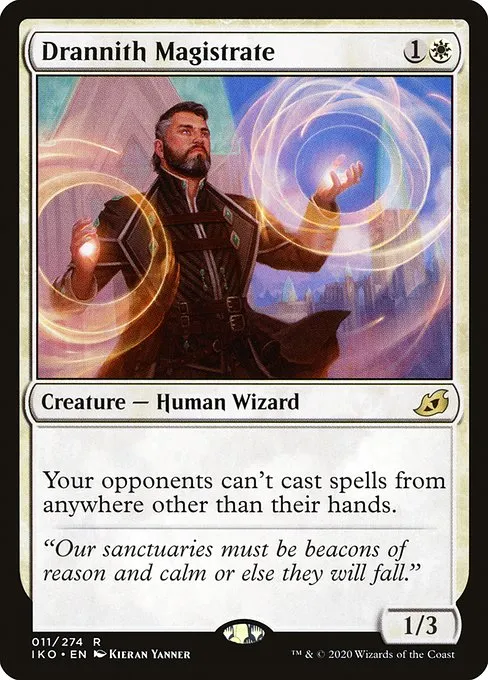
The Game Changers list is the load-bearing piece of the whole framework. As of February 2026 it sits at around 40 cards, which is down from the peak in early 2025 after Wizards trimmed ten of them in October. Mana Drain, Drannith Magistrate, Smothering Tithe, the heavy tutors like Vampiric Tutor and Demonic Tutor, plus a chunk of fast mana. The full list lives on EDHREC’s Top Game Changers page and it’s worth bookmarking, because the contents move.
The other barometers are easier to remember: two-card infinite combos, extra turns, mass land denial, and how long the average game runs at that bracket. Bracket 2 expects around eight turns minimum before someone wins. Bracket 3 expects six. Bracket 4 expects games to end whenever the cards say they end.
That’s the whole framework. It’s not a calculator. Wizards has said as plainly as they say anything that this is “a communication tool to guide pregame conversations about game expectations and player intent.” Moxfield and Archidekt both have bracket estimators now, and they’re useful, but they’re estimators.
The pod calibration problem
Your sense of “powerful” is shaped almost entirely by who you play with. If your home pod runs decks topping out at midrange Bracket 3 (an Atraxa Superfriends, a tribal deck or two, the occasional precon upgrade), then your idea of a “strong Bracket 3 deck” is calibrated to that ceiling. When someone walks in with an actually high-end Bracket 3 list, still no Game Changers, still slow-ish, but ruthlessly tuned, it feels like Bracket 4 to you. So when you build something that competes in your pod, you call it Bracket 3, and you’re probably right relative to your pod. The bracket system isn’t pod-relative. It’s supposed to be format-relative.
This is what the EDHREC piece is poking at. The author talks about a Kiora deck they built for fifty bucks that wins nine games out of ten in their pod. That doesn’t make the deck Bracket 4. It makes their pod Bracket 2 wearing Bracket 3 lapel pins.
I have the opposite version of this, kind of. There’s a Korvold deck I’ve been calling Bracket 3 for over a year because it has zero Game Changers, no infinite combos I run on purpose, and no MLD. But it consistently kills the LGS rando pod on turn six and the wins all look the same. Ramp into Korvold turn four, treasures, food tokens, dies, comes back, table loses to value. By the Game Changer criteria, it’s clean Core. By the average-win-turn criteria, it’s not. By the win-rate-against-strangers criteria, it’s something I should be honest about.
I keep saying Bracket 3.
I don’t have a clean answer for that. I think the honest move is to ask my opening pod and let them push me up if they feel it, but I haven’t actually done that and I keep saying Bracket 3.
A self-audit that takes about ten minutes per deck
This is the procedure I ran on my five decks. It was useful enough that I’ll do it again before any pickup pod with strangers.
For each deck, open the list and run six checks:
- Game Changers. Count them. Cross-reference with EDHREC’s current list, because the list moves. More than three and you’re at least Bracket 4. Zero is a Bracket 1-2-3 candidate.
- Two-card infinite combos. Including ones you don’t tutor for. If the pieces exist in your 99 and could land naturally, count them. One or two means Bracket 3 minimum.
- Mass land destruction. Any Armageddon, Ruination, Jokulhaups, or Cataclysm-style effect. Even one bumps you out of Bracket 1-2.
- Extra turns. Time Warp, Temporal Manipulation, Walk the Aeons. These aren’t always Bracket 3+ flags on their own, but a deck running three or more is signalling intent.
- Average win turn. This is the squishy one and the most useful. Look at your last ten games and write down what turn each ended on. If the median is turn five, you’re not Bracket 2. If it’s turn nine, you’re not Bracket 4.
- Win rate against your pod. EDHREC’s piece floats a 33% threshold. I think that’s too soft. At four-player Commander your “fair” rate is around 25%. If you’re consistently winning more than a third of games at a bracket, drop a step in honesty if not in deck construction.
That last one is the one nobody wants to do. I sat with my Korvold record and counted nineteen pod wins out of forty-something games over a year. That’s roughly 47%. The deck is not a Bracket 3 deck the way most people use the term. It’s a Bracket 3 list that has been calibrated against a Bracket 2 pod for a year, which functionally makes it a Bracket 3+ at any wider table. The label is technically correct on paper. But “this list is on the strong side of three, expect to see Korvold turn four pretty often” is what I should be saying in pregame.
That’s the whole point of pregame talk anyway. The bracket label is a starting point for the conversation, not the end of it.
The deck that breaks my own rules
So yeah, brackets. One year in. Honestly I still don’t know how to talk about my Niv-Mizzet, Parun pizza-club deck without sounding like I’m sandbagging or overselling. It runs no Game Changers. It runs one infinite combo that I added by accident when I rebuilt the manabase and forgot Niv plus Curiosity is still a thing. I almost never win with it. My win rate is somewhere south of 20%. But the combo is there. So is it Bracket 3?
It feels like Bracket 2 in play. The list says Bracket 3 because of the combo. I’d take it to a Bracket 2 pod and call out the combo line in pregame. Whether that’s “honest” or “loophole” probably depends on whether you’re the kind of player who reads pregame talk strictly or loosely.
I lean loose. Other people in my pod lean strict. We argue about it most weeks. There’s no winner.
How I actually track the bracket label now
I used to keep a spreadsheet. Now I track decks in Eldwyn and the bracket label is just a tag I add manually, the same way I tag “needs sleeves” or “missing 2 lands.” I started writing the bracket label as B3 (soft) or B3 (strong) for myself, not for the pod. The official system doesn’t have soft/strong tiers within a bracket. I find I need them for my own honesty.
The Game Changers list will keep moving. Wizards has been pretty clear they want to make small adjustments rather than overhauls, but small adjustments still mean cards leaving and joining. If you have a deck running cards currently on the list, set yourself a six-month reminder to recheck. A card moving off the list can drop you from a soft Bracket 3 to a comfortable Bracket 2 without you touching the deck.
It also goes the other way. A friend of mine had a deck I won’t name to protect his guilt. Wizards added a card he was running to the Game Changers list in October. The deck didn’t change. The label did. He was annoyed for about a week and then he just took the card out.
The pregame conversation gets shorter and the games get better when nobody walks in lying about where they are. Or, in my case, when nobody walks in earnestly believing a Bracket 3 thing about a deck that’s been quietly Bracket 3+ for eleven months.
If you’ve got a stack of Commander decks and you haven’t done the audit, do it. It’s not fun. You will discover that at least one of them is what your pod has been politely calling “the deck that always wins”. That deck is the one you owe the pregame caveat to. The other ones, the ones you thought were strong, might actually just be slightly tuned Bracket 2s wearing fancier sleeves.
If you want a head start, I’d run audit step five first. The win-rate one. That’s the test that tells you the most in the least time, and it’s the one that’s hardest to argue with when the spreadsheet (or the app) is sitting right there in front of you.