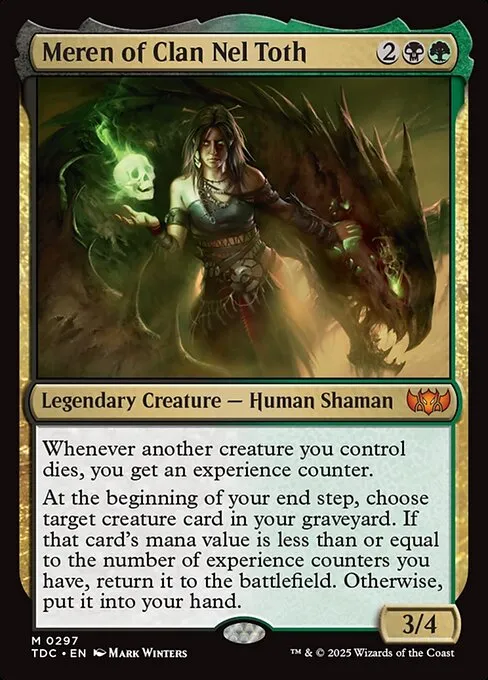
I built my Meren of Clan Nel Toth deck almost entirely from a box of cards I’d accumulated over three years of prerelease events and draft nights. Didn’t buy a single card for the first version. Was it good? No. It was terrible. The mana base was four different kinds of tap lands and I was running Elvish Visionary as card draw because I didn’t own a Phyrexian Arena. But it worked, sort of, and I won a game with it once by reanimating a Gray Merchant of Asphodel three times in a row, which felt way better than it should have.
The usual way people build Commander decks is backwards. They find a commander on EDHREC, look at the top cards in that commander’s page, buy the ones they don’t have, sleeve it up. That works fine but it’s expensive and it skips the part I find most interesting, which is figuring out what you can do with what’s already in your collection.
Scan first, pick a commander second
Most people pick a commander and then go shopping. I’d argue you should scan your collection first and then see which commanders fit what you already have.
When you scan a big pile of cards and get them into a database, you can filter and search in ways you can’t do by flipping through a binder. How many green creatures do I own? What removal do I have in black? Do I have enough artifacts to make an artifact-matters commander work?
I didn’t know I had 14 creatures with enter-the-battlefield effects in Golgari colors until I scanned my collection and filtered for them. That’s what pointed me toward Meren. If I’d been browsing EDHREC first, I probably would have picked something flashy like Korvold and then spent $80 filling in the gaps.
The approach is simple. Scan everything you own that isn’t already in a deck. Sort by color identity. Look at where the density is. If you’ve got 40 playable red cards and 8 playable white cards, maybe don’t build Boros. Go where the cards are.
The 60% rule
A good Commander deck has 100 cards. A playable Commander deck has 100 cards. These are the same number but the standard for “good” and “playable” is very different.
I’ve found that if you can fill about 60 cards from your existing collection (including lands), you’ve got a real deck. The remaining 40 will be basics, cheap utility cards you pick up for a quarter each, and maybe 5-10 actual purchases. That $15-30 in targeted singles is a lot more pleasant than $80-120 for a deck built from a netlist.
The 60% doesn’t have to be optimized. Some of those cards will be placeholder-tier things you swap out over time. Your first version runs Doom Blade instead of Deadly Rollick. Your Diabolic Tutor stands in for Demonic Tutor. That’s fine. The deck plays games and you improve it gradually.
Honestly, some of my favorite decks started this way and never really got “optimized.” My Meren deck still runs Elvish Visionary two years later because I like the card and it works with the reanimation theme and I just never got around to upgrading it. Or maybe I don’t want to. It’s got personality at this point.
Where collections usually have gaps
So the bad news. There are categories of cards that almost nobody has enough of just lying around, and you’ll probably need to buy some of these.
Mana base is the big one. Commander needs good multi-color lands and most people’s collections have a random assortment of tap lands from various sets with maybe a few shock lands or check lands mixed in. If you’re building a two-color deck you can usually cobble together something workable. Three colors gets rough. Running fifteen basics and eight tap lands is, I mean, it works, but you’ll feel it in every game where you need two specific colors on turn three.
Card draw is the other gap. Every Commander deck needs 8-10 sources of card draw and most people’s loose collections lean heavy on creatures and removal. Cards like Harmonize, Night’s Whisper, and Read the Bones are cheap enough that buying a few isn’t painful, but they’re the kind of thing you don’t tend to accumulate from limited play.
Ramp is usually fine. Sol Ring is in every precon, Arcane Signet is in every precon, and if you’ve picked up any prerelease kits in the last few years you probably have a handful of mana dorks and signets. The Strixhaven Commander precons each have decent ramp packages too, so if you grab one at the upcoming prerelease you’ll cover that gap fast.
The precon shortcut
Commander precons are kind of the cheat code for this approach. A precon gives you 100 cards that are already a functional deck, plus a bunch of staples (Sol Ring, Command Tower, various signets and talismans) that slot into any future deck you build.
So yeah, precons. They’re like $45-50 at most stores. Five Strixhaven ones are about to drop. If you buy one and scan it alongside your existing collection, you’re looking at maybe 130-150 Commander-playable cards. That’s easily enough to build a second deck from the leftovers, especially if the precon shares colors with cards you already own.
I bought the Prismari Performance precon from the original Strixhaven and ended up building two decks out of it. The precon itself as Zaffai spellslinger, and then a separate Talrand, Sky Summoner deck using the blue instants and sorceries that didn’t make the cut for Zaffai plus stuff from my collection. Talrand is mono-blue so the mana base was just islands and the few utility lands I had lying around. Zero additional purchases. It’s a sixty-percent deck for sure but it wins games.
The inventory advantage
The thing about knowing exactly what you own is that it changes how you think about deck building. Instead of “what’s the best card for this slot” the question becomes “what do I already have that fills this role.” And often the answer is something you forgot you owned.
I had a Cyclonic Rift sitting in my bulk because I’d pulled it from a Masters set and forgotten about it. That’s a $40 card that was doing nothing because I didn’t know it was there. Scanned the collection, found it, put it in the Talrand deck. Suddenly I have a $40 card in a deck that cost me nothing to build.

The other thing is tracking what gets allocated where. When you build multiple Commander decks, you start having cards that could go in two or three different decks. If you know your full inventory and what’s allocated to which deck, you can make decisions instead of guessing. “Should I buy a second Rhystic Study or just move it between decks?” is a question you can actually answer if you know what each deck has.
Actually, most people I know just own one copy of expensive staples and physically move them between decks. Annoying but cheaper than buying multiple Rhystic Studies at $60 each. I do this with Sol Ring even though Sol Ring is like two bucks. Just because I’m lazy about maintaining multiple copies of cards I know I’ll need.
Maybe the real move is to have one binder of Commander staples that floats between decks and a bunch of per-deck boxes for the cards that stay put. I’ve been meaning to set that up for months and haven’t gotten around to it, which probably means I never will.