There’s a stack of Wilds of Eldraine draft chaff on my kitchen table right now. About forty rares, the kind of pile you accumulate when you’ve drafted a set a dozen times and kept meaning to sort. Two of them are Beseech the Mirror. I know they’re worth something. I don’t know what they were worth last August, I don’t know what they’ll be worth next March, and that’s the part that’s bugging me.
Rotation is coming in February 2027, under Wizards’ new calendar-aligned schedule. That’s roughly ten months out. And when it hits, it’s going to drag six sets out of Standard at the same time, because 2026 was a skip year: Wilds of Eldraine, Lost Caverns of Ixalan, Murders at Karlov Manor, Outlaws of Thunder Junction, Bloomburrow, Duskmourn: House of Horror. All at once.
If you care about MTG collection value before rotation in any systematic way, this spring is when a baseline is actually useful. Not because you’re about to sell anything. Because in ten months you will absolutely want to look back and see what these cards were worth when you still had options, and you won’t be able to unless you wrote it down.
A six-set rotation is not a normal rotation
The usual rotation knocks three, maybe four sets out of the format. Demand thins, prices on Standard-only cards soften a few weeks in advance, Commander staples mostly hold, bulk rares fall off a cliff nobody was paying attention to anyway. Predictable. Mildly annoying. You can time it a little if you feel like it.
Six at once is a different pile. Two years of Standard-legal draft environments leaving in a single month. The collection-value question isn’t “what did my Duskmourn rares do?” — it’s “what did everything I’ve opened since September 2023 do?” Two years is a long time to track in your head, and if you were buying precons or playing a lot of Commander during that window, there’s going to be a surprising amount of paper in your boxes that used to be worth listing and isn’t anymore.
The partial good news is that Foundations isn’t going anywhere. It’s parked as a Standard-legal evergreen set through at least 2029. Anything that got a Foundations reprint, and a lot of things did, had its ceiling reset by that alone, because Standard players now have a legal printing that doesn’t rotate. A card’s “peak” might already be behind it, and you won’t realize until you compare.
What a baseline actually looks like
This doesn’t need to be elaborate. I go back and forth on how much to track. A couple months ago I was building a spreadsheet with peak prices, buylist prices, TCGplayer market values, all of it, and after about ninety cards I gave up and closed the tab. The sweet spot for me is one number per card: today’s market price, from the same source every time, logged against the card and printing.
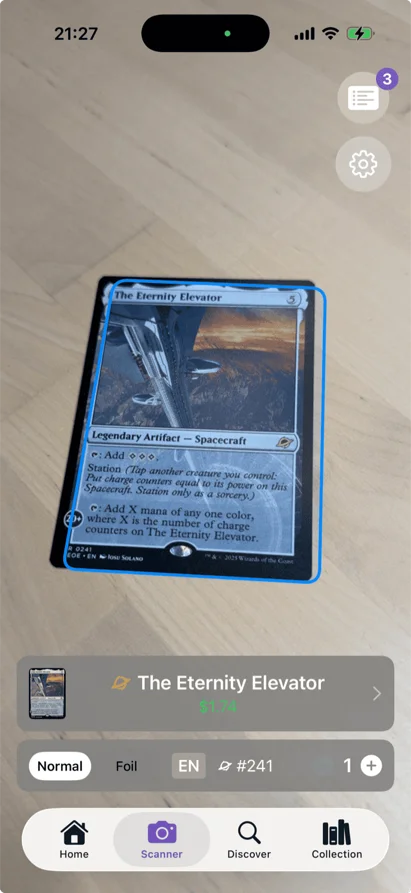
If you already use a scanning app, the collection tool does this for free the moment you add a card. The scan timestamps it. You don’t have to think about it. In March I fed about two thousand cards through mine over two evenings (bulk, sleeved commanders, a couple of trade binders, the pile of draft leftovers), and now I have a real number attached to the date. When February 2027 hits I can sort by biggest loss and see exactly which rotation casualties hurt me and which ones I should’ve moved in fall.
If you’re not using an app, a Google Sheet works. Card name, set code, quantity, price, date. That’s it. Don’t add columns you won’t fill in. You’re not doing accounting, you’re taking a photograph of right now.
The cards most likely to move
This is the part where I’d normally list a dozen specific rotation-vulnerable cards with current prices and pretend I have strong opinions about all of them. I don’t. I have opinions about maybe four.
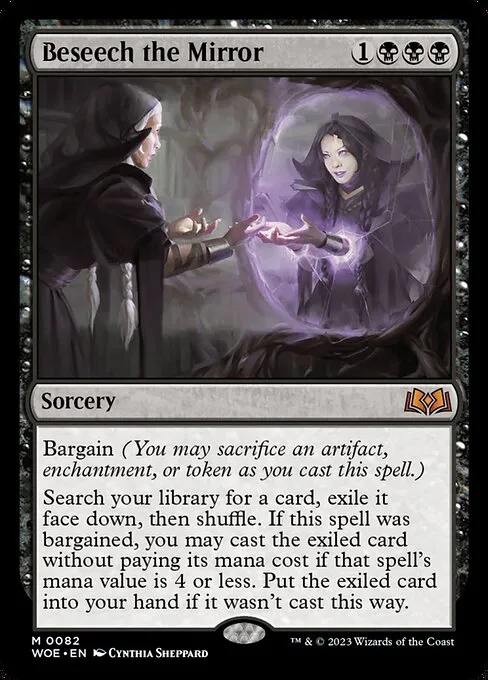
Beseech the Mirror is the one I keep thinking about. It’s in Legacy decks, it’s in Modern, it’s in Commander, and it has basically nothing to do with Standard rotation except that its Wilds of Eldraine printing is about to become a rotated-out version. A card like that barely notices rotation. The playset I opened at prerelease is going to be worth roughly what it’s worth now, plus or minus reprint risk, because it’s a multi-format card.
Sheoldred, the Apocalypse rotated out last summer with the Dominaria United cycle and is still close to a hundred dollars a copy. That’s the shape of a card with real Commander and Pioneer demand. The rotation story for cards like that isn’t really about rotation at all.
The cards that are actually going to move are the Standard-only ones. Midrange rares that show up in a Bloomburrow deck and nowhere else. Duskmourn enchantments that do a specific thing only one format wants. The two-of in a Standard deck nobody’s sleeving for Pioneer. Those are the cards whose value cliff is in front of them. If you scan your collection you can usually spot them by filtering for “Standard-legal, no Modern or Commander play.” Or you can eyeball it, which is how I do most of my filtering, and I’m not going to pretend I don’t.
Why now and not in November
Most rotation guides will tell you to sell “before rotation, but not right before.” That advice is correct and also kind of useless, because the actual selling window is the six to eight weeks when people are still speculating on the new format. Roughly November 2026 through early January 2027.
But by that window the prices are already moving. A card that was $3.80 in September is $2.40 in December. If your baseline was “I bought four at $3.80,” you have a real comparison. If your baseline is “I think this used to be worth more?”, you’re guessing. Guessing is how I ended up holding a playset of Fabled Passage from Throne of Eldraine that I kept meaning to sell at peak. I still have them. They’re fine. I’m fine. Everything’s fine.
Starting now, in April 2026, also has the benefit of being before the next few sets land. Secrets of Strixhaven is two weeks away. Marvel Super Heroes is in June. Each release reshapes the Standard metagame and drags prices around. A snapshot today captures a stable-ish state before the next wave of supply and churn. In a month you’ll be measuring against moving targets.
What I actually do
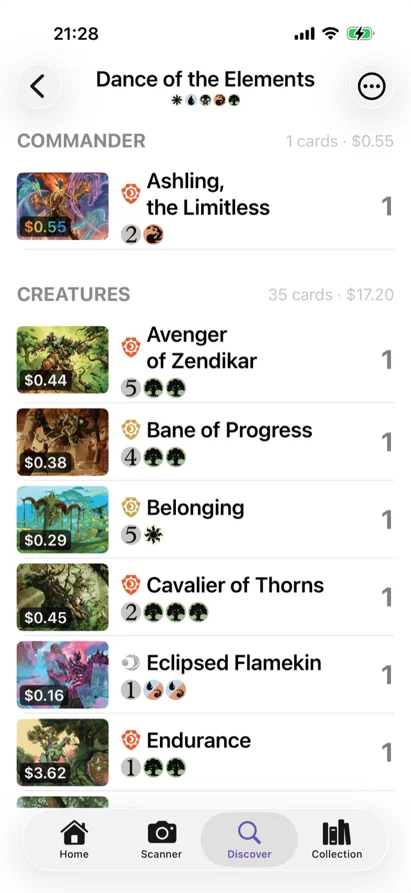
Once a quarter I run everything in my “active” boxes through a scan. Decks I’m playing, the trade binder, anything I might consider selling. I don’t bother with the bulk commons bin. I look at the collection value number in the app, write it down in a note I’ll find next quarter, move on. Ten minutes. Maybe fifteen if I get distracted by a card.
The other thing I do, honestly, is note peak prices for individual cards I care about. Not all of them. Just the chase rares from sets I have a lot of, or cards I suspect I might actually sell. For those I’ll screenshot the TCGplayer page so the history graph is captured. If you’re a heavy drafter, keeping a running list of your bulk rares is worth the twenty minutes it takes, because a lot of rotation casualties live in that pile.
There’s a case against all of this, though. Tracking values on a schedule can turn a hobby into accounting, and I sometimes catch myself checking prices more than actually playing. A friend at my LGS, a guy who’s been playing since Tempest, says he never tracks anything. Buys what he wants, trades for what he needs, eats the rotation losses as the cost of enjoying the game. He might be right. I sometimes think he’s right. Then I remember the Fabled Passages.
If you play mostly Commander, a lot of this doesn’t hit you directly. Commander cards don’t rotate and mostly don’t care about Standard’s schedule, though they absolutely care about reprint risk, which is a different article. Building Commander decks from what you already own sidesteps the rotation problem entirely. Same with older formats. I wrote about Premodern a couple of weeks back and the whole appeal there is that the cards mostly stopped moving twenty years ago.
But if you’ve been drafting current sets or buying Standard precons, and you haven’t thought about February 2027 yet, this is the month to start. A baseline now is cheap. Recreating one in December when prices are already sliding is impossible.
Now I need to go scan those forty Wilds of Eldraine rares before I lose the motivation.