My dad has a shoebox of Magic cards from when he played in college. Tempest, Urza’s Saga, some Mirage stuff. He stopped playing around 2001 and the cards have been in his closet ever since. Every couple of years I’d ask if I could have them and he’d say “maybe they’re worth something” and then neither of us would check. Last month I finally scanned the box and there was a Gaea’s Cradle sitting under a pile of basic Forests. That card is over $1,200 now. My dad played it as a land in his elf deck in 1998 and forgot about it.
That story is unusual, obviously. Most boxes of 90s Magic cards don’t have a $1,200 card hiding in them. But a lot of them have cards that used to be worth nothing and are now worth $10, $20, $40, because of a format called Premodern that’s been gaining traction fast.
What’s Premodern
Premodern uses cards printed in Standard-legal sets from 1995 to 2003. That’s 4th Edition through Scourge. No planeswalkers, no pushed creatures, no snowballing value engines that end games on turn three. It was created in 2012 by a guy named Martin Berlin and stayed pretty niche for over a decade, popular in Scandinavia and parts of Spain but not really on anyone’s radar elsewhere.
Then Magic Online added it in December 2025 and everything changed. Suddenly thousands of players could try the format without owning physical cards. Pro players started streaming it. Polygon wrote a whole tournament report from a Barcelona league. And the price of Premodern-legal cards started climbing.
The important thing for collectors: Premodern-legal cards are old. Many of them have exactly one printing. When demand increases on a card with one printing from 1998, there’s no reprint coming to ease the pressure. The supply is what it is and it’s been shrinking for 28 years as cards get lost, damaged, or locked in collections.
The cards that moved
Plaguebearer from Exodus spiked from about a dollar fifty to $19 in eight days during mid-March. It’s since settled to around $9, but that’s still six times what it was a month ago. It became sideboard tech in Premodern Recur-Survival decks and because Exodus is the only printing, the supply pressure is real even after the initial frenzy cooled.
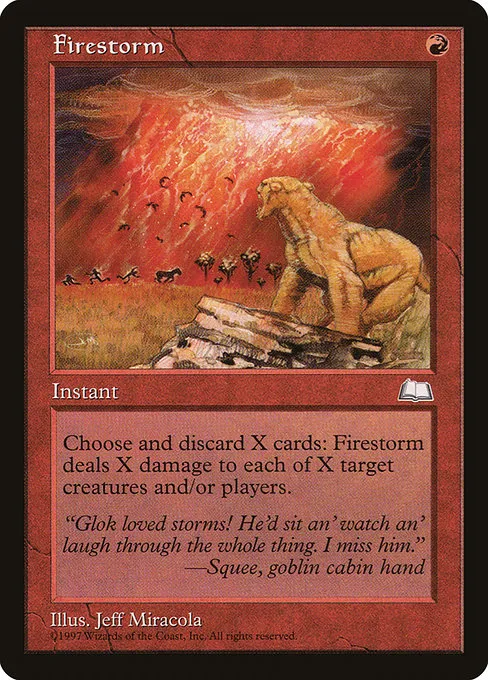
Firestorm from Weatherlight climbed from $14 to nearly $50. It’s a one-mana instant that can function as a board wipe in discard-heavy strategies. At the time of writing there were maybe ten Near Mint copies listed and the cheap ones were being bought immediately.
The Apocalypse printing of Yavimaya Coast went from $18 to over $30, even though the card’s been reprinted a dozen times. The other printings are under a dollar. The entire price increase is Premodern players specifically needing the old-border Apocalypse version because that’s the only one that’s format-legal. The spread between printings tells you exactly what’s driving the demand.
Gaea’s Cradle is sitting around $1,300 and it gained meaningfully this month alone. Reserved List, one printing, and now relevant in another format on top of Commander and Legacy. That one probably keeps climbing.
The old-border problem
Here’s the thing about cards from this era that makes them tricky to sort. Sets before Exodus in 1998 don’t use colored rarity symbols. The set symbol is black on every card regardless of whether it’s a common or a rare. So if someone is going through a box of Ice Age or Revised cards and sorting by “does this look important,” they’re literally guessing. I’ve talked to people who’ve found Reserved List cards in bulk boxes because the person who sorted them originally didn’t know what they were looking at.
Even in sets that do have rarity symbols, the values have shifted so much that sorting by rarity is misleading. An uncommon from Exodus might be worth more than a rare from the same set if the uncommon sees Premodern play. The old heuristic of “rares are valuable, everything else is bulk” just doesn’t hold for this era.
And then there’s the condition issue. Cards from the late 90s have been sitting in closets and shoeboxes for two decades. Some of them are in binders with the old O-ring style that dents cards. Some are in stacks with rubber bands. Some have been shuffled without sleeves for years. The price data you see online is for Near Mint copies, and a lot of these cards are LP or MP at best. Still worth money, just less.
So what do you actually do
If you have cards from roughly 1995 to 2003, or if you know someone who does (parents, older siblings, that one friend who played in college), it’s worth going through them. Not because every card is going to be a Gaea’s Cradle but because the floor for “interesting Premodern card” has risen and keeps rising as the format grows.
Scan the whole box. I know, I keep saying this in every post. But the reason I keep saying it is that visual sorting doesn’t work for this era. The cards are old, the rarity indicators are unreliable, and you can’t memorize the price of every card printed between Mirage and Scourge. There are hundreds of sets in that window. Thousands of cards. The scanner checks actual price data; your memory checks vibes from 2019.
So yeah, Premodern. Format’s been around since 2012 but it’s having its moment right now after the MTGO launch. I don’t actually know if it’ll keep growing or if it’ll plateau once the novelty wears off on Magic Online. The paper community seems pretty dedicated though. Barcelona runs monthly events, there are leagues in Scandinavia, and more LGSes in the US are starting to host tournaments. If the growth keeps up, the cards that haven’t spiked yet are the ones to watch. Single-printing uncommons from sets like Urza’s Legacy, Mercadian Masques, Invasion block. Stuff that’s currently sitting in your dollar bin at the LGS.
I should probably call my dad and tell him to stop leaving the Cradle in a shoebox. Actually I should probably just take the whole box at this point. He’s not going to scan it himself.