My store still doesn’t have Hobbit prize packs. It’s August 19. The set came out on the 14th and the guy behind the counter has been telling everyone the same thing since: boxes are in transit, the distributor got shorted, check back in a couple weeks. There’s a Post-it on the register that says NO HOBBIT PACKS in blue Sharpie, which I think is a genuine customer service innovation and should be more widely adopted.
I’d filed that under normal release-week chaos. Then I went and read the Hasbro Q2 2026 earnings release, mostly out of habit, and found a line that made me look at the Post-it differently.
The March cybersecurity breach cost Hasbro roughly $25 million in second-quarter revenue and added $11 million in expenses. And the company said it expects further costs tied to the incident in coming periods.
The half-billion number
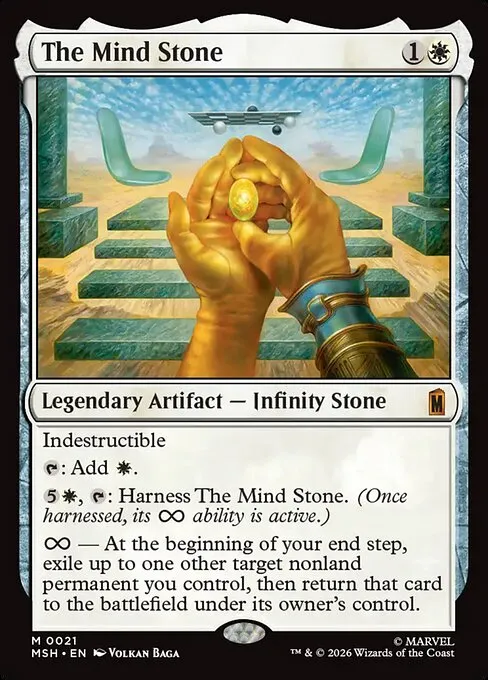
The headline is the one everybody quoted. Magic: The Gathering did $545.3 million in Q2, up 32 percent, the first time the game has cleared $500 million in a quarter in its thirty-plus year history. Chris Cocks called it the flywheel firing on all cylinders. Marvel Super Heroes was the engine, which tracks, since The Mind Stone is still sitting at $53.13 two months after release and that’s the kind of number that only happens when a lot of people want a card and not enough boxes got opened.
Here’s the comparison that actually stopped me. In Q2 of last year, the entire Wizards of the Coast and Digital Gaming segment did $522 million. That’s Magic plus Dungeons & Dragons plus Arena plus D&D Beyond plus the licensed games. All of it. This year Magic on its own beat that number by twenty-three million dollars.
The rest of the report is the usual mix. Wizards segment up 27 percent to $663.8 million with a 40.7 percent adjusted operating margin. Full-year guidance raised from 3-to-5 percent growth to 5-to-7. Buyback target doubled to at least $200 million. Consumer Products, which is the actual toys, posted an operating loss of $7.5 million on tariffs. Monopoly Go! chipped in $44 million. Dividend of seventy cents payable September 2.
The part nobody covered
Every MTG outlet ran the $500 million story. I didn’t see one connect it to the shipping.
Hasbro detected unauthorized access to its network on March 28 and filed the 8-K on April 1, which is exactly four business days, which is the legal minimum. You don’t hit the minimum on a disclosure unless you decided it was material almost immediately. Systems went offline. Parts of Hasbro.com were throwing maintenance errors. The filing warned that interim business continuity measures “may continue for several weeks” and “may result in some delays.” That was the language in April. In July they quantified it: $25 million of revenue that didn’t happen, $11 million of expense that did, more coming.
So yeah. The breach. March. And here I am in August looking at a Sharpie Post-it about missing prize packs. It’s tempting to draw a straight line, and I want to, and I’m not sure I can.
Because Hasbro also said in that same release that order processing and shipping were back to normal. Then on August 13, four days before the Hobbit street date, the Wizards Play Network confirmed that Play Boosters were delayed reaching select US distributors with fulfillment expected to complete by early September. Star City Games said publicly that their distributor was one of the affected ones. If shipping was normal in July, what happened in August? Maybe nothing related. Maybe a print run scheduled during the six weeks the systems were down just landed late, the way a delayed shipment ripples through a quarter after the thing that delayed it got fixed. That’s a reasonable story. It’s also me constructing a narrative from two data points and a Post-it, and I know it.
What I’m more confident about is the shape of the thing. A company that just told investors it expects further costs from an incident in coming periods is a company that hasn’t finished paying for it, and “cost” at Hasbro’s scale means logistics, fulfillment, and production planning, not just lawyers and consultants.
What a delayed print run does to a price you’re looking at
This is the practical bit and it’s the reason any of the earnings stuff matters to somebody with a binder.
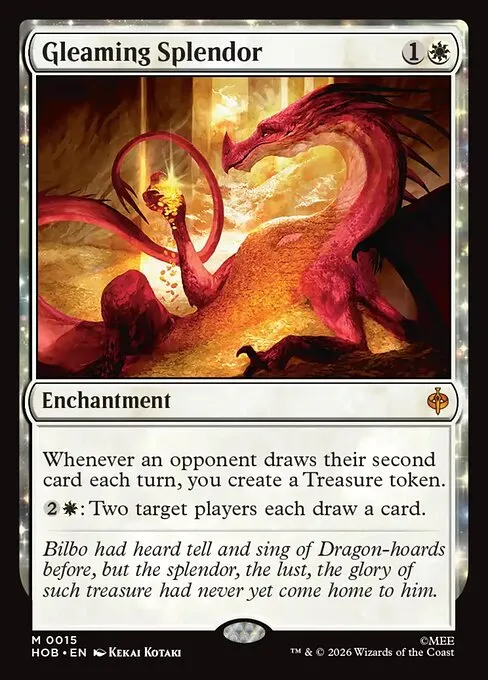
When a chunk of the print run hasn’t been opened, the singles market is running on artificial scarcity with a published expiration date. Gleaming Splendor is $42.28 right now. Smaug the Magnificent is $29.44. Those numbers were set by a market where boxes that exist and are already paid for haven’t been cracked yet. Early September, they get cracked, and supply arrives into a news cycle that has already moved on to Reality Fracture spoilers. I went through this in more detail when the Hobbit release-week prices came out, and nothing since has changed my read.
If you’re buying, wait. Not as a clever play, just because the constraint has an announced end date and there’s no reason to pay the constrained price.
I bought an Edge of Eternities box in a supply-constrained window last year, exactly like this, convinced the shortage was structural. It was not structural. It was a boat. The box is on my shelf, unopened, and every time I check what the singles are worth I close the tab and go do something else. So take the “wait for September” advice from somebody who has demonstrably failed to follow it.
Growth in 2027, on one fewer set
The other line from the call I keep chewing on is Cocks saying they have “line of sight to continued growth in 2027.”
Wizards is releasing six premier sets in 2027 instead of seven. So the plan is more revenue from fewer premier releases. That math resolves in exactly one direction, and it isn’t through the premier boosters. It’s through the supplemental layer: Commander decks, inserts, Secret Lairs, Eternal-legal products, Festival boxes, whatever gets invented next year. I already went through the 2027 schedule product by product and counted thirty-nine SKUs across those six sets, which felt like a lot at the time and now reads like a forecast.
For a collection, that’s reprint velocity. If a set has more products attached to it, it has more slots to fill, and the slots get filled with cards people already want. That’s the whole reprint trap and it doesn’t get better when the per-set product count goes up.
The thing I got wrong back in April when I wrote up the Q1 numbers was framing the pressure as a set-count problem. Nine sets on a sticky note, I said, too many. But 2027 cuts a set and the shelf doesn’t get lighter. The count was never the variable.
Anyway. Go check what you’re holding from Marvel, because two months is about when the second wave of supply finishes hitting and the release-hype prices finish deflating. Took me twenty minutes to run my Marvel binder back through a scan and update the numbers, and about a third of them had moved more than a dollar since June. Mostly down. The Mind Stone was not one of them, annoyingly, because I don’t own one.