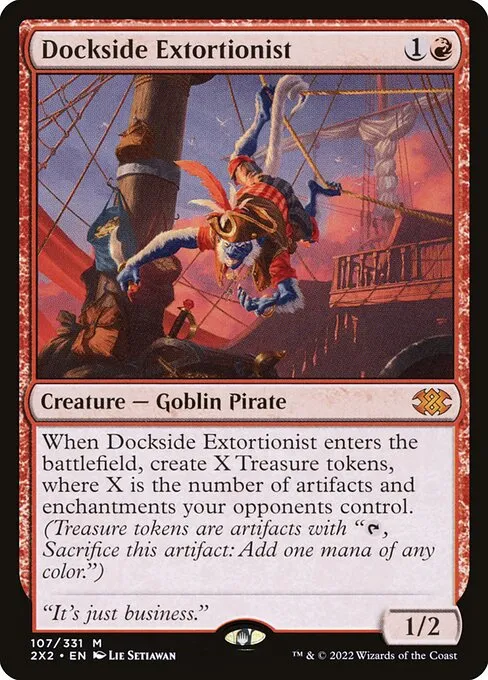
There’s a foil Dockside Extortionist in one of my binders that I refuse to look at. I bought it during the brief window when everyone was convinced it was the best red card in Commander, paid something like $55 for it, sleeved it, felt smart. Then the Commander Rules Committee banned it, and the foil cratered. I knew it had dropped. I just didn’t want to know by how much. The app had the current number the whole time, quietly marking it down against Scryfall while I refused to look. The $55 was only still alive in my head.
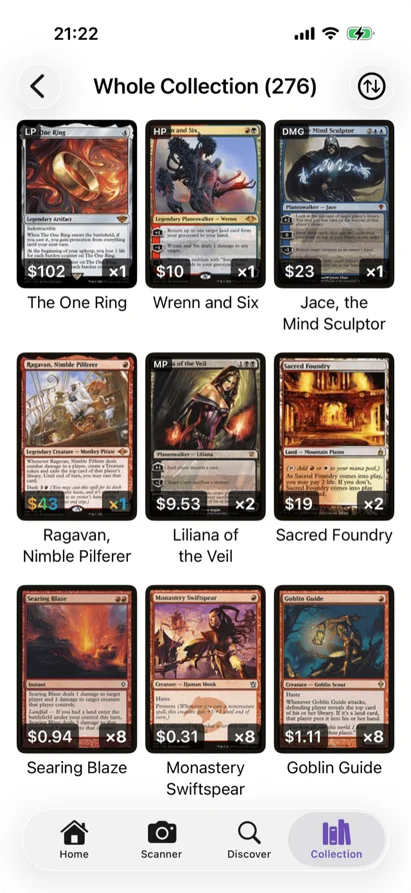
That’s the whole problem, and it’s why “how often should you re-price” is a slightly mislabeled question. If your collection lives in something like Eldwyn, the prices update themselves every day. What the app can’t do is make you look.
Most of your collection doesn’t move
Pull up your collection value right now. Whatever the total is, the overwhelming majority of it is sitting in cards that haven’t changed price in months and won’t change next month either. Bulk commons are worth bulk. Your Pioneer staples drift a few cents. The eighty-cent uncommons you scanned last spring are still eighty-cent uncommons.
If you sat down on the first of every month and went through your collection card by card, you’d spend that time confirming nothing happened to 95% of it. Which is fine, I guess, if you enjoy scrolling. But it’s not where the actual changes live.
The value in a typical collection concentrates. A handful of cards carry most of the dollar weight, and those are the only ones whose prices actually swing enough to matter. Pricing a collection honestly is mostly about getting those few cards right and not lying to yourself about the rest. Re-pricing is the same job, just repeated.
So the real question isn’t “how often.” It’s “what just happened, and do I own any of the cards it touched?”
Prices move on events, not on the calendar
Card prices don’t drift upward smoothly like a savings account. They sit flat and then jump, usually because something specific happened. And the things that move them are almost all announced in advance or at a predictable time.
Ban announcements are the big one. When a card gets banned in a competitive format, the price reacts within minutes, not days. I’ve watched the comments under a Banned & Restricted post tell me where a card was heading before the market had even caught up. Dockside losing its spot in Commander is the version everybody felt, but it happens every B&R cycle to something. If you own a chunk of a format’s staples, the morning after a ban is when your collection value is most wrong.
Reprints are the slower, more predictable killer. A card that hasn’t been printed since some ancient set creeps up year over year on pure scarcity, and then a Masters set or a Secret Lair drops it back into supply and the price gives most of that back. The thing is, you usually get warning. Masters sets get announced. Spoiler season runs for a couple of weeks. If you’ve been holding spec cards hoping they’d climb, the announcement is your re-pricing trigger, and honestly your selling trigger too.
Then there’s the tournament spike, which is the one I trust least. Some card wins a big event, demand spikes over a weekend, the price doubles, and then it bleeds back down over the following week as the hype cools and people relist. If you’re going to re-price around those, do it knowing the Saturday-night number is usually higher than the Monday-morning one.
A re-pricing cadence that isn’t insane
Here’s what I actually do, and it takes almost no time because it’s reactive instead of scheduled.
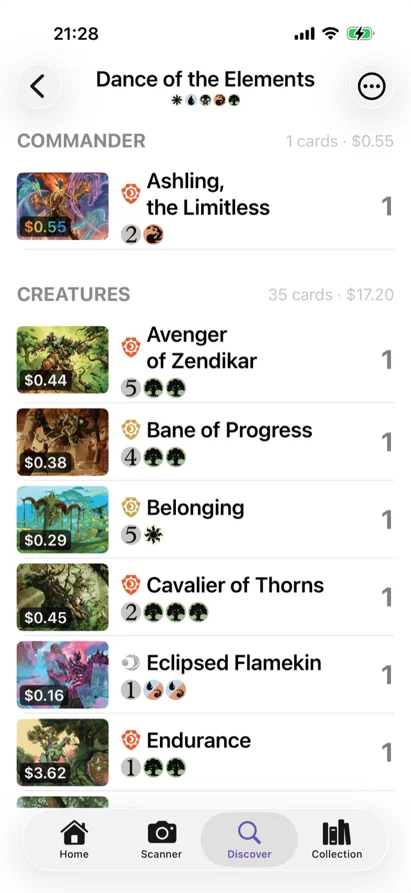
I keep a baseline. Once, I scan the whole collection in properly so I have a real starting number and, more importantly, a record of which cards make up most of the value. After that the prices keep themselves current, so the total is never the thing I’m checking. That list of maybe thirty or forty cards carrying the value is the only thing I actually watch. Setting that baseline once is the work; everything after is maintenance.
Then I re-price on triggers:
Ban & Restricted announcements. These run on a schedule Wizards publishes. The week one lands, I check my expensive competitive cards. That’s it. If nothing I own got hit, I close the app.
Masters set and Secret Lair reveals. When a reprint product gets announced, I look at whether any of my higher-value cards are reprint candidates. If a card I’m holding shows up in the spoilers, that’s the moment its current price is about to become fiction.
Big set releases. A new set shifts demand around its format. After a release weekend I’ll glance at the cards that play with the new stuff. Commander is the sneaky one here, because EDHREC inclusion data tends to lead the price by a couple of weeks. A card climbing the popularity rankings now is often a card climbing the price charts later.
And then maybe twice a year, around rotation and again before the holidays, I’ll do a full pass to scan in whatever I picked up and never added. That’s the calendar part, and it’s deliberately rare.
So that’s, what, four or five moments a year where I actually open the app to look at prices, plus two scheduled sweeps to add new cards. Compared to babysitting 4,000 cards every month, it’s nothing.
When the calendar actually does matter
Okay so I’ve spent this whole article telling you not to re-price on a schedule, and I want to walk that back a little, because there’s one situation where a calendar genuinely beats events.
If you’re holding cards specifically as value, treating part of your collection like an asset rather than a pile of playables, then you do want a regular snapshot. Not to act on, just to have. Insurance, estate stuff, knowing whether your “investment” is actually up or down. For that, a monthly or quarterly number you can point to is worth more than reacting to every spike. The event-driven approach tells you when something changed; the scheduled snapshot tells you the trend.
For most of us, though, the collection isn’t an asset. It’s cards we play with that happen to be worth money. And for that, chasing a monthly re-price is just anxiety with extra steps.
The number you don’t update is a lie
Back to my Dockside. I finally looked it up while writing this. The regular copy from Double Masters 2022 is sitting around $12 now. The foil I paid $55 for is worth, generously, less than half what I gave for it. Sheoldred, the Apocalypse, on the other hand, the card I almost sold two years ago because I was sure she’d tank after rotation, is still nearly $95. I was wrong about both, in opposite directions, and I only know that because I went and checked.
That’s the actual value of looking. Not the total at the bottom of the screen, which updates itself and mostly stays put anyway. It’s the specific cards where your mental price and the real price have quietly drifted apart, and the longer you go without looking, the bigger that gap gets on exactly the cards you most want to be right about. The app keeps the number honest on its own. Re-pricing, the part that’s actually on you, isn’t a chore you do on the first of the month. It’s something you do the morning after Magic does something.
I opened the app after the last B&R announcement to check the one card I was worried about. Took about a minute. Turned out fine. Closed it, didn’t think about prices again for six weeks. That’s the cadence.