I was at a CommandFest a few summers back, killing time before my draft pod, and I wandered over to artist alley. There was an artist I’d been a fan of for years sitting behind a folding table, and on the table was a stack of cards that looked, from a distance, like normal cards. Then she flipped one over to sign and the back was completely white.
That was my first MTG artist proof. I bought it for $30, she did a little graphite sketch of the creature on the back while I waited, and I walked away holding what was effectively a one-of-one piece of art on a Magic card. I have no idea where to log it in my collection. That problem hasn’t gotten easier.
Artist proofs (APs, “whitebacks”) are real Magic cards with blank backs that Wizards prints in tiny quantities and gives to the artists who illustrated them. The current standard is 50 non-foil per printing, plus 30 foils since 2015. They’ve existed since Beta. They’re not tournament legal, they don’t show up in TCGPlayer’s standard catalog, and Scryfall doesn’t model them as separate variants. Mystery Booster and The List don’t get APs at all.
If you’ve never noticed them, that’s by design. They live in a parallel collector ecosystem most players never see, sold mostly through artist webstores, a Facebook group called Magic: The Gathering artist proof cards sale trade display, a Discord server, and at convention art halls.
The Price Spread Is Huge and That’s Most of the Story
The cheapest way in is a blank artist proof straight from an artist’s webstore. A common-rarity blank from a recent set might run $20-40. If you want the artist to draw something on the back, you’re commissioning art, and the prices break out roughly like this: pencil sketches around $40-100, ink work or non-painted color around $100-300, fully painted commissions $200-700. Paintings on Commander staples or famous cards can climb past $1,000 without much resistance, especially if the artist isn’t currently taking commissions.
Then there’s the chase tier, which is where outsiders hear about APs and assume that’s the whole hobby. A Beta Black Lotus artist proof signed by the late Christopher Rush sold at auction for $615,000. Post Malone reportedly paid $800,000 for another one. Five-digit APs of cards like Wheel of Fortune and Gaea’s Cradle are a thing that happens. That’s not where you and I are shopping.
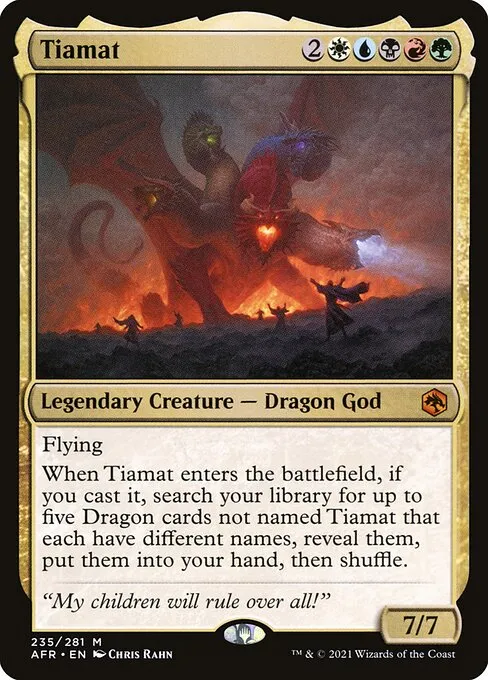
The middle is where it gets interesting. Two artists, Chris Rahn and Tyler Jacobson, each painted five Tiamat artist proofs back in 2022, one head of the dragon per card. The combined ten paintings sold for over $20,000, which is around $2,000 per painted AP. Those numbers feel real to me in a way that auction-house Black Lotus numbers don’t. You’re not buying a finance asset. You’re buying something an artist made specifically for you on the back of a card you can hold.
Where to Actually Buy Them
The hubs:
- Artist webstores and Etsy. Matt Stewart, Jason Felix, Aaron Miller, Sarah Finnigan, Steve Ellis, Natalie Andrewson, and dozens more keep online shops stocked with whatever APs they currently have. Direct, transparent, and usually the best entry point.
- The MTG Artist Proof Facebook group. Started by collector and agent Mark Aronowitz years ago, it’s the historical center of gravity for the whole scene. About 4,000 members, lots of auctions, lots of artists posting new work.
- The MTG Artist Proofs Discord. Smaller, faster-moving, more conversational. Several artists and agents have dedicated channels there.
- Conventions. MagicCon and the bigger CommandFests usually have an Art of Magic hall where artists sell APs from binders. This is the only place you can watch an artist sketch on a card in front of you.
- Gallery shows. Donny Caltrider has curated three exhibitions called Magic: The Gathering in Miniature at Gallery Nucleus in California. The most recent one, in early 2026, gathered 333 artist proofs from 111 artists across six continents. The online portion is still browsable.
The convention path is my favorite. It’s slower, you have to be at the right place at the right time, and binders are picked over fast at big events. You also end up meeting the person whose name appears on the bottom of cards you’ve been playing for years, which is something the algorithmic flow of buying singles online has a way of erasing.
The Logging Problem
This is where I keep getting stuck.
If I scan the front of an AP through Eldwyn or any other recognition app, it matches the regular card. Fine. The app correctly identifies it as, say, Glen Elendra Pranksters from Lorwyn. But it can’t know that this particular copy has a blank back, that there’s a graphite cougar drawn on it by the artist, that it’s signed and numbered as 12 of 50, or that the right comparable for pricing is a different Glen Elendra Pranksters AP someone listed on the Facebook group three months ago. The standard card-database model doesn’t capture any of that, because the standard model is built around printings, not unique pieces.
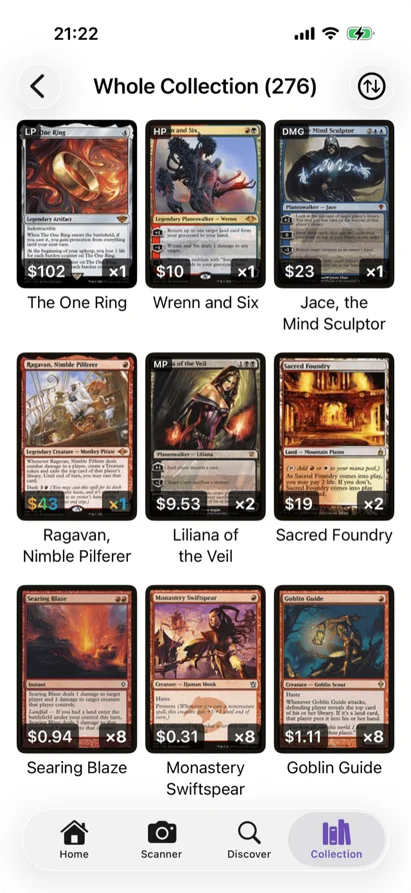
What I do, which is imperfect: I scan the front like a normal card to log the printing, then I tag it with a custom note containing the artist name, the medium (“painted, acrylic, 2024”), the AP number if it has one, whether it’s signed, and a photograph of the back. The note is the only thing that captures what makes the card mine. The price field on the regular printing is meaningless here. A Glen Elendra Pranksters AP with custom art is worth whatever someone is willing to pay for it the day you list it. The regular Lorwyn common’s price is irrelevant context.
I store APs separately, too. Not in the rare binder, not in a deck box, not sleeved up with the rest of a Commander deck. They live in top loaders in a small archival box, organized by artist instead of by set. Sounds like overkill. Mostly it’s a fix for a deeply stupid moment of mine, where I realized I’d shuffled a sketched AP into a Commander deck and pulled it out as a draw step. The graphite was fine. My pulse was not.
So yeah, storage. Boring. You sort the cards, you put them in the box, you remember not to mix them with playables. The thing nobody tells you is that some painted APs have raised paint that catches on standard sleeves, so for those you skip the sleeve and use a hard top loader straight. Acrylics especially. Found that out the hard way with one I’d rather not talk about.
Should You Bother
Honestly, probably not, unless something about it pulls at you specifically. APs are a niche of a niche. The community has its own chat groups, its own pricing conventions, its own social rhythms, and getting in halfway is harder than ignoring it altogether. If you’re trying to manage a regular collection, especially one geared around play and trade, APs add complexity without obvious upside.
Then again. I keep thinking about that first one I bought, the little graphite sketch. It’s been on my desk for three years. I look at it more often than I look at any other card I own. Something happens when you collect for long enough where market value stops being the primary reason a piece matters, and you start caring about which objects have a specific story attached to them. APs are good for that. Better than Secret Lairs or Special Guests or any other Wizards-engineered scarcity product, because they’re not engineered. They’re the artist getting paid to make something for you.
If you want the cheapest way to find out whether you’re going to like it: pick an artist whose work you actually like, find them at the next MagicCon you’re attending, and ask if they have proofs for sale. Spend $30. See what happens. eBay has 3,700 listings if you can’t get to a convention, but I wouldn’t start there. The whole point of the niche is the human behind the card. You can also start with your existing rare binder and pick one card you’ve owned forever, then go find the artist’s website and see if the AP is still in stock. That’s a fun search either way.
A note for anyone scanning their collection: plan ahead for the day you bring an AP home. Decide now how you’ll log it, because the natural workflow (“scan, done”) doesn’t work, and figuring it out at 1am with a brand new painted card in your hand is how I ended up with three different inconsistent note formats on three different APs. Now I have a template. It took me embarrassingly long to write that template.