My rare binder is 14 pages from being the same binder I started in college. Different pages, different sleeves, mostly different cards, but the same navy-blue three-ring binder with a busted spine and a corner that got chewed by a roommate’s dog in 2013. It has survived three moves, two playgroups, a brief phase where I tried to sell off everything, and a longer phase where I pretended I hadn’t bought anything at prerelease. Last weekend I dumped it all onto the kitchen table to reorganize it for the third time in four years, and I realized something uncomfortable: I still don’t know the right way to organize an MTG rare binder.
There’s no one right way, which is the honest answer nobody wants. But there are three systems that actually work for someone with twenty years of sets jammed into one place, and each one breaks in a specific way. The one you pick depends on what you’re actually doing with the binder.

By color, then by mana value
This is the system I keep coming back to. Five color sections (plus colorless, multicolor, and lands), and within each color you sort by mana value low to high. Creatures and noncreatures get loosely split within each mana value band, but don’t go hard on it. You want Rhystic Study and Baleful Strix on the same page, not separated because one is an enchantment and the other is a creature.
The pitch for this system is that it mirrors how you actually build decks. You’re brewing a mono-black Commander list, you flip to the black section, and you thumb through 2-drops looking for disruption. You don’t need alphabetical order, because you’re browsing. You’re letting the binder surprise you. Half the best decks I’ve built started because I flipped past a card I’d forgotten I owned.
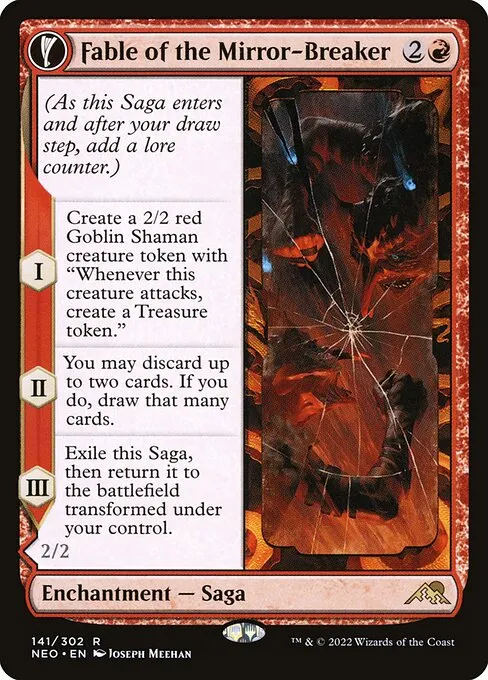
Where it breaks: sets of cards with very different power levels end up on the same page. You’ll have a playset of Swords to Plowshares (about $2 per copy in the newest Commander reprint) next to a foil Thoughtseize worth more than your sleeves and your binder combined. Traders looking at your binder will pull out the Thoughtseize and miss the fact that your red section is full of Ragavan and Fable of the Mirror-Breaker. If you’re using the binder as a working-deck-building tool, this is fine. If you’re showing it to someone at an LGS hoping to do a stack-on-stack trade, it’s frustrating for both of you.
By format legality
This is what I run when I’m being disciplined, which is rarely. Standard in the front, Pioneer next, Modern after that, Legacy/Vintage, and Commander at the back. Within each format, by color. Lands get their own section no matter what.
The appeal is that it maps to what you’d actually pull cards for. When a new Standard set lands, you know exactly which pages matter. When someone asks if you have Modern staples, you flip to one section. My Ragavan and Fable copies sit with the Modern cards. My Rhystic Study lives at the back with Commander.
Where it breaks: rotation. Every year you redo half the binder, because cards that were Standard last year are now Pioneer-only, and cards you had stuck in Pioneer have drifted into Modern relevance. And the Commander section becomes the largest thing in the binder, because what is a Commander rare if not “any rare from the last fifteen years that someone, somewhere, has put in a deck.” It bloats. You end up needing a dedicated Commander-only binder, which defeats the single-binder goal you started with.
I ran format legality for about eighteen months and abandoned it the weekend after the Modern Horizons 3 spike hit fetches like Windswept Heath. Half my fetches needed to be moved from Modern to “also Pioneer now, but also Commander,” and I spent three hours flipping pages around a living room floor while my wife asked me, with real concern, whether this was how I wanted to spend a Saturday. It was. But the system broke.
By use case
This is the system Card Kingdom’s blog recommends, roughly, and the one I think is actually the most honest. You sort by what each card does for you. Commander staples you actually use. Standard/Pioneer stuff you might jam into a deck. Trade bait, including cards you’ve already decided you don’t want. Sentimental cards that aren’t leaving the binder no matter what they’re worth.
The trade-bait section is the important one. Mine currently has a Dockside Extortionist I’ll never play with again (it’s banned in Commander now and I don’t have a cEDH pod), a bunch of Sheoldred copies from when I thought I’d build more black decks than I actually do, and a Force of Will I’ve been waiting two years to trade into something I want more. This section exists because “I own this card” and “this card belongs in my collection” are different statements, and pretending otherwise is how binders become landfill.
Where it breaks: you have to actually decide what each card is for, and most of us don’t want to. It’s a lot easier to slot a card into “black” than into “Commander staple I’ll use” vs. “Commander staple that’s a trade piece” vs. “might be a Commander staple in a year.” Use-case sorting forces honesty. Most collectors, including me, find ways to avoid it.
The question nobody asks: what actually goes in the rare binder
Spent the whole first half of this article on how to sort the cards, and I haven’t said anything about which cards belong there in the first place. This is actually the bigger problem, at least if your rare binder is doing the thing I assume most people’s rare binders are doing, which is holding the valuable cards you want to keep or trade.
Here’s the rule I landed on after the last reorg: a card earns its binder spot if it’s either worth more than $2 or I’d actively miss it if it vanished. Everything else goes in boxes. I know, I know — the second criterion is entirely vibes-based, and I had three arguments with myself over whether a lightly played Siege Rhino (worth twenty-seven cents right now, but it won me an Alpha Strike in a 2015 LGS finals I still think about) qualified. It does. Sentimentality gets a vote.
What doesn’t earn a spot: Commander rares under $2 that aren’t in a deck I play. Standard rares from the last two rotations that haven’t held value. Any card I own four or more copies of in sleeves I could stack in a deck box. Old bulk rares I’m keeping “just in case.” Siege Rhino stays because of the memory; other bulk rares without a story don’t.
This is the part nobody writes about. Every organizational guide online tells you how to sort. Almost none of them tell you to be ruthless about what goes in at all. A rare binder packed with stuff you don’t care about and can’t trade is a worse object than a thinner binder full of cards that matter to you.
So yeah, the actual reorg
So yeah, reorganizing. I ended up on the color-then-mana-value system again, with a dedicated “trades out” pocket at the back. Took about four hours. Found two cards I’d forgotten I owned — a Goldspan Dragon from an old Strixhaven Commander deck, which is now around $9, and a Sheoldred I’d genuinely lost track of. Scanned everything as I went so at least the next reorg doesn’t start from “what’s actually in here.”
One thing I’ll flag: I use Eldwyn for the scanning pass because it gives me a running value total while I’m flipping through, and when I’m doing this kind of deep reorg I want to know whether the binder has drifted meaningfully in value since the last audit. It’s also how I catch myself keeping a card that isn’t worth the sleeve — you sort of feel the justification go wobbly when the price is staring back at you.
The thing I keep re-learning is that no organizational system is permanent. Every set, every ban announcement, every format shake-up changes what matters and where it should go. The best binder is the one you’re willing to redo. The worst is the one you arranged perfectly in 2019 and haven’t touched since.
Mine’s already a little wrong, because Secrets of Strixhaven just dropped and I haven’t slotted the new cards in yet. I’ll get to it. Or I won’t, and I’ll do another four-hour reorg in six months and pretend that was always the plan.