My most expensive bit of MTG education was a foil playset of Faithless Looting I panic-sold the day after the August 2019 Modern ban announcement. Shipped all four at $4 a piece because the LGS Discord said “they’re going to zero.” Standard frame did drop. But the original Dark Ascension foils never got cheaper than what I sold them at, and seven years on they’re sitting at $8.50 each on TCGplayer. I had cashed out of a card whose floor was already in.
That trade taught me what I now think every collector should learn before selling their first banned card. Most people make one of two mistakes when a ban hits. They panic-sell inside 48 hours, or they hold forever assuming the card will eventually come back. Both are usually wrong. Both happen because they’re skipping the four questions that actually decide what a banned card is worth.
Here’s the playbook. Four questions, in order, before you do anything with a card that just got banned.
Question 1: Is the card legal in any other format I care about?
This is the question that gets skipped most often, and it’s the one that actually decides whether the card has a floor. Wizards bans cards from individual formats, not from the game. A Modern ban doesn’t touch Commander, Vintage, Legacy, Pioneer, or cube. A Standard ban doesn’t touch anything but Standard.
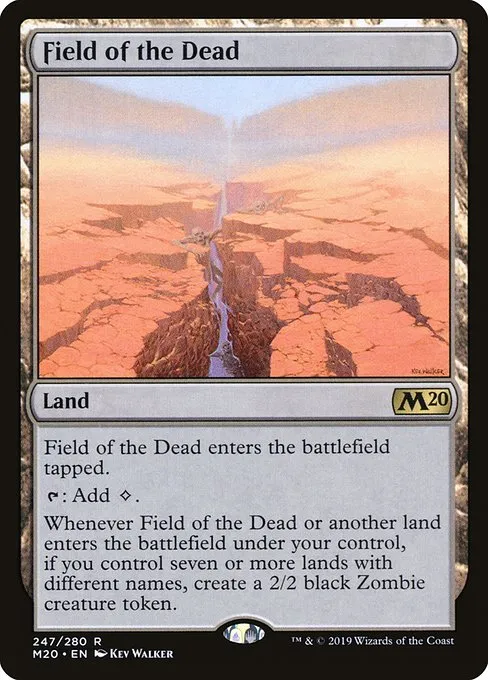
Field of the Dead is the clearest illustration I can think of. It’s been banned in Standard and Modern since 2019. Six years on, the M20 printing is sitting at $32.87 regular and $46.15 foil. The Special Guests printing is $43.68 regular and $81.58 foil. That isn’t a banned card. That’s a Commander staple that happens to be banned in two formats. Both bans had almost no effect on its long-term price because Field of the Dead was always doing its actual work in EDH decks, where it’s still legal.
Underworld Breach is a similar case. Banned in Modern, still legal in Legacy and Vintage, and a chase mythic in Commander. The THB printing is $12.84 regular and $14 foil. The Special Guests borderless is $28.76. The ban barely registered on its price because nobody was buying Underworld Breach to play in Modern in the first place; they were buying it for the formats and tables where it still works.
Before you do anything else, check the legality. Scryfall lists every format at the bottom of each card’s page. If the card is legal in EDH and sees regular Commander play, the ban changes its narrative more than its price. If it’s banned in every format where it ever played, the floor is much lower, usually wherever residual EDH or casual demand sets the support level.
Question 2: Does the card have multiple printings worth treating separately?
When people talk about “the price of a banned card,” they almost always mean a single number. That number is usually the most common printing, and it’s usually the one taking the worst hit. The premium printings tell a completely different story.
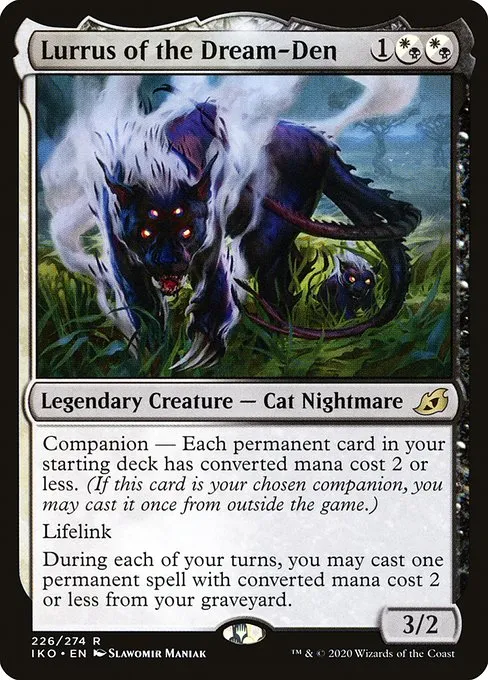
Look at Lurrus of the Dream-Den. The standard Ikoria printing is at $2.22 regular, $2.94 foil. Read just that and you’d assume Lurrus is bulk. But the Multiverse Legends foil mythic version is $43.32. The full-art etched showcase from MUL is $575. Not a typo. The collector-grade printings of a card that’s banned in Modern, Pioneer, and Legacy still trade for hundreds of dollars because they’re the printings EDH players and binder collectors actually want.
The pattern repeats almost every time. Standard frame craters. Borderless or showcase versions hold most of their value. Original-set foils, if there’s a story behind them, sometimes even climb. Hogaak, Arisen Necropolis is at $1.49 in the standard MH1 frame because it’s banned everywhere it played, but the MH1 foil is still $8.32 because nostalgia and the “I built Bridgevine in 2019” crowd will always pay a small premium for the printing they remember.
When you’re deciding what to do with your copies, separate by printing in your tracking app before you do anything else. Four standard MH3 Phlages and one borderless Phlage in your binder are different cards from a finance perspective. Treat them like different cards.
Question 3: What’s the historical floor for this kind of card?
Banned cards don’t go to zero. They settle at whatever level non-format demand can support. The patterns are remarkably consistent if you look at enough of them.
Once-mythic powerhouses that get banned across multiple formats tend to floor between $2 and $4 for the standard frame, with foils at 2-3x. Lurrus floored at $2.22. Hogaak floored at $1.49. Faithless Looting commons sit at around $0.36 across most reprints. Those are the bottom-tier cases, where the card got banned out of every format it played in and nobody’s reaching for it at Commander tables.
Cards that get banned in one format but stay legal in others usually hold between 30% and 60% of their pre-ban high, depending on how active the still-legal format is. Lotus Field’s M20 printing was around $7 at its 2024 peak; it’s at $5.30 now, with foils holding at $13.48 because of Commander demand. That’s the shape a ban takes when there’s a real legality safety net underneath.
I should be honest about something. I don’t have a clean predictive model for which cards land where on the curve. I have a decade of watching this pattern, a handful of mental anchors I trust, and a willingness to wait two weeks before doing anything. That’s not a model. That’s a gut check. But it works better than the alternative, which is panic-pricing into the first wave of speculator listings.
Question 4: How long should I wait?
This is the only question with a clean answer. Wait 30 days.
The first 48 hours after a ban are noise. The next two weeks are speculator listings, panic sells, and lowball trade offers. Real prices for banned cards happen around the 30-day mark, when the speculators have moved on, the EDH players have decided whether they care, and the next bit of metagame coverage has stolen the attention. If you absolutely need the cash for something else, sell on day 1 at the still-elevated price before speculator listings tank the floor. If you’re holding for value, wait until day 30. Anything in between is the worst version of both options.
Running this week’s bans through the playbook
I wrote about the May 18 Modern bans yesterday, and the obvious thing to do is run Phlage and Lotus Field through the same four-question filter to show what it looks like in practice.
Phlage, Titan of Fire’s Fury fails Question 1 cleanly. Banned in Modern. Banned in Pioneer (always was, by virtue of MH3 being non-Pioneer-legal). Modern was the only competitive home. EDH play exists, mostly in Boros midrange shells, but not at volume. The floor is going to come from collector demand rather than format demand. Question 2 partially saves things: the borderless MH3 frame will hold while the regular frame keeps falling. Question 3 puts the standard frame floor around $6 to $9 based on the Lurrus and Hogaak pattern, with the borderless hopefully stabilizing closer to $15 or $20. Question 4 says don’t sell anything until mid-June.
Lotus Field passes Question 1, sort of. Still legal in Pioneer, Legacy, Vintage, and Commander. EDH is where the real demand sits. Question 2 matters a lot because the card has been reprinted into oblivion in the past year, so you should be sorting by printing before doing anything. The M20 foil is the printing EDH players want. The Stellar Sights borderless treatments hold for similar reasons. The SOC precon reprint and the standard non-foil drift toward $2 to $3. Question 4 still applies, but the floor is going to settle higher than Phlage’s because of the legality net.
The playbook isn’t an oracle. The borderless Phlage might surprise everyone and hold near its current $21, or the Lurrus pattern might dominate and it floors at $8. Lotus Field foils might creep up over the next year as the EDH crowd realizes their non-foil precon copy isn’t going to feel right in their nice deck. Running the four questions gets you to “hold the borderless, sell the regulars, wait on the foils” in two minutes, which is the actual decision the playbook is designed to surface.
So yeah. Bans. Every few months. You sort, you scan, you check the legalities tab, you wait. If you tracked your collection honestly to begin with, the rest is mostly arithmetic on what changed. And if you happened to own a foil etched Lurrus showcase, well. Apologies for everyone else’s $2.22 cardboard.