There’s a long white box in my closet I’ve been avoiding for about eight months. Maybe 3,000 cards, no sleeves, no order, a mix of three different people’s draft leftovers that all ended up in my hands after a friend moved across the country and didn’t want to ship them. Every time I open the closet door it’s just sitting there, judging me.
The reason it’s still unsorted isn’t that sorting is hard. It’s that I keep imagining the full version of the job. Color, then rarity, then type, then alphabetical, the whole 20,000-card-collector ritual you read about on forums. And when that’s the picture in my head, of course I close the closet door again.
So this is the post I wish someone had handed me before I started overthinking it. How to get a giant pile of unsorted Magic cards into a state where you actually know what you own, in an afternoon, without committing to a sorting system you’ll abandon by next month.
Sorting and “knowing what you own” are two different jobs
Here’s the thing that took me embarrassingly long to figure out. When people say “sort my collection,” they’re usually trying to answer one of two completely different questions, and the questions need different amounts of work.
Question one: what’s in here that’s worth money? Question two: can I find a specific card in ten seconds when I’m deckbuilding?
The first one barely requires sorting at all anymore. The second one requires the deep, maintainable, alphabetized system, and honestly most people who build that system stop maintaining it within two sets. I’ve done it. I had a beautiful WUBRG-then-rarity-then-alphabetical setup in 2019 and it survived exactly until Throne of Eldraine showed up and I dumped forty new rares into a pile “to sort later.” They’re still in that pile. Conceptually.
If your real goal is question one, you don’t need to alphabetize anything. You need a triage pass.
The triage pass
Get a table. Put on something you don’t have to watch (I do long YouTube video essays, treat them like a podcast, the Rhystic Studies back catalog is perfect for this). Pour out a manageable batch, maybe 300-500 cards, not the whole box. A whole box spread across a table is how you end up quitting after twenty minutes.
Then you make three piles and only three:
Obvious bulk. Commons and uncommons you recognize as filler. Most draft chaff, most basic lands, the third copy of a Standard removal spell from two rotations ago. Don’t think hard. If you hesitate, it’s not bulk, it goes in the next pile.
Might be something. Rares, mythics, foils, anything older than maybe 2015 that you don’t immediately recognize, anything with weird borders or art you haven’t seen. This is the pile that matters. You’re not pricing anything yet, you’re just pulling it out of the river.
Decks and keepers. Cards you know you want for a specific deck, sentimental stuff, the foil you’re keeping because it’s pretty even though it’s worth a dollar.
That’s it. Three piles, fast hands, no rarity sub-sorting, no color sorting. A 500-card batch goes in about fifteen minutes once you stop second-guessing. The bulk pile is usually 80-90% of the volume and you can stop caring about it the moment it’s separated. I wrote more about what to actually do with that mountain of commons in a separate post, but the short version is: it’s a shoebox in the closet, not a project.
Where the scanning happens
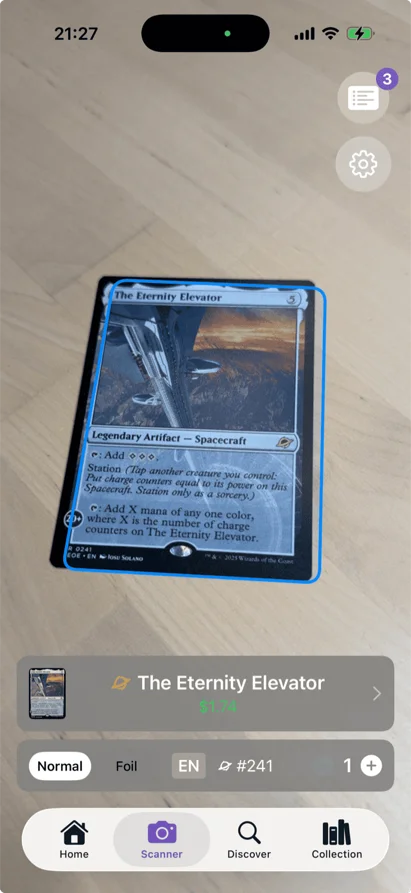
The “might be something” pile is where I scan. Not the bulk, not the lands, just the cards that survived triage. This is the step that replaced 90% of the physical sorting I used to do, because once a card is in the app I don’t actually need it to be in alphabetical order on a shelf. I can search.
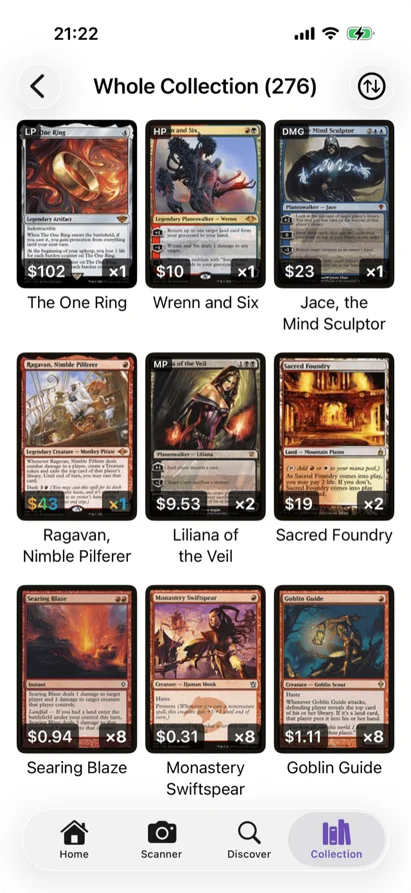
Scanning the survivor pile does the pricing work for you. You find out the Windswept Heath is worth real money, the Sol Ring from some Commander precon is a buck or two, and the forty rares you were nervous about are mostly worth a quarter each. That last part stings a little every time. You build up a story in your head about the secret value hiding in the box, and then the box tells you the truth.
A few cards always fight the scanner. Older alternate-art stuff, heavy foil curl, the watermarked clan cards from Khans throw it off. I covered the foil and alt-art gotchas in their own post because there are enough of them to be annoying. But for a normal survivor pile of a few hundred cards, you’re correcting maybe five of them by hand.
So yeah. Scan the pile that matters, leave the bulk alone, and now you’ve answered question one. You know what’s in the box. For a lot of people that’s the entire reason they wanted to sort in the first place, and they never needed the alphabetizing at all.
If you do want it findable, sort by set, not color
Okay, but say you’re in the question-two camp. You want to physically pull a card on demand for deckbuilding. Then you do need a real system, and I’ll give you the one piece of advice that I think actually matters: make set your top-level sort, not color.
Color-first feels natural. It’s how we think about the game. But it has a brutal flaw. Every time a new set releases and you want to file the new cards, you have to finger through your entire collection to slot each card into its color section. With set as the top level, a new set is just a new divider at the front. You never touch the old cards. Someone on r/magicTCG put it better than I will: color-first means you’re handling your whole collection every release, set-first means you’re handling one set.
Within a set I go color, then rarity, and I stop there. I do not alphabetize. Alphabetizing within a single set’s single color is the point where effort stops buying you speed. You can eyeball thirty white rares from one set faster than you can maintain alphabetical order across a thousand. Maybe that’s just me. People who run stores would probably yell at me for this.
Although. Now that I write it out, I’ll admit there are nights I wish I had alphabetized, because flipping through a fat stack of one color looking for one card is genuinely slow, and the “eyeball it” thing works great until you’re tired. So maybe the honest answer is that the right depth depends on how often you actually pull cards, and I pull cards way less often than I tell myself I do.
Make the maintenance trivial or don’t bother
The dirty secret of every sorting system is that the initial sort isn’t the hard part. The hard part is the second week, when twelve new cards show up from a TCGplayer order and you don’t have a home for them yet.
The fix that worked for me is dumb. I keep one small box, an “inbox,” next to where I open mail. Everything new goes in there unsorted. Once it’s full-ish, or once I’m bored on a Sunday, I do one triage-and-scan pass on just that box. It never grows into the eight-months-in-the-closet monster because it physically can’t hold more than a couple hundred cards. The big sort happens once. The inbox happens forever, in tiny doses.
If you’ve got a genuinely huge backlog and the idea of even triaging it makes you want to lie down, that’s a real signal worth listening to, and downsizing might be the better move than sorting. Sorting cards you’re never going to use is just moving your problem into nicer boxes.
I should go deal with that closet. I’ve got maybe two hours and a Rhystic Studies video queued up, and at minimum I’ll know whether that white box is hiding anything before the weekend’s over. Probably it’s 2,900 lands and a Goblin Settler. But there’s always the chance.