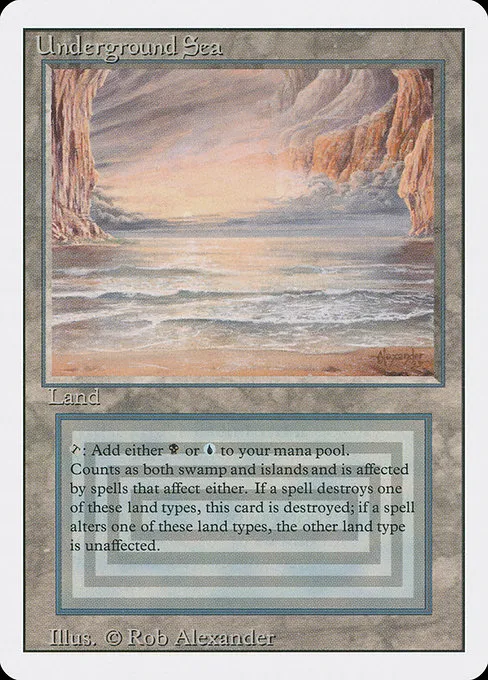
My friend Dan keeps a Revised Underground Sea in a regular penny sleeve. Just the one layer. No top loader. Nothing else. He’s had the card for eleven years. It’s worth north of nine hundred bucks right now, and he treats it like a draft chaff common.
I’ve stopped trying to convince him. He’s fine. The card has soft corners that it had when he bought it and they haven’t gotten worse. The sleeve is barely scuffed. It lives in a three-ring binder next to some Khans of Tarkir fetchlands that probably get more page traffic than it does.
I bring this up because the conversation around MTG card protection gets skewed by grading YouTubers and sports-card collectors applying Pokémon-pull logic to a game that plays differently. Magic cards get shuffled. They sit in decks for years. They’re traded at tables, not just listed on eBay.
So here’s how I actually decide. Three tiers: sleeves for everything, top loaders above a value threshold, slabs basically never. I’ll work through each one, and then say something unpopular about grading.
Everything gets sleeved
Every card I own has a sleeve on it. Commons, basic lands, tokens, draft chaff, whatever. Cheap insurance. A 500-pack of KMC penny sleeves runs about fifteen bucks and protects against the most common damage vector, which is boring. Just surface wear from pulling cards in and out of binders, or friction from sliding a deck into a deck box over and over.
If the card is going to see play (FNM, kitchen table, Commander night), I double sleeve. Inner penny sleeve, outer Dragon Shield or Ultra Pro. This is the tournament-legal standard and it’s overwhelmingly what people do for played cards.
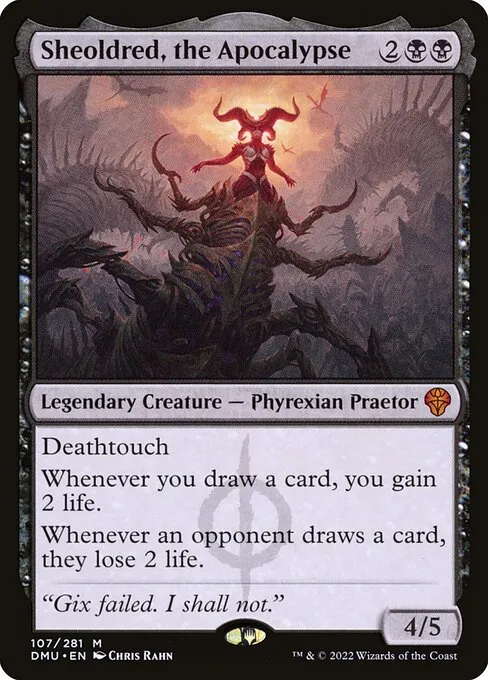
The spot most collectors get wrong at this tier is bulk. A lot of folks throw bulk into a shoe box unsleeved because “it’s just bulk.” Fine, except a year later you pull out a card you forgot was in there. Maybe a Sheoldred, the Apocalypse that was a bulk rare when you dropped it in but is now ninety bucks. And it has edge whitening from riding around in a box. That’s real money gone. I had this exact thing happen with a Dominaria United Sheoldred I tossed into a 400-count box at prerelease in 2022, and when I dug it back out last year it had rub marks on one edge that dropped it from NM to LP. Eight bucks difference, roughly. My fault for not sleeving it that night.
Top loaders above a value threshold
Top loaders get weird fast because there’s a cottage industry trying to convince you that every card worth more than a nickel needs one. I disagree. They’re a pain to store, they don’t stack in standard card boxes, and flipping through a binder of top-loaded cards is miserable.
My threshold is around forty dollars. Above that, sleeve plus top loader. Ragavan, Nimble Pilferer sits in top loaders in my collection. So does Orcish Bowmasters. Sheoldred in the main Dominaria United printing, also top loaded. The math changes at that price: the top loader costs fifteen cents, and the gap between a near-mint copy and a lightly played copy on TCGplayer is usually five to ten bucks. Break-even is immediate.
Below forty, sleeve-in-binder is fine. Above forty, I’m not willing to risk the edge ding that drops condition one grade.
A detail nobody mentions in protection guides: top loaders themselves can damage cards. Don’t force a card in. Don’t skip the penny sleeve inside. Don’t store them with the card sliding loose. Use a team bag, or painter’s tape over the opening. I learned this from a prerelease promo foil I found later with a scuff across the face from bouncing around in a top loader in a drawer for a year. No binder, no bag, just loose in a Dragon Shield box next to a pile of dice.
For foils, top-load earlier. Foils warp, and a foil Sheoldred in a binder sleeve alone isn’t going to stay flat for years. Once it bends even slightly, flattening it back is basically “you can’t, really.” The top loader gives it a flat backstop sleeves don’t.
Slabs, reluctantly
So yeah, slabbing. Comes up every year. My honest position has shifted over the last couple years. I used to be more bullish on grading MTG cards, and now I think it makes sense for maybe one percent of what grading companies would love you to send them.
The math for MTG is rough. A BGS submission at base tier is about fifteen bucks per card, plus shipping both ways, plus insurance on the return. Call it twenty-five to thirty-five all-in per card. Turnaround is listed at seventy-five business days and I’ve had submissions take considerably longer. PSA’s cheaper tiers stretch to a hundred fifty business days or more.
For the fee to make sense, the graded copy needs to sell for at least $30-50 more than the raw copy. That’s a high bar for most MTG cards. A $40 Modern rare isn’t going to jump to $80 because it’s in a slab. The buyers paying premium for graded MTG cards are mostly the ones who already know how to assess condition themselves, and they’re looking at vintage stuff like Alpha, Beta, Unlimited, early foils, and specific old promos. Not Modern Horizons chase cards.
My rule, tentatively: only consider slabbing a card worth north of three hundred dollars in a segment where grading is the norm. Old-school foils. Alpha rares. Signed cards. Reserved List staples in exceptional condition. I wouldn’t slab a Sheoldred. I wouldn’t slab a Ragavan. I probably wouldn’t even slab Dan’s Revised Underground Sea because it’s not mint and the premium only really kicks in at BGS 9 and above, and his isn’t getting there.
One exception. If you’re selling a very expensive card to a buyer you don’t know, a slab is authentication, and authentication is worth paying for. Alpha stuff gets counterfeited. People are getting burned. A BGS or PSA slab is a letter that says this is real, and that’s worth something.
(Though if the raw market gets meaningfully worse about authenticity this year, I could see myself submitting more cards next year. I’m not religious about the “one percent” number.)
Which grader, if you’re going to
BGS historically owned MTG grading because players wanted subgrades, and Magic cards reward that kind of detail. Centering and corners vary a lot across old sets. CGC has eaten into BGS share since about 2023. PSA is dominant in sports but has never commanded the same premium on Magic cards. A PSA 10 on an MTG card does not consistently outsell a BGS 9.5, which is the opposite of what happens with a baseball rookie.
With Collectors Holdings now owning PSA and BGS (the acquisition closed late 2025), there’s open speculation about how independent BGS grading stays. I don’t have a settled take. I’d still send MTG to BGS or CGC today, but I’m watching.
What most collectors get wrong
Purely functional paragraph. Most collectors over-protect cards they handle rarely and under-protect cards they handle constantly. A binder of commons on a shelf inside a closed binder does not need top loaders. A Commander deck with a $90 card that’s been shuffled four hundred times has absorbed way more wear than the binder stuff, and probably should have been double-sleeved from day one.
I think about handling frequency too, not just value. The decks I play every week have more aggressive protection than the singles I trade at similar price points. The Sheoldred in my Atraxa deck has been double-sleeved from the day I picked it up. The Sheoldred sitting in a binder for long-term hold is just top-loaded. Same card. Different job.
Keeping a digital record of which cards have crossed into the top-load tier helps a lot. I’ll scan a binder in Eldwyn in about twenty minutes and see which cards have appreciated past my threshold since the last check. Sheoldred was the big recent one for me. Five years ago it was a bulk rare, I missed the climb, and only reorganized that binder last spring.
One last thing and then I’ll stop. If you’re buying protection products, buy the ones that say “acid-free” and “PVC-free” on the packaging. Old PVC-heavy products do damage cards over decades, and this is one place the paranoia is justified. BCW, Ultra Pro, Dragon Shield, and Vault X all make products that meet this bar. Generic Amazon off-brands often don’t.