There’s a specific kind of mess that happens about twenty minutes into opening a booster box. You’ve got your rares in one pile, except some of them slid under the wrappers, and the foils are stuck together, and you opened a pack to “just check” before you finished sorting the last one, and now there are two streams of cards merging on your coffee table with no clear boundary. By pack fifteen you’ve stopped caring which pile is which. You’ll deal with it later. You won’t.
Marvel Super Heroes officially hits shelves Friday, June 26, and a lot of you are going to be sitting in front of exactly that pile this weekend, either from a prerelease kit or a box you preordered back when the discounts started getting silly. So before you crack the first wrapper, I want to talk about the boring part nobody plans for: actually recording what you pulled, and what those cards are worth on the one day they’re worth the most.
The price you see right now is the ceiling
Here’s the thing about preorder numbers that the hype videos won’t lead with. They’re the high.
I’m not being cynical, it’s just how new sets work. Supply is at its absolute lowest the week before release because almost nothing has been opened yet. Everyone who wants a chase card has to buy it from the tiny pool of preorder copies, so the price floats up on thin air. Then Friday hits, thousands of boxes get cracked at once, and the same card is suddenly everywhere. Prices sink. Sometimes a little, sometimes off a cliff.
You can already watch it happening with the sealed product. The Play Booster Box launched at a $209.70 MSRP and Amazon has quietly walked it down to around $130, with the market hovering right about there too, down something like 23% in a single month. That’s before the set is even out. The cards inside follow the same gravity.
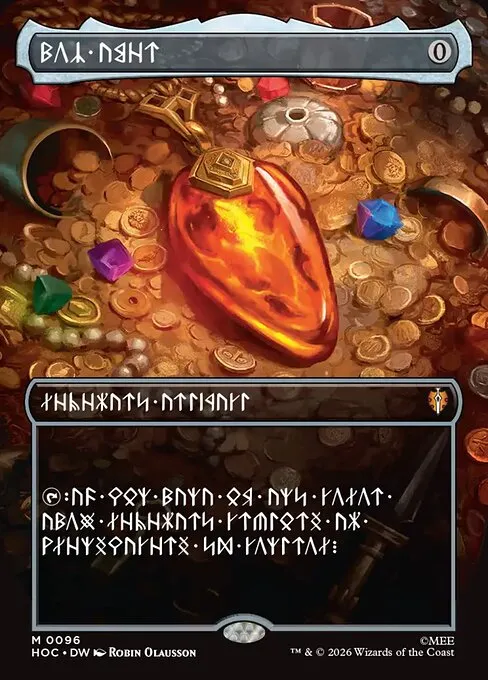
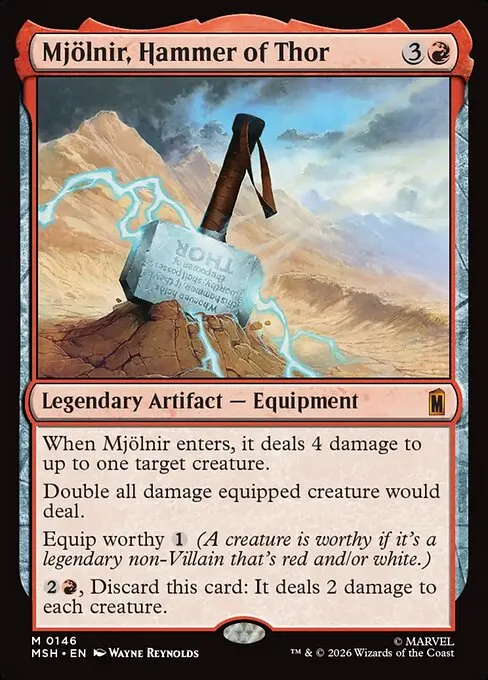
Take The Mind Stone, the marquee mythic everyone’s chasing. It’s sitting around $66 on preorders as I write this. I’d bet real money it’s not $66 in August. Mjolnir, Hammer of Thor is up near $18, its foil over $40, and those equipment-payoff cards always cool off once the prerelease brewing dies down and people realize how many copies exist. None of this means the cards are bad or that you shouldn’t be excited. It means the number you write down this weekend is a snapshot of a peak, not a resting value.
So why bother logging at the peak at all? Because the peak is the data point you can never get back. You can re-check a price next month any time you want. You cannot go back and reconstruct what your binder looked like the day the set dropped unless you wrote it down then. A baseline is only useful if you capture it at a fixed moment, and release day is the cleanest fixed moment a set ever has.
Logging 100-plus cards without losing the afternoon
A Play Booster box is thirty packs. Call it 200-ish cards once you count the commons, lands, and the inevitable handful of tokens. Marvel adds its own wrinkles on top, because between the borderless comic-panel treatments, the foils, and the double-faced character cards, a third of the box is going to be some kind of alternate frame.
The way I do it, and the way that actually saves time rather than feeling like it should:
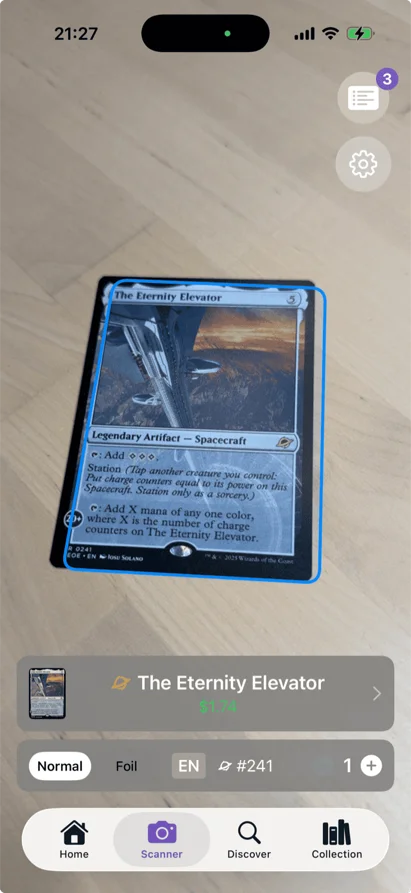
Don’t sort first. This is the counterintuitive part. The instinct is to sort everything into rarity piles and then record it, but that’s two passes over the same cards. Just scan them in the order they come out of the pack. Hold the card, scan, drop it in a box, next card. The app figures out what it is, including the set and the specific treatment, so you’re not the one squinting at collector numbers at 11pm. I got through a full prerelease pool the other week in about half an hour doing it this way, and most of that was me stopping to actually read the new cards because I’d never seen them.
The double-faced ones are where you slow down. Bruce Banner flips to The Incredible Hulk, that kind of thing. Scan the front face. The recognition handles the rest, but if a card’s been sleeved into a top-loader already because it’s a foil mythic you’re precious about, the glare can throw it. I pull foils out of the loader, scan, then re-sleeve. Annoying, but it beats a mystery entry in your collection three weeks later.
Foils in general are the recognition headache with this set. The comic-book-panel borderless cards especially, because the art bleeds in ways the scanner doesn’t always expect. I wrote a whole thing about scanning foils and alternate-art cards that applies directly here, the short version being good light, matte background, no direct overhead glare. Marvel is going to stress-test all of it.
And honestly, you don’t need to log the commons the same day. The mythics and rares and any foil you’d be sad to lose, do those while the box is open and the memory of which pack held what is fresh. The bulk can wait for a rainy Tuesday. I know that contradicts the whole “capture the baseline” pitch I just made, and maybe it does, but a Bear common from Marvel is going to be a quarter forever and nobody’s pretending otherwise. Pick your battles.
What the Commander decks do to your baseline
If you grabbed one of the four precons alongside your box, your logging job gets more interesting, because the precons are stuffed with reprints that already have a long price history.
Roaming Throne shows up again at around $51. Sword of Fire and Ice near $30. Teferi’s Protection in the mid-$30s. These aren’t new cards finding their price, they’re established staples getting another printing, which means the math runs the opposite direction. A reprint pushes the price of existing copies down, so if you already owned a Sword of Fire and Ice, logging this new copy is also a quiet reminder to re-check the old one. The whole reprint trap thing is real, and a precon dropping four staples at once is exactly the kind of event that moves a number you weren’t watching.
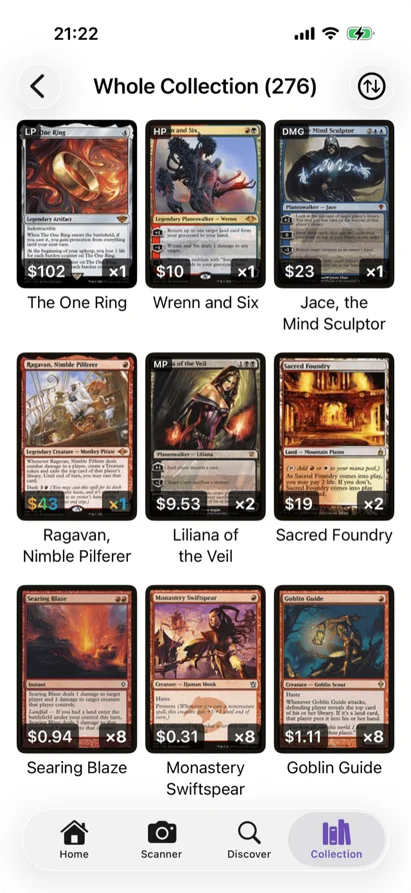
I went back and forth on whether the precon reprints are even worth pulling apart for value or whether you just keep the deck together and play it. For most people, keep it together. But if you’re the sort who’s going to dismantle it for the chase reprints anyway, log them as singles, not as “one Doom Prevails precon,” because the deck-as-a-unit number and the sum-of-parts number drift apart fast once you start selling pieces. I have opinions about people who break up perfectly good precons, and most of those opinions are that I am one of them.
Don’t act on Friday’s number
The last thing, and the one I have to remind myself of every single release. The price you log this weekend is for the record, not for a decision.
I learned this the dumb way. When Lord of the Rings dropped I cracked a box, saw a couple of cards spiking on preorder energy, and immediately listed them to “lock in the gains.” They sold, sure. Then those exact cards kept climbing for three more weeks while the genuinely scarce stuff settled out, and I’d sold into the noise at basically the floor of where they eventually landed. The lesson wasn’t “always hold.” It was that release-week prices are too jumpy to trade against, in either direction.
Log everything. Watch it drift for a few weeks. The cards that hold value after the initial flood are the ones actually worth your attention, and you can only spot them if you’ve got the starting number written down. If you want the deeper finance read on which Marvel cards are likely to survive the settle, I went through the chase cards and reprints separately. For this weekend, the job is smaller than that. Open the packs, scan the pulls, write down what they’re worth on the day they’re worth the most, and then put your phone down and enjoy the fact that you get to play Magic with the Hulk now.