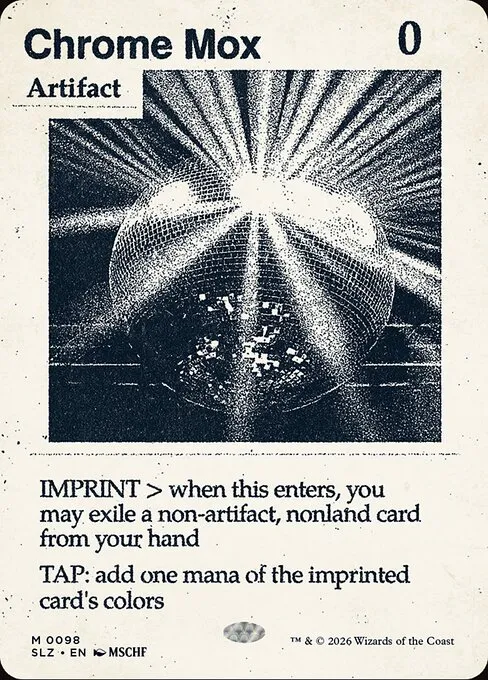
I spent a genuinely embarrassing amount of time yesterday looking at a black-and-white photocopy of a disco ball, trying to work out which Magic card I was holding a picture of. There’s no set symbol on it. No mana symbols either, just a zero in the top right. The type line says “Artifact” and nothing else. Eventually I read the name at the top of the card, which is obviously what a normal person does first, and it was Chrome Mox.
That’s the Zeta Set, and it goes on sale September 2 at noon Eastern through the Secret Lair Chaos Vault. It’s a collaboration with MSCHF, the Brooklyn art collective, and it’s built as a tribute to the handmade playtest cards Richard Garfield and friends were cutting out with scissors in 1992. Every card is Xeroxed, collaged, and slightly broken-looking on purpose.
The part that actually matters is that you don’t get to pick. This is the first Secret Lair sold as randomized boosters. $19.92 buys you a sealed envelope with seven cards in it: three commons, two uncommons, one rare or mythic, and one wildcard of any rarity. Limit twelve per customer. The price is a 1992 joke, which is cute, and I’d have preferred $15 with no joke.
The completion math is bleak and I don’t think Wizards minds
121 cards. Three visual treatments each, called Photocopy, Photocopy Negative, and Color Banding. That’s 363 distinct printings before you count the 17 bonus cards MSCHF designed that haven’t been revealed yet.
Twelve packs times seven cards is 84 cards. If every single one arrived unique, which it won’t, you’d finish with under a quarter of the set.
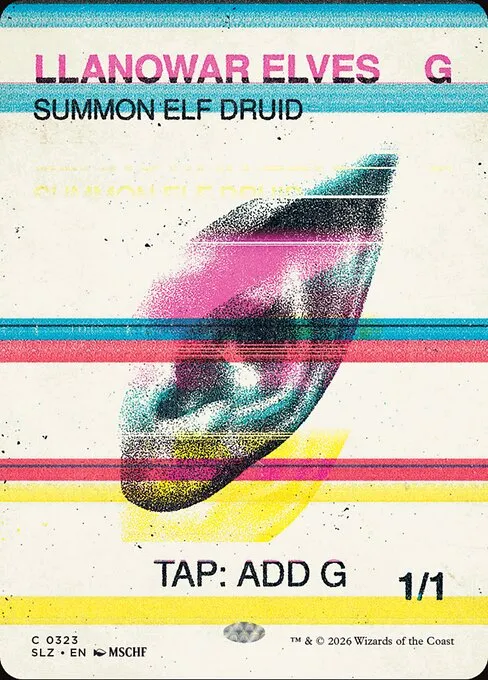
I checked Scryfall this morning and 37 unique cards are up so far, which comes to 111 printings in the database. The collector numbers gave away the structure: Llanowar Elves is number 81, and also number 202, and also number 323. Same card, three blocks of 121, one block per treatment. So the collector number at the bottom of the card is the only thing that tells you which treatment you own, because the card itself doesn’t say.
Every previous Secret Lair was a known quantity. Five cards, published list, you clicked buy and you knew what was coming in the envelope. Even the weird ones, like the Chaos Vault drops back in May, told you exactly which reprints you were getting before you paid. Completing a set was a purchasing decision. Now it’s a slot machine with a spend cap on it.
Although. Let me argue against myself for a second, because “you can’t complete it” only holds if you insist on doing it out of packs. Singles will exist within a week of release. Secret Lair singles always show up on TCGplayer fast, and if you want the Photocopy Negative Sensei’s Divining Top specifically, you’ll be able to buy the Photocopy Negative Sensei’s Divining Top specifically. It’ll cost more than opening packs would have. But the set isn’t sealed off, it’s just expensive to approach the normal way. I still think the randomization changes the shape of what owning this thing means, and I’m less confident about that than I was two paragraphs ago.
The rarity letter is decorative
Here’s the thing I keep poking at. Look at the bottom left corner of a Zeta card and you’ll find something like “C 0088” or “M 0098”. That letter is the rarity. It’s the only place the rarity appears, because there’s no set symbol in the type line to color-code.
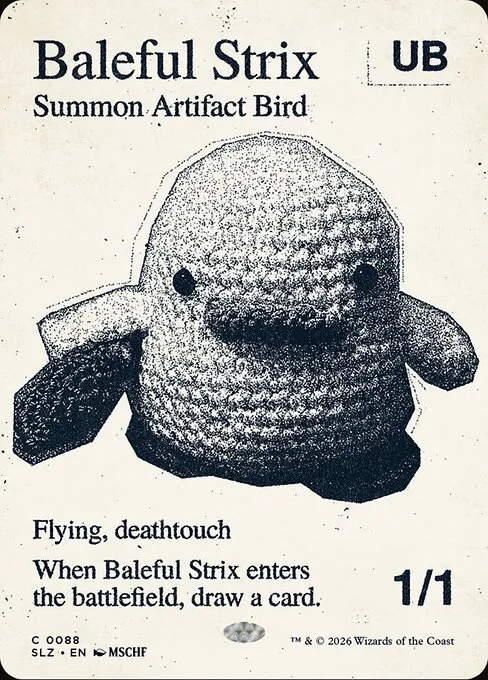
That’s Baleful Strix, as a crocheted amigurumi bird, at common. First common printing of the card in Magic’s history. Which caused about four hours of excitement in the Pauper community before Gavin Verhey posted that Secret Lair printings don’t affect Pauper legality, full stop, and the excitement turned into a different kind of noise.
The rule Pauper has always run on is simple: if a card has ever been printed at common anywhere, it’s legal. Zeta breaks that by existing. Wizards’ answer is essentially that Secret Lair sits outside the rule, which is a defensible call and also a new asterisk on a format that was popular partly for not having asterisks. Nobody thinks Baleful Strix would warp Pauper. People are annoyed about the precedent, and I understand why, though I’d rather have the disco ball Chrome Mox than a clean rulebook.
So you’ve got a card with a printed rarity of common that is not legal in the common format. Meanwhile Chrome Mox sits at mythic, and the cheapest real copy of Chrome Mox you can buy today is $153.70 in Eternal Masters. Doomsday is an uncommon in Zeta and about $1.10 in its Marvel Super Heroes Commander printing. Savannah Lions is a common and $0.19. Urborg, Tomb of Yawgmoth is around $54.82 in Time Spiral Remastered.
The rarity symbol on a Zeta card tells you which slot of the pack it fell out of. That’s it. It doesn’t predict legality and it doesn’t predict price, and if you sort your binder by rarity, these 363 printings are going to sit in the wrong drawers forever.
Sorry, tangent
In 2019 I photocopied a whole Legacy deck on my parents’ inkjet because I wanted to test a Lands list before committing four figures to it. Cut them out with kitchen scissors. They were bad. Wildly off-center, one of the Wastelands was printed at about 90% scale for reasons I never diagnosed, and the ink smudged if you looked at it wrong. I brought them to a store night and the guy running it very politely said no, and I’ve thought about that stack of paper every time someone posts about proxy culture since.
Anyway, MSCHF made the professionally manufactured version of my bad inkjet cards and Wizards is charging twenty dollars a pack for seven of them, and honestly? Good for them. The Llanowar Elves is a single prosthetic elf ear. Arcane Signet is a cygnet, because cygnet, signet. Birds of Paradise is that dodo engraving everyone has seen. Land Tax is a pile of loose change. Niek Dekker at MSCHF made the Eerie Interlude art by putting his hand on a flatbed scanner and dragging it while it scanned, which stretched his wedding ring across the image several times over. That’s the level of care here and it’s much higher than the aesthetic suggests.
What I’d actually do on September 2
Buy what you want to open and don’t pretend it’s an investment. The reprint value inside a pack isn’t the point and it won’t be flattering: Llanowar Elves is $0.34 in Foundations, Arcane Signet is $0.80, Savannah Lions is under a quarter. The money cards exist, Chrome Mox and Urborg and Sensei’s Divining Top at $36.05 for its cheapest printing, but they’re one slot out of seven and you’re not going to open your way into profit.
Log them the day they land, though, and log them properly. The three treatments are separate printings with separate collector numbers, and a card that says “Summon Artifact Bird” on it with the mana cost written as the letters U and B inside a hand-drawn box is going to be a challenge for any recognition system, including ours. I’d scan the front to catch the name, then check the collector number by hand against which of the three blocks it lands in, the same way I’d handle any printing where the visual cues have been stripped out.
And write down what you paid per pack, because in four months somebody is going to ask you what the Color Banding Brainstorm is worth and the only honest answer will involve dividing $19.92 by seven.