Somewhere in a closet I have a binder that’s been one card short of a complete Return to Ravnica set for about eleven years. Every common, every uncommon, all the rares, all the mythics except one. I won’t tell you which card because it’s embarrassing how cheap it is now. I stalled there over a decade ago, told myself I’d grab the last one next time I was at the shop, and then RTR rotated out of Standard, my playgroup drifted to other formats, and that binder quietly became a monument to almost.
That’s the part nobody warns you about when you decide to complete a full MTG set. Getting to 90% is fast and genuinely fun. You crack packs, you trade for the obvious gaps, the pages fill up. The last 10% is where set collecting goes to die.
What a “complete set” even means
You have to settle this before you start or you’ll lose your mind halfway through. There are two definitions and they’re wildly different amounts of work.
A complete set, the old-school definition, is one copy of every card in the main set, numbered by collector number. For a modern Play Booster set that’s somewhere around 280 cards. Totally achievable. You can do most of it with a booster box and a handful of singles to plug the holes, or just buy the whole thing as singles in an afternoon.
A master set is every printing of every card. The base version, the extended-art and borderless and showcase versions, the foil of each of those, the surge foil, whatever treatment Wizards invented that quarter. A modern master set can balloon to 500, 600, sometimes 700+ cards once you count all the Booster Fun. And nobody agrees on where the boundary is. Do the promos count? The Special Guests? The bonus sheet? I’ve seen forum threads argue about this for fifty replies and reach no conclusion, so I’ve stopped pretending there’s a correct answer.
My honest take is that for most people the base set is the goal worth chasing, and the master set is a money pit. You’ll spend more finishing the last few foil mythics of a master set than you spent on the entire base set. Although… I don’t know. The foils are kind of the whole point for some collectors. The bling is the fun. If chasing a complete run of surge-foil showcase cards is what gets you opening packs, who am I to call it a money pit. I’d just want you to know what you’re signing up for before you’re 400 cards deep and the last six cost more than your car payment.
Pick a set you can actually finish
This matters more than people give it credit for. Not every set is a reasonable completion target, and picking the wrong one is how you end up with my RTR binder.
Older small sets and core sets are the gentlest on-ramp. Fewer cards, no Booster Fun explosion, and the singles have mostly bottomed out in price, so the commons and uncommons are basically free. A set like that, you can knock out the commons and uncommons for the price of a couple booster packs and then pick away at the rares.
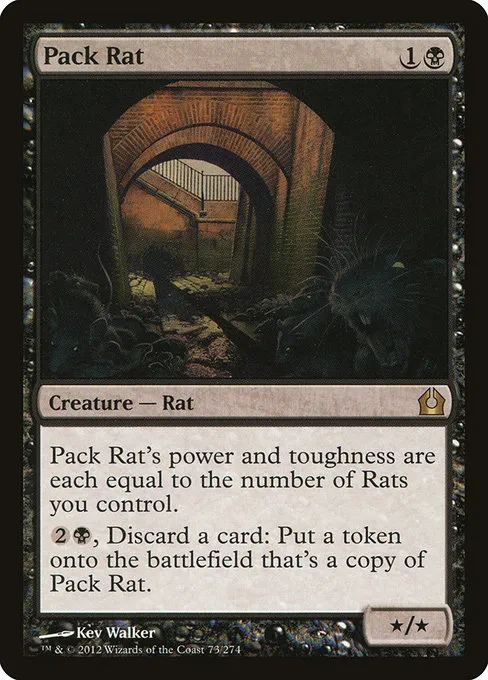
The trap is the chase mythic. Every set has one or two cards that cost more than the rest of the set combined, and they’ll stall your completion for years if you let them. Return to Ravnica had Pack Rat lurking as a deceptively strong uncommon, but the real wall in most sets is a single splashy mythic. You can have 279 of 280 cards and the last one costs more than everything else put together. So before you commit to a set, look up its most expensive card. That number is your real cost to complete, not the bulk you’ll breeze through first.
Universes Beyond sets are their own warning label. The Lord of the Rings set and the new Marvel set are gorgeous and people love them, but they’re priced like collectibles, not like a Standard set you finish for fun. Completing one of those is a real financial commitment. Go in eyes open.
The actual hard part is knowing what you’re missing
Here’s where set collecting falls apart for most people, and it’s got nothing to do with money. It’s tracking.
You think you know what’s in your binder. You don’t. I’ve bought a “missing” card at an LGS, brought it home feeling accomplished, and then found a copy I already owned wedged into a different binder from two purchases ago. Paid full price to duplicate something I had the whole time. If you’ve been collecting more than a couple years, running a want list against your collection instead of against your memory is the single biggest thing that’ll save you money.
The old way to handle this was a spreadsheet. One row per card, columns for whether you own the common, the uncommon, the rare, the foil. People still do it and it works, it’s just tedious to maintain, and the second you fall behind on data entry it stops being trustworthy. A want list you don’t update is worse than no want list, because you’ll trust it and buy wrong.
So yeah, tracking. The whole game. You think you’ll remember. You won’t. You’ll be standing at the singles case, phone in hand, trying to recall whether you ever picked up that one red rare, and you’ll either skip it and miss it or buy it and double up. Every time. There’s no winning that from memory once a collection gets big.
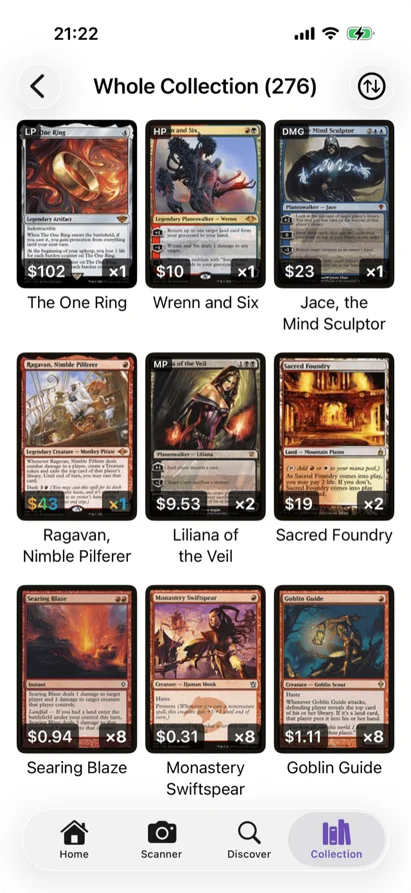
The reason I bring up the app at all here is that this exact problem is what it’s good at. When you scan your cards into Eldwyn and then browse a set, it shows you a running “X of Y collected” count right at the top, so a glance tells you you’re at 247 of 281 instead of you guessing. And a want list shows how many of each card you already own, so you can export just the gaps and shop the actual holes instead of rebuying. That’s the whole pitch. Know what’s missing, don’t pay twice.
A few habits that make completion stick
Log cards as they come in, not in a giant batch later. The batch never happens. I say this as someone whose “I’ll sort it this weekend” pile once hit four shoeboxes.
Decide your completion grade up front. Are you fine with played copies for the commons, or does every card need to be near mint? For a base set I’d say played commons are completely fine, save the condition fussiness for the rares you actually care about. You can always upgrade a beat-up common later for pocket change.
And accept that the last few cards will be annoying out of proportion to their value. The cheap mythic that nobody stocks because it’s not worth a vendor’s case space is somehow harder to find than the chase card everyone has in stock. My RTR binder isn’t stalled on an expensive card. It’s stalled on a card so cheap and forgettable that I keep forgetting to order it. Maybe writing this is what finally gets me to add it to a list.