The fourth copy of Arcane Signet is what finally got me. I was building a new Commander deck, went through my usual TCGplayer cart, hit checkout, and a week later when the cards showed up I went to slot the Signet in and thought, hang on. I have one of these in the Edgar deck. And the Korvold deck. And I’m pretty sure there’s one floating loose in the bulk box from when I tore apart a precon two years ago. So now I own four, three of which I forgot existed, and I paid shipping on the fourth like an idiot.
That’s the thing about rebuying cards you already own. It’s almost never the chase cards. You’re not going to forget you own a Gaea’s Cradle. You remember exactly where your expensive cards live because they live rent-free in your head. It’s the forty-cent commons and the staple two-drops that get you, because they’re spread across five decks and a binder and nobody tracks them. A want list against your collection is the boring fix for the boringest money leak in the hobby.
Where the money actually goes
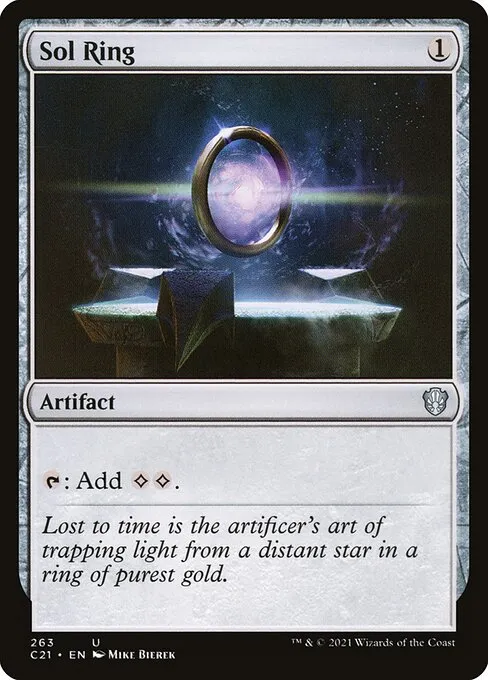
Here’s the math that made me actually care. Say you run six Commander decks. Most of them want the same dozen colorless rocks and utility lands: Arcane Signet, Sol Ring, Command Tower, Cultivate-into-whatever, the usual. None of these cost real money. Sol Ring is a buck and change, Arcane Signet and Command Tower are both under fifty cents. So who cares, right?
You care when you realize you’ve bought eleven Command Towers over four years and you can physically locate maybe six of them. The rest are in decks you dismantled, in the bulk box, in a deckbox in a drawer you don’t open. Each individual purchase felt free. The aggregate is forty-some dollars of green lands and a junk drawer full of duplicates you’ll never use because every deck that needs one already has one.
And it’s not only the cheap stuff, that’s just where it’s most common. The expensive version of this mistake is uglier and rarer. I know a guy who bought a second Dockside Extortionist for a deck because he genuinely could not remember whether the first one was in his cEDH list or whether he’d traded it. He didn’t want to tear down a sleeved deck to check, so he just bought another. That’s a sixty-dollar question answered with a credit card instead of two minutes of looking. He found the original later. In the deck. Where it had always been.
A want list is just a diff
The actual tool here is simple, and most deckbuilding sites already do half of it. A want list is a comparison: here are the cards this deck wants, here is what I own, show me only the gap. The gap is your shopping list. Everything else, you already have, go find it.
Moxfield and Archidekt both let you upload a collection and then “browse decks by missing or owned cards,” which is the feature doing the heavy lifting. You build the decklist, the site cross-references your uploaded collection, and it flags which cards you need to acquire versus which are sitting in a box somewhere. Archidekt’s collection compare and Moxfield’s missing-cards view are the same idea wearing different UIs. The catch, and it’s a real one, is that the collection has to actually be accurate. A want list run against a collection you haven’t updated since January is just a confident wrong answer.
Which is the part everyone skips. Keeping a digital list of physical cards current is genuinely annoying. You buy cards, you trade cards, you pull a deck apart, you draft on a Friday and come home with forty new commons, and unless you log all of it the moment it happens, the list drifts. Within a couple months your “collection” is fiction.
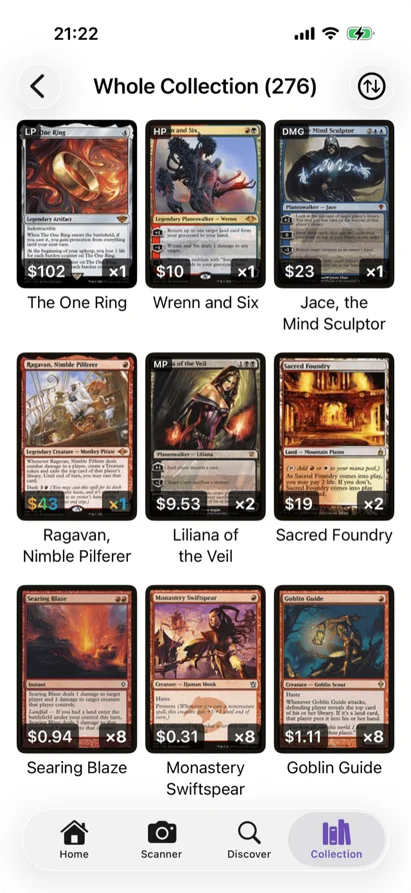
This is the entire reason I started scanning instead of typing. Adding a card by hand means searching the name, picking the printing, setting the count. Forty cards from a draft is a forty-step chore and I will simply not do it. Scanning a stack is hold-scan-drop, hold-scan-drop, and the count updates as you go. I scanned a whole dismantled precon back into my collection in about ten minutes, which is roughly nine more minutes than I’d have spent before giving up and leaving it untracked. The app I use for this is the one I work on, so take that with whatever salt you like, but the principle holds no matter what you track in: the list is only worth anything if updating it is fast enough that you actually do it.
How I actually run it
So my loop now, and I’m not claiming it’s clever, it’s just a loop:
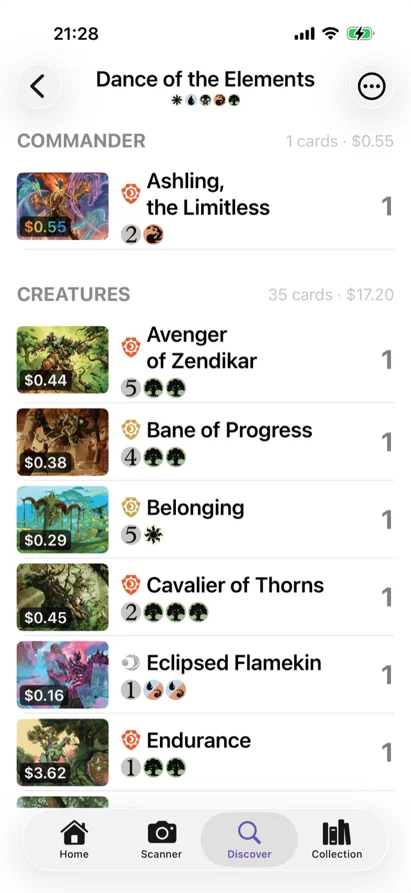
Build the deck digitally first. Whole thing, all 100 cards, before I buy or pull a single physical card. Then I mark which cards I own against my scanned collection. The ones I own, I go physically dig up, even when that means tearing down a deck I wasn’t playing anyway. The ones I don’t own go on the want list, and only that list goes in the cart.
The dig-up step is the one people resist and it’s the one that saves the money. Yeah, it’s a pain to pull eight cards out of three different decks. It’s less of a pain than buying eight cards you already own. Usually. There’s an honest counterargument here that I go back and forth on, which is that some staples are cheap enough that the time isn’t worth it. If a card’s under a quarter, is hunting through four decks for it really a better use of my evening than just adding it to a cart I’m already filling? Probably not, for that one card. But “it’s only a quarter” is exactly the logic that got me to eleven Command Towers, so I don’t fully trust it.
The other thing a current want list quietly fixes is trades. When someone at the LGS asks if you’ve got a spare of something, “let me check” used to mean “let me guess.” Now it means I actually know, which makes me both a better trade partner and a harder one to lowball. If you do much in-person dealing, knowing what you own before you sit down is half the battle.
When it’s not worth it
I want to be fair, because the want-list workflow isn’t free and it isn’t for everybody.
If you run one deck and a casual binder, you don’t need any of this. You can hold a single deck in your head. The diff between “what this deck wants” and “what I own” is small enough to eyeball, and setting up collection sync is more overhead than the problem deserves. The break-even is somewhere around three or four active decks, in my experience, which is also right about when people stop being able to remember where their Sol Rings are.
And if you mostly buy singles for one Standard or Pioneer deck and rotate it, the duplicate problem barely exists. This is a multi-deck Commander hoarder’s disease, mostly. I say that as the multi-deck Commander hoarder.
So yeah. I don’t know, maybe four copies of Arcane Signet is fine, actually. They’re forty cents. I could’ve just shrugged. But there’s a difference between owning four because you chose to and owning four because you lost track, and the second one is the one that bugs me. It’s not the money, at that price it’s never the money. It’s the not knowing. I’d rather build a deck from what I already own and be sure than buy blind and find out later.
Anyway. Go count your Command Towers. I’ll wait.