Someone at my LGS is flipping through my binder. He stops on a card, taps it, and says “what do you want for this?” And there’s this little dead-air moment where we both pull out our phones, and I already know we’re about to disagree about a number.
That moment is where most people lose money trading in person. Not to scammers. To the fact that nobody at the table agrees on what a card is “worth,” because there isn’t one answer, and a lot of us never learned that.
I want to talk about how to value an MTG trade across a table without either burning the other person or getting quietly fleeced yourself. It’s mostly two things: understanding that the price you’re looking at is actually three different prices, and a handful of habits that keep the whole thing honest.
The number on your phone is three numbers
Here’s the part that took me embarrassingly long to internalize. When you look up a card and it says $10, that’s usually the market price, roughly what the card sells for between players on TCGplayer right now. It is not what a store will give you for it. It is not what the card “owes” you. It’s one data point.
The buylist price is what a vendor will pay you in cash for that same card, and it’s lower. Sometimes a lot lower. A $10 market card might buylist for $6, or $4, or in store credit a bit more than that. The gap isn’t the store being greedy, it’s them covering the cost of holding the card, listing it, shipping it, and eating the risk that it tanks before it sells.
Then there’s “trade value,” which is the made-up one. It’s the number two players actually agree to at the table, and it floats somewhere between market and buylist depending on who wants the card more, how liquid it is, and whether either of you actually needs it. There’s no app for trade value. It’s a negotiation.
So when a casual player hands you their binder and values everything at full TCGplayer market, and you value yours the same way, and you trade straight across, you both think you got a fair deal. And you might have. But if one of those cards is a Standard staple that’s about to rotate and the other is an out-of-print Modern card, the “even” trade wasn’t even at all. One of you traded a melting ice cube for something solid.
Who needs the card more
This is the lever everything pivots on, and it’s the thing finance people understand that casual traders don’t.
If someone’s flipping through my binder and lands on a card I’m not particularly attached to, and they clearly want it, I have the power in that trade. That doesn’t mean I should gouge them. It means a “fair” trade here isn’t necessarily straight-across-market, because I’m giving up something I’m fine keeping and they’re getting something they came looking for. Asking for a little extra isn’t sharking. Lying about what the cards are worth is sharking. Those are different things, and the difference is whether your trade partner knows what’s going on.
The flip side: if I’m the one who needs the card, I should expect to give up a bit of value to get it, and I should be okay with that. The person trading down to me (handing over one expensive card for a pile of my smaller ones) is doing me a service. Piles are annoying to move. Single staples are easy. That convenience has a cost and the cost is mine to pay.
I genuinely go back and forth on how hard to push this, though. Part of me thinks every trade should be a clear-eyed value calculation, because it’s your money and your collection. And part of me thinks the guy who squeezes three extra dollars out of a kid at FNM is the reason in-person trading basically died for a decade. I’ve watched both happen. The grinder who wins every micro-trade also somehow never has anyone left who wants to trade with him. So I land on: know the numbers cold, then choose to leave a little on the table on purpose. That’s not weakness, it’s just understanding that your reputation at a 50-person LGS is worth more than a Bolt.
The same card isn’t the same card
Printing matters way more than newer players expect, and this is where I see honest mistakes turn into lopsided trades.
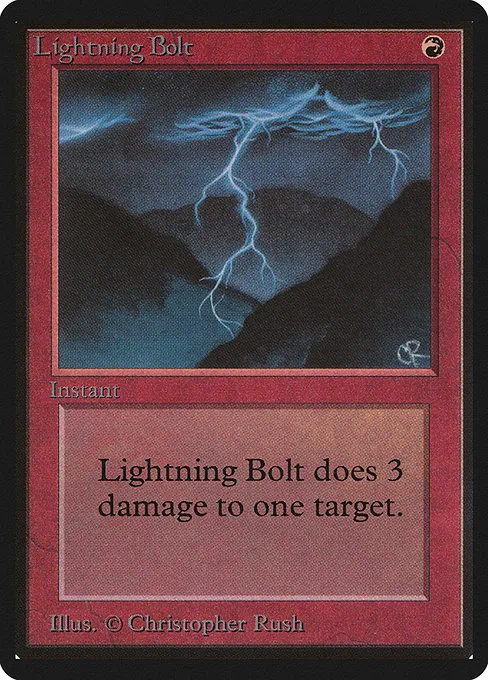
“I’ll trade you a Lightning Bolt” means nothing on its own. A Beta Lightning Bolt is a few hundred dollars. The Secrets of Strixhaven one is a couple bucks. They’re the same card by name and they’re not remotely the same trade. Foil vs nonfoil, borderless vs regular, the box-topper version vs the draft-set version, an old promo vs the reprint that just came out last month. All of it moves the price, sometimes by 5x or 10x.
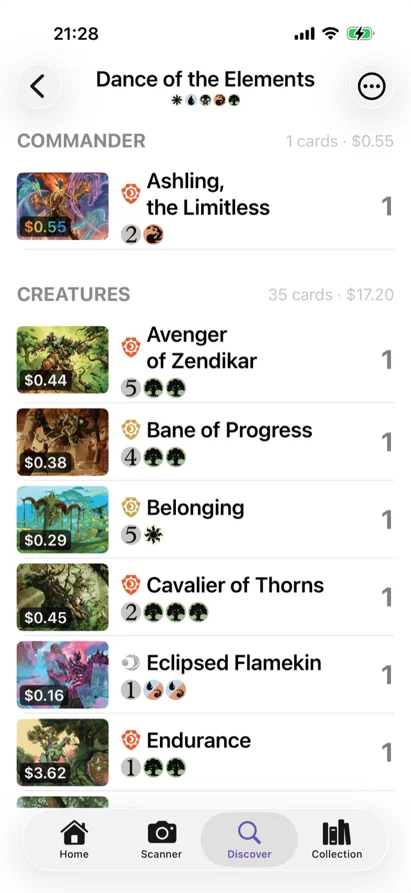
So before you agree on a number, agree on which card you’re actually looking at. Pull the exact printing up, not just the card name. If you’re scanning a binder to price it (I’ll usually run a whole binder through Eldwyn before someone comes over so I’m not fumbling card-by-card), make sure the scan caught the right set, because the alternate-art ones love to trip recognition up.
And condition. A played, scuffed copy of a $40 card is not a $40 card. If you’re going to trade anything with real value, unsleeve it and actually look at the corners and edges under decent light. Ask permission before you unsleeve someone else’s cards, that’s just manners, but do look. Heavy play knocks a meaningful chunk off, and “near mint in the binder, lightly played in the hand” is a real phenomenon.
A short list of things that keep it clean
So yeah. Trading. The actual at-the-table stuff. Most of it isn’t complicated, it’s just habits. Let me dump the ones that matter.
Look prices up in front of each other. Not to be adversarial, just so you’re working off the same source. If you both pull TCGplayer market, fine, you’re at least speaking the same language and you can negotiate from there.
Tell people which cards aren’t for trade before they start flipping. Saves the awkward “oh, not that one” every few pages. Some folks flip the off-limits cards upside down in the binder. I like that.
Don’t force a trade. You opened someone’s binder, you didn’t find anything, that’s allowed. “Thanks for letting me look, nothing I need today” is a complete sentence. You don’t owe them a transaction, and pretending you do is how you end up overpaying for a card you’ll never play.
Be careful with anything suspiciously cheap or suspiciously clean. Counterfeits are good now. If a high-value card’s price feels too good or the card feels off in some way you can’t name, slow down. I wrote a whole thing on spotting fakes but the short version at a trade table is: trust your gut and don’t be embarrassed to ask questions.
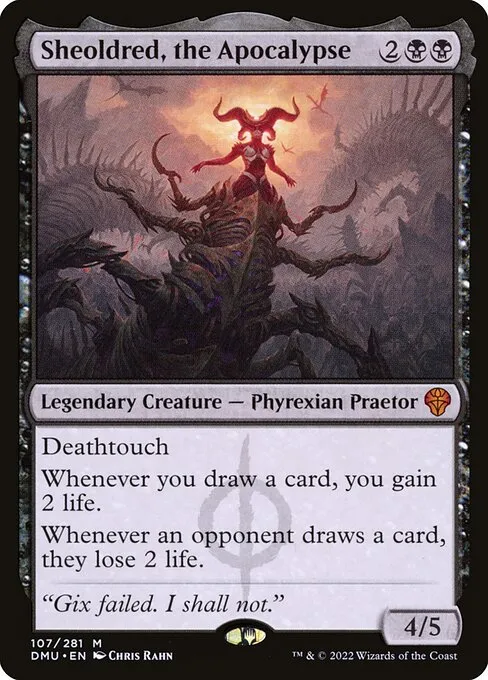
The one that still stings: years ago I let a Dominaria United Sheoldred go for store credit basically at launch, when she was maybe $70 and I’d convinced myself the hype was peaking. She’s around $95 now and somehow keeps climbing. I don’t even play black. I just hate that I read it wrong and acted fast for a few bucks of credit I spent on draft that same night. Holding wouldn’t have killed me. Lesson, sort of, except I’m sure I’ll do it again.
I don’t actually know the “right” amount of margin to leave in a trade, by the way. I don’t think anyone does. It depends on the person, the card, whether you’ll see them again next week. The number isn’t a rule, it’s a feel you build up over a couple hundred trades, most of which you’ll slightly misjudge.
The thing I’d tell newer players is just: know that market, buylist, and trade value are three separate things, and you can’t be talked out of a number you actually understand. Everything else is reps.