A friend brought a Jeweled Lotus to FNM last September and asked me to look at it before he sleeved it. He’d bought it from a guy in a Discord server for $45, which was already a flag. I held it up against my phone flashlight expecting the faint bluish glow that comes through real Magic cardstock, and got nothing. Just a brown rectangle of dead light. He drove home with a $45 piece of cardboard, and I drove home thinking about how much I still trust the light test, which these days is “less than I used to.”
PSA dropped their first-ever fraud report this week. The headline number was $200M in counterfeits intercepted in 2025, with submissions of fake cards jumping 250% as a share of total volume. Pokémon got most of the press because Pokémon is most of PSA’s business now. But MTG made the top 10 most-counterfeited TCG list, and the report had a note that I keep coming back to: a meaningful chunk of fake Magic cards in circulation started life as player proxies for deck testing, then bled into the secondary market when someone offloaded a binder.
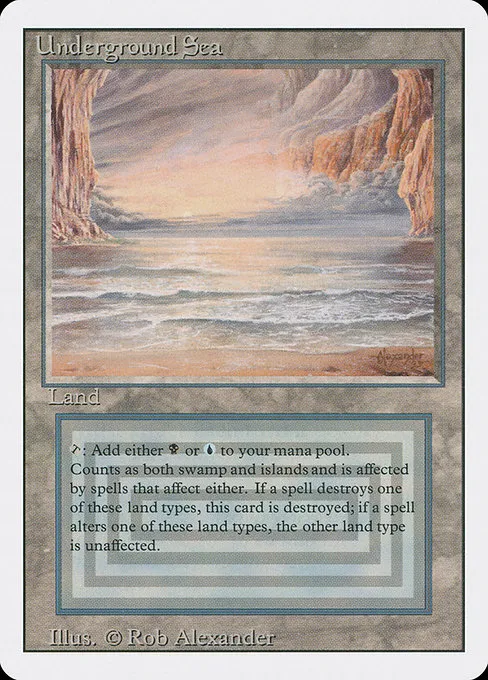
That changes the threat model. It’s not just Chinese mass-produced Underground Seas getting laundered through eBay (though those exist, and at $938 a pop on Revised they’re worth faking). A bigger slice now is the guy at your LGS who bought nice proxies for cube four years ago, lost track of which ones were which, and is selling his binder before a move. He’s not trying to scam you. The card is still fake.
The classic tests, and where they still work
The light test is the cheapest and fastest thing you can do, and it catches most fakes. Hold the card a few centimeters from a phone flashlight. Real cards have a semi-transparent blue inner core, so you’ll see a faint bluish glow through the card. Counterfeits are usually opaque, or the light comes through orange-ish. This is the test I do on every card that costs more than a sandwich.
The bend test is the next one most people mention. Gently bow the card between your fingers, let it spring back, and check for creases. Real Magic cards flex; many proxies crease at the fold or hold a slight curve after. I never do this on a card I’m about to spend three figures on. The official Wizards “Buyer Beware” article from way back when literally tells you not to do it on foils or repeatedly on the same card, because even real cards eventually crack. It’s a real diagnostic that has a way of becoming a self-fulfilling damage assessment if you overdo it.
Then there’s the loupe. Under 30x or 60x magnification, real Magic cards show a rosette pattern of overlapping CMYK dots. Counterfeits often show streaks, solid color blocks, or non-circular dots. The classic green-dot test (look at the green pip on the back; real cards have four red dots in an L-shape inside the yellow ring) is part of this same family. Both still work for cheap proxies. Both are less reliable for the modern stuff. The fake security stamps people were posting on r/mtgfinance back in 2022 (the ones with that telltale “WIZARDS WIZARDS” pattern) have gotten cleaner since, and rebacked cards (where a counterfeiter splits a real card apart and grafts a real back onto a fake front) pass everything in this paragraph by design.
Where I’d put my time in 2026
The catalog match. Compare the card against what Scryfall says actually exists. This sounds obvious. It’s also the thing I see people skip the most.
Things to verify:
- Collector number. Every card has one in the bottom-left corner. If you scan or search a card and the number on yours doesn’t match the printing’s range, you have a wrong card or a fake.
- Set symbol. Color and shine of the holofoil should match the rarity. Proxies often get the rarity tint wrong on the symbol itself.
- Watermark. If a card is supposed to have one (Mirran/Phyrexian on New Phyrexia, college symbols on Strixhaven, faction symbols on a half-dozen others), it should actually be there, and in roughly the right spot. Proxies skip watermarks more often than you’d think.
- Frame era. If someone offers you a “Beta” Underground Sea and the card has rounded corners, modern pinline, or a 2003-onward copyright stamp, walk away. I’d say “run” but I don’t actually run from these encounters, I usually just go vague and leave.
I bought a Mox Diamond off Facebook Marketplace in 2019 for $300 below TCG market. Seller had photos, said his dad died, said he needed to liquidate before the funeral. Card showed up. Passed the light test. Passed the bend test (which in retrospect I shouldn’t have done). Failed the catalog match in the most embarrassing way possible: the collector number font on the bottom was kerned differently than every other Stronghold rare I owned. Compared it side by side to a Scryfall photo and you could see the “55” was wrong. Mox Diamond Stronghold is around $1078 today; back then it was around $650. I paid $350 to learn that the catalog check beats every other test I can do without a microscope.
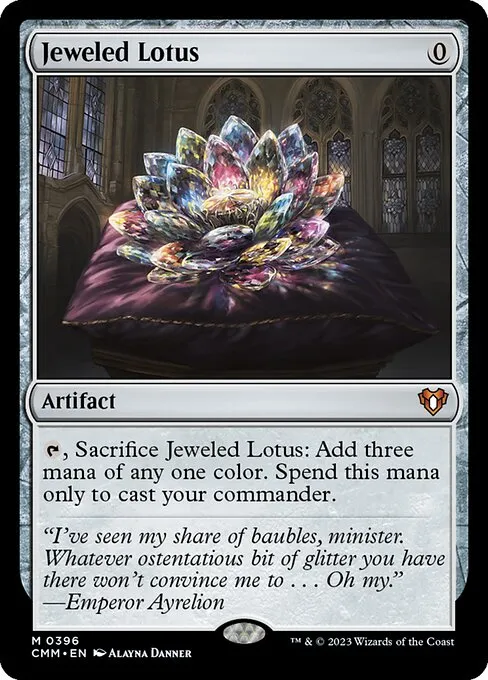
Jeweled Lotus is a good current example because it’s the modern card I see faked most. Original Commander Legends Jeweled Lotus is around $40, the extended art is closer to $75, and the foils get well into three digits. That price band ($40-200, high enough to be worth faking and low enough that you’re not buying it from a dealer) is the danger zone. Anything over $500 is usually moving through enough trust-and-grading filters that the obvious fakes get caught. Anything under $20 isn’t worth a counterfeiter’s time. The cards in the middle are the ones that wander.
The scanning angle
The reason I built Eldwyn around scanning is also the reason a scanner is the laziest counterfeit defense. When the app reads a card and pulls the matching record from Scryfall, you immediately see whether the collector number, set symbol, and frame match a real printing. A proxy with the wrong number stands out the second the app tries to identify it. A proxy with the right number but the wrong set symbol gets identified as a different printing, which is also a flag. It won’t catch a perfect rebacked Underground Sea with the correct number printed on it. Nothing on this list will. But it’ll catch the things that wandered into a stranger’s binder, which is most of what you’ll actually run into.
The scanning workflow also makes a side-by-side easier. If I’m buying anything notable, I’ll scan the card I’m holding, scan a known-real copy of the same printing from my own collection, and compare on the same screen. I do this less for “is it a fake” and more for “is the print run / frame / treatment what I think it is,” but it catches the same things. If you don’t have a same-printing reference card, our post on organizing a rare binder has notes on building one.
Some people swear by a precision scale. Real Magic cards weigh about 1.7-1.8 grams. Proxies on the wrong cardstock can be off by 0.2g or more. I’ve never owned a scale that precise and I’m not buying one for this. But if you’re verifying a four-figure card and you have one in a kitchen drawer, it’s free information.
The honest part
Look, most fakes I’ve actually held in person have been bad. Like, comically bad. The colors are off. The black borders bleed. The cardstock feels like a Cheez-It box. You hand a real Underground Sea and a fake one to a five-year MTG player and they’ll pick the real one out without a magnifier. The genuinely terrifying fakes (the ones that pass the light test, have correct rosettes, and feature the right security stamp) exist, but they’re rare, and they almost always target single high-value purchases, not bulk binders. If you’re inheriting a collection or working through a bulk box you got at an estate sale, the threat is dozens of mediocre proxies, not one masterpiece counterfeit. The detection methods should match that. Most of the time, fast tests on every card beat one slow careful test on the most expensive one.
Actually, I want to walk that back a little. If you’re spending $500+ on a single card from anyone who isn’t a major retailer, you should be doing the slow careful test no matter what your collection looks like. The price band where I’d skip the loupe is the $10-50 trade-night stuff where the time cost of doing a full check is higher than the expected loss from one fake slipping through.
So yeah. Light test, bend test (if you must), loupe, catalog match. Done in that order. The first three together take maybe sixty seconds. The catalog match is the one that catches the new generation. If you’re buying through Card Kingdom, SCG, TCGplayer Direct, or your LGS, you can mostly skip all of it. If you’re buying anywhere else, do at least two of the four.
If you spot a fake after buying, your one real play is to report it through whatever payment processor handled the transaction (PayPal and eBay both have reasonable buyer-protection windows), document everything with timestamps, and never ship the fake back without insurance and tracking. Wizards used to take counterfeit submissions for analysis. They stopped doing that years ago. The current position is basically “don’t buy fakes.” So don’t.