I sold a Sheoldred last year for what I thought was a fair price. Listed it as the regular Dominaria United rare, priced it to move, shipped it the next morning. The buyer messaged me a week later, very politely, to mention I’d actually sent the borderless one and undercharged by about forty bucks. I told him to keep it and not worry about it. Mostly I felt dumb, because the difference was printed right there, on the card, in a spot I’d been ignoring for fifteen years.
That little number under the art. The collector number. It’s the single most useful thing on a modern Magic card if you’re trying to figure out which version you’re holding, and almost nobody reads it.
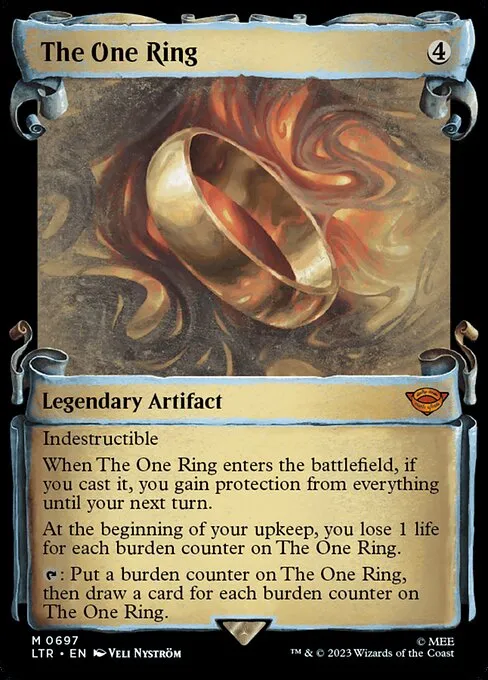
Magic has a card treatments situation now. A feature or a problem, depending on how you feel about your wallet. A single card can exist as a plain version, a borderless version, an extended-art version, a showcase version with a totally different frame, a retro 1997-style frame, and then most of those come in foil and non-foil, and then the foil itself might be traditional or surge or textured or one of a dozen others. The One Ring from the Lord of the Rings set has something like eight or nine distinct printings once you count finishes, and they run from about $100 for the basic one to over $1,200 for a borderless foil.
Up top is the showcase printing, the one with the ornate scroll frame. Here’s the same card as the plain pack version, the one most people actually open:
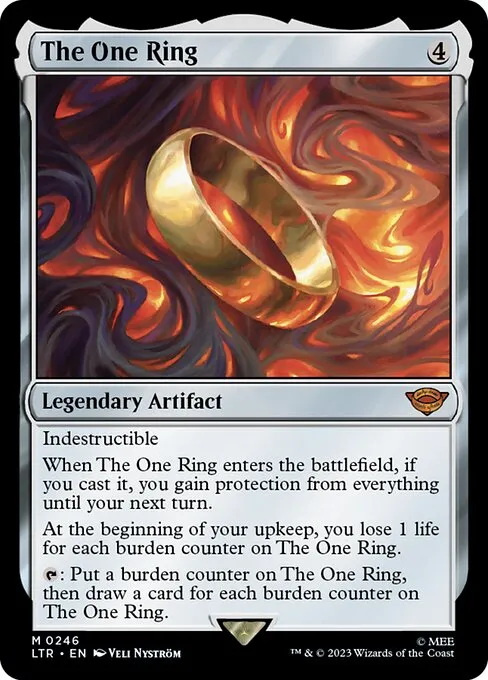
So when you pull a card, or buy a single, or inherit a box, the actual question isn’t “what card is this.” You know what card it is. The question is “which of the seven versions of this card is this,” and that’s the part that decides whether you’re looking at a $3 rare or a $90 chase printing.
The collector number does most of the work
Here’s the thing nobody told me until embarrassingly recently. Cards in the main set get numbered first, roughly in color order: white, then blue, black, red, green, then the multicolored cards, then artifacts and lands. So in a 250-card set, the normal copies you’d open in a draft booster live somewhere in that 1-to-250 range.
Everything fancy gets numbered after that. The borderless versions, the extended-art versions, the showcase frames, the alternate-art ones, they all start counting up from 251 and beyond. Scryfall and the official rules call this “outside set numbering,” which is a clunky name for a genuinely useful rule of thumb: if the number under the art is bigger than the size of the main set, you’re holding a special version.
Extended art is the easy one to picture. Same card, same art, but the picture spills out to the side edges and the frame goes skinny. The number sits up in that high range too, which is how you tell it from the regular when the art alone won’t:
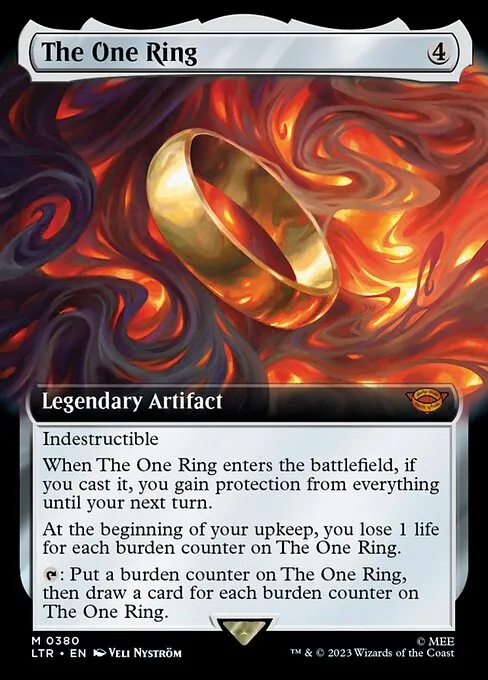
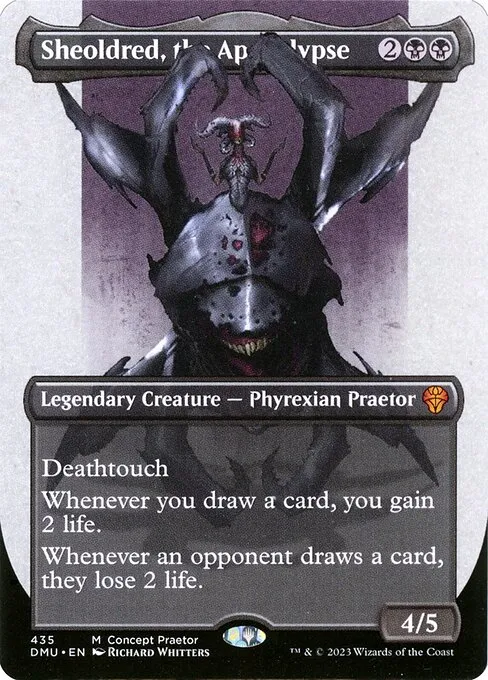
Sheoldred is a clean example. The plain rare is number 107. The borderless Concept Praetor I accidentally shipped is 435. Same card, same name, same text. One number tells you instantly that it came out of the back half of the collector slots, where the good stuff lives.
That trick worked beautifully right up until Wizards changed the numbering format around March of the Machine. They went to four-digit numbers and quietly dropped the old “107/280” fraction that used to tell you how big the set was. Which means the cleanest part of the whole system, the part where the denominator told you exactly where the cutoff was, is just gone now. You have to know the set size some other way, or eyeball it. I’m still annoyed about this. It was the one elegant thing.
A couple more tells that haven’t changed. The expansion symbol’s color is your rarity: black for common, silver for uncommon, gold for rare, that orangey-red for mythic. And foils. A traditional foil shares its collector number with the non-foil, so the number alone won’t tell you it’s foil, you have to look at the card. But foil-etched cards get their own separate number. Old cards from the late 90s used a little star next to the number to mark a premium printing, which is a fun detail to know when you’re digging through someone’s 1999 binder.
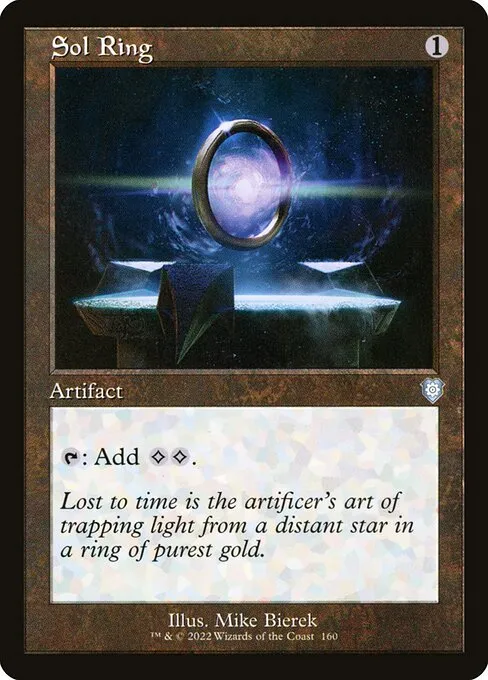
The retro frame is the one treatment you don’t even need the number for. The brown border, the thin serif title, the older layout, it reads as old from across the table, even on a card printed in 2022:
Why card treatments break your collection’s value
Now the part that actually costs people money. Two copies of one card can be priced like they’re from different games.
The One Ring is the poster child. The regular pack version sits around $100. The scroll-frame showcase, the gorgeous one up top, is closer to $270. The extended-art version barely clears the regular, around $115, though its foil jumps past $330. A borderless foil clears $1,200. And the one-of-one serialized copy, the single numbered 1/1 that existed in the entire print run, famously sold to Post Malone for a reported $2 million. Same five-mana artifact. Same indestructible draw engine. The art and the frame are the entire difference in price.
But, and this is the part people get wrong in the other direction, special does not automatically mean more expensive. I want to push back on my own setup here a little. Everyone assumes the fancy frame is worth more, and a lot of the time it just isn’t. Sheoldred’s plain rare is about $95. One of its showcase printings actually trades a hair under that, somewhere below $80, because so many got opened and the demand for that particular frame isn’t there. The borderless runs around $130. So you’ve got three versions of one card spread across a fifty-dollar range, and the “premium” one is the cheap one. If you logged all your Sheoldreds as the borderless because borderless sounds expensive, your collection’s value is now a polite fiction.
This is the whole reason getting the printing right matters for pricing your collection honestly. A spreadsheet that says you own “Sheoldred x3, worth $390” is wrong in both directions if two of them are showcases. The number’s only as good as the printings behind it.
The foils are where I give up
Okay so foils. There are, what, fifteen of them now? Traditional rainbow foil, the normal one. Surge foil, which is shinier and has this varnish to it. Textured foil, where you can feel raised lines in the art, started in Double Masters 2022. Etched foil, the grainy metallic-paint one from Commander Legends that they used all over the Mystical Archive. Then halo, step-and-compleat with the little Phyrexian symbols stamped across it, gilded, galaxy from Unfinity that looks exactly like an old Pokémon card, confetti, fracture, invisible ink with the hidden text. I’m definitely forgetting some. I always forget some.
Honestly, I can’t reliably name a foil by looking at it anymore, and I’ve been doing this a long time. Surge and traditional I can usually call. Textured you can feel with a fingernail. Past that I’m checking Scryfall like everyone else. A flat scan barely shows the shimmer anyway, so even if I dropped a foil photo in here it wouldn’t tell you much.
What matters for your binder isn’t memorizing the catalog. It’s two things. One, foil and non-foil are different prices, often by a lot, and a special foil treatment can be its own price tier on top of that. Two, foils curl and warp in a way the cardboard versions never do, so the expensive printing is also the fragile one. Great combination.
The really sneaky case is when the art is identical across printings and only the frame edge or the finish changes. That’s where I’ve watched people, myself included, confidently misidentify a card. It’s also why printing tells double as counterfeit tells, since the people faking cards rarely get the finish exactly right.
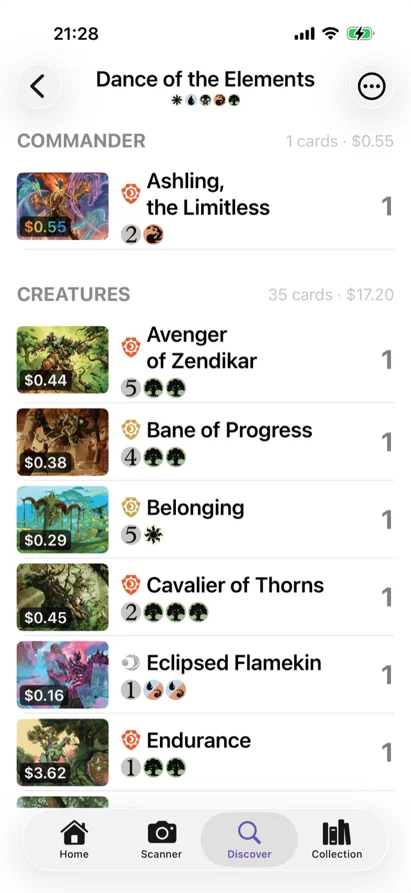
When I’m cataloging a box, the move I’ve settled into is to scan first and read the collector number second, before I trust whatever the recognition guessed. Card scanners are good at reading the name and the art. They are not always good at telling a borderless from a regular when the art is the same, which is its own whole headache with foils and alternate arts. So I scan, then I glance at that number under the art, then I fix the printing if it’s wrong. Takes two extra seconds per card and it’s saved me from a few more forty-dollar apologies.
Do you need to do this for your bulk commons? God, no. The vast majority of your collection is cards where the printing is the printing and nobody will ever care. It’s a small slice, the chase mythics and the borderless staples and the foils, where reading the number is the difference between knowing what you own and guessing. But that small slice is usually most of the dollar value sitting in the box, so it’s the slice worth slowing down on. The rest you can rip through.
I still think about that Sheoldred sometimes. Forty bucks isn’t much. But the buyer knew exactly what he’d received the second he opened the envelope, because he’d bothered to learn the one thing I hadn’t.