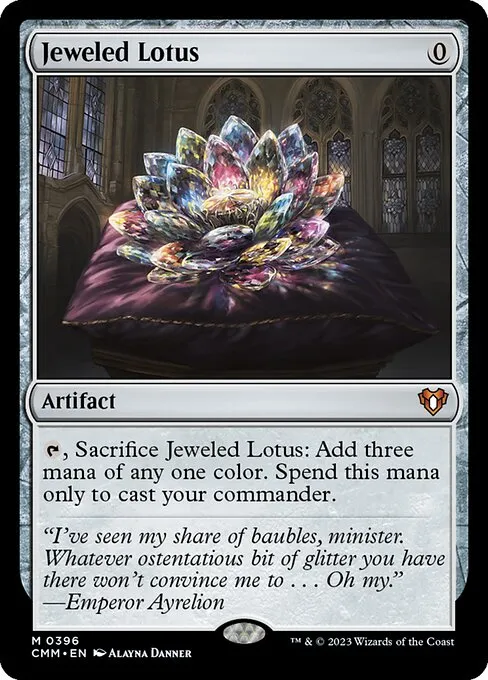
I pulled a foil Jeweled Lotus from a Commander Legends Collector pack five years ago, set it on my playmat, walked away to grab a drink, and came back to a Pringle. Not a full Pringle yet, but trending hard. By the next morning it had a clear arch from edge to edge, front side bowed up, foil layer on top, you could rock it on a flat table.
That’s how every MTG player learns about foil curling. Open something expensive, leave it out, look back, panic.
The good news is the physics are well understood, the fix is reversible if you catch it early, and most of the prevention is cheaper than a single Codex Bundle. The bad news is that almost every guide online is wrong about which direction your humidity should go, which is why some of you have been making your collection worse for years without realising.
How MTG foils actually curl
A foil MTG card is three layers stacked: a Mylar foil sheet up front, a glue layer in the middle, and a normal cardboard back. Wizards prints them in a controlled environment where the cardboard’s moisture content sits somewhere around 60-65%. The glue cures, the foil bonds, the card leaves the factory flat.
Then it ends up in your house. Your house is not the printing facility.
The Mylar foil layer doesn’t expand or contract. The cardboard layer absorbs and releases moisture all the time. So when the room dries out, say you have forced-air heating running through January or you live somewhere desert-adjacent, the cardboard fibres shrink. The foil doesn’t. The cardboard pulls itself smaller against an unmoving Mylar sheet, and the card arches with the foil on the outside of the curve. Foil-side convex, cardboard-side concave. People call this “arching.”
The opposite happens when humidity gets too high. Cardboard swells, Mylar stays the same size, card cups the other way. Foil-side concave. People call this “cupping” or, less politely, “potato chip.”
The default fix that most early forum advice gave was “throw a silica gel packet in your deck box, dry the cards out, and they’ll go flat.” This is the wrong direction for most people. If your house gets dry in winter and your foils are arching, dropping them into a desiccant chamber will make them shrink even further from their printed-flat state. They’ll arch even harder. SaffronOlive’s Tawnos’s Toolbox piece on MTG Goldfish documented exactly this. Cards left in silica went fully arched in twelve hours.
You don’t want a dry chamber. You want a chamber that matches the card’s printed humidity, which sits roughly between 55% and 72% depending on the set.
Reading the curl direction
Before you do anything, look at the card edge-on. Is the foil side bulging outward, or is it dipping inward?
If the foil bulges out (the card looks like a shallow dome with the foil on top), the cardboard has lost moisture relative to where it was printed. The fix is rehydration.
If the foil dips inward (the card looks like a soup spoon with the foil at the bottom), the cardboard has gained moisture. The fix is dehydration.
The two require opposite interventions, and you can absolutely make a curl worse by guessing wrong. Spend ten seconds looking before you act.
The hydration chamber
For arched cards, this is the technique that actually works. You’ll need a clear plastic Tupperware container, a paper towel, and a small platform that won’t get soggy. I use the upside-down plastic lid from a pencil case. Cupcake liners or a small upside-down dish work too.
Lightly damp the paper towel. Not soaking. Damp. Lay it on the bottom of the container. Put the platform on top of the towel so the platform sits dry. Place the curled card foil-side up on the platform, close the lid, walk away for thirty minutes. Check. If it looks slightly wavy and softer in shape, that’s the sweet spot. If it’s still rigidly arched, give it another thirty.
What you want is to overshoot. A card that comes out perfectly flat from the chamber will dry out again and re-arch within a day. A card that comes out faintly cupped, slightly past flat in the other direction, has the right amount of moisture to settle into flat as it acclimates.
Once it looks right, take it out, slip it into a sleeve, and press it under a heavy book overnight. In the morning it should be playable-flat. If it overshot and is now noticeably cupped, leave it sleeved on a desk in normal air for a day and it’ll come back.
Don’t ever try this with an iron or a hairdryer. The Mylar can delaminate and once it does there’s nothing to fix. I know somebody at my LGS who put a Modern Horizons 2 foil Ragavan under a clothes iron set to wool. The foil layer separated from the cardboard and bubbled. The card stopped existing as a card and started existing as a piece of art project.
Sleeves are a delay, not a solution
The same Tawnos’s Toolbox experiment double-sleeved foils with Eclipse Matte outer sleeves and KMC Perfect Fit inners, then dropped them into pure desiccant. The double-sleeved cards held up flat for about two weeks. After two weeks, the moisture had equalised through the sleeve plastic anyway, and the cards started arching just like the bare ones.
If you live somewhere humid or somewhere dry, sleeves don’t save your foils. They slow the curl rate. Whatever the ambient humidity of your house is, given enough time, your sleeved foils are going to drift toward it.
I want to walk that back a little, because there’s a real argument that for cards you actually shuffle and use, double-sleeving is doing other work. It’s protecting against shuffle wear, sweat from your hands, the binder pocket pulling on the corners. The “sleeves stop curling” thing is a myth. The “sleeves are useless” take is also a myth. They’re protecting against a different category of damage.
For long-term storage of cards you don’t touch, the actual answer is humidity-controlled deck boxes.
The two-way humidity pack trick
Cigar humidors solved this problem decades ago with two-way humidity packs. They’re little square pouches with a saturated salt solution that maintains a target relative humidity inside whatever sealed container you put them in. Boveda, Integra, et cetera. They cost about a dollar each and last several months.
For MTG foils, the consensus working range is 55% to 72%. Tawnos’s experiment landed on 62% as the goldilocks middle for a mixed collection, with 55% slightly under-hydrating and 72% slightly over. If you live somewhere persistently dry, a 62% pack in a sealed deck box keeps cards stable. If you live somewhere persistently humid, 55% will work fine. If you’re in a stable climate, anywhere in the range is fine and the difference between 62% and 65% is invisible to the naked eye.
Some practical bits. The pack needs to be in something close to airtight. A regular plastic deck box is OK, a cardboard fat pack box isn’t. The pack works whether it’s at the edge or middle of the box. One pack handles roughly a thousand sleeved cards. When the pack feels rock-hard or completely brittle it’s done, replace it.
The set-by-set thing nobody talks about
Different sets curl at different rates because they were printed at different ambient humidities at different facilities at different times of year. Commander Legends is the famous offender. I have foils from that set that came out of the pack already faintly arched. They were not flat at the printer’s loading dock. Newer Collector Booster runs have been better but not consistent.
So your collection is going to have some sets that fight whatever humidity pack you picked, some that stabilise immediately. You’ll never get every foil in every set perfectly flat at the same humidity setting. That’s just how it is. Pick a target, get most of them flat, learn to live with the one CMR Mana Drain that wants to arch a little no matter what you do.
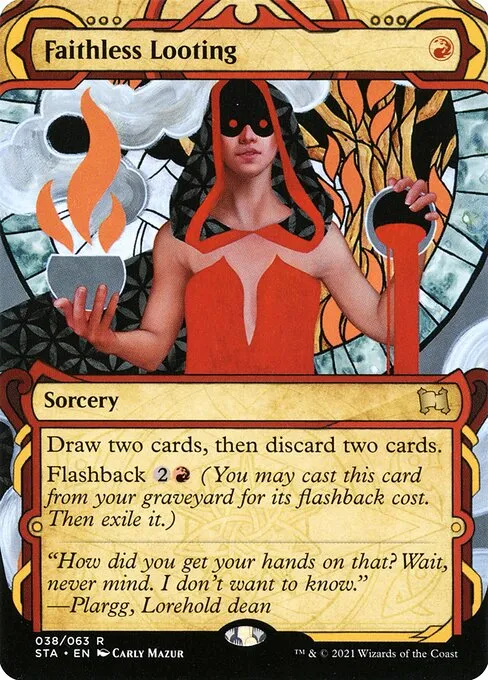
I keep my Strixhaven Mystical Archive foils in a 62% box and the Faithless Looting in there is dead flat. The Mana Drain in the same box still has a faint arch. Different facility, different time of year, different end state.
What this changes about your collection
So yeah, foils. Storage. The whole thing. You’ve probably been doing it kind of half-right for years and the cards have mostly survived. They will continue to mostly survive even if you do nothing.
But if you have a few cards in your binder that you actually care about, a foil Mana Drain at $50, a foil Jeweled Lotus at $90, a Lord of the Rings Bundle The One Ring you’d be sad to lose, the move is one humidity pack in one sealed box. Twelve dollars. Done. You’re better off than 95% of paper-Magic players.
When you’re auditing what’s worth protecting at that level, scan and price the collection first so you know which cards matter. Then decide which ones go in sleeves, which in toploaders, which in slabs, and which just live in a long box. Foils that matter, into the humidity-controlled box. Bulk foils, into whatever, they’re probably fine.
The cards I’m most paranoid about, I scan them in before they go into the humidity box, because if anything ever happens (a moved-out roommate, a flood, a fire) at least I know the printing, the set code, and what it was worth the day I last looked. Half of why I started using a scanner app was after losing track of a foil Sneak Attack from Urza’s Saga at a draft night in 2009 at a store in Cambridge that doesn’t exist anymore. I’d be lying if I said I remember the box it came out of. I’d be telling the truth if I said I remember exactly the kid I think took it.
Anyway. Damp paper towel, raised platform, thirty minutes, sleeve, book overnight. Try it on a bulk common foil first.