There’s a Phyrexian-language Lukka in my trade binder that I paid fourteen dollars for at a Phyrexia: All Will Be One release event, because it looked like something out of a body horror film and I’d decided in roughly nine seconds that weird script meant scarcity and scarcity meant money. It’s worth fifty-two cents now. I’ve left it in the binder on purpose so I have to look at it every time I flip past R.
So I’ve been staring at the Hobbit Dwarvish language cards for about a week with that card in mind.
Five mythics, all runes
The Hobbit Eternal is the eternal-legal companion set arriving with The Hobbit on August 14. Buried in it are five cards transliterated into Dwarvish, and Wizards means transliterated literally. Name, type line, rules text, all of it in Cirth runes. They’re Collector Booster exclusives, non-foil and traditional foil only, no surge foil. And they’re always in Dwarvish regardless of what language pack you open, which I find genuinely funny.
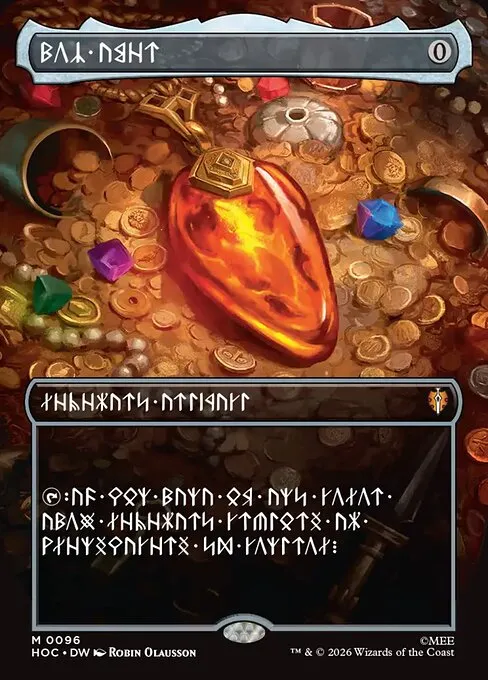
The five, by collector number: #93 Dwarven Warriors, #94 The Reaver Cleaver, #95 Arcane Signet, #96 Mox Amber, #97 Treasure Vault.
Preorders as I write this: Mox Amber at $299.99. Dwarven Warriors at $75.00. Arcane Signet at $54.93 non-foil, $79.99 in traditional foil. The Reaver Cleaver and Treasure Vault haven’t got a settled number yet, which happens with the low-supply stuff until enough copies list.
Now hold those next to what the same cards cost in a normal frame. Arcane Signet has been printed in essentially every Commander precon ever made and runs somewhere between $0.33 and $0.64 depending on which 2026 deck you pull it from. So the Dwarvish one is preordering at about 120 times the cost of the identical card in English. Dwarven Warriors is a 1993 common that has been bulk for three decades: $0.16 in Fourth Edition, $0.20 in Revised, $0.84 in Unlimited. Even the Alpha printing is only $27.47. The Hobbit version is preordering at nearly three times an Alpha card.
None of the five have an English printing in the set, either. If you want a Hobbit Eternal Mox Amber, the runes are the only option.
Does the script hold value on its own
Magic has run this experiment before and the results are not flattering.
There are 49 Phyrexian-language printings across Phyrexia: All Will Be One, Secret Lairs, and a scattering of individual cards going back to Kaldheim. Sort them by price and the bottom of the list is a graveyard. Nahiri, the Unforgiving in Phyrexian sits at $0.40. Lukka, Bound to Ruin at $0.52, which is my binder. Tamiyo, Compleated Sage, $0.76. Ajani, Sleeper Agent, $0.93. These were splashy Collector Booster treatments on a brand-new mechanic and a beloved villain faction, and four of them are cheaper than a booster pack sleeve.
The Phyrexian cards that did hold are the ones where the card underneath was already good, and even then the script didn’t add anything. Sheoldred, the Apocalypse in Phyrexian is $73.15. The plain English Dominaria United printing is $97.93. The runes version is the cheap way to own her. Elesh Norn, Mother of Machines at $23.28 is the closest thing to a genuine premium anywhere in the group.
Then there’s the counterexample that ruins my tidy argument. The Elvish Sol Rings from Tales of Middle-earth Commander are at $1,657.63, $557.71, and $462.52 across their three collector numbers, against a plain English Sol Ring from the same set at $2.29. That is a real, enormous, alt-script premium that has held for three years.
I went back and forth on this for a while. The obvious read is that the Elvish Sol Rings were vanishingly rare and Sol Ring is the most universally played card in Commander, so it’s scarcity times demand and the runes are decoration. Which is probably right. But three years is a long time for pure decoration to hold four figures, and I don’t have a clean explanation for why the Elvish ones stuck while the Phyrexian planeswalkers cratered. Maybe Tolkien script reads as prestige and Phyrexian reads as a gimmick. Maybe LTR buyers were just wealthier. I genuinely don’t know.
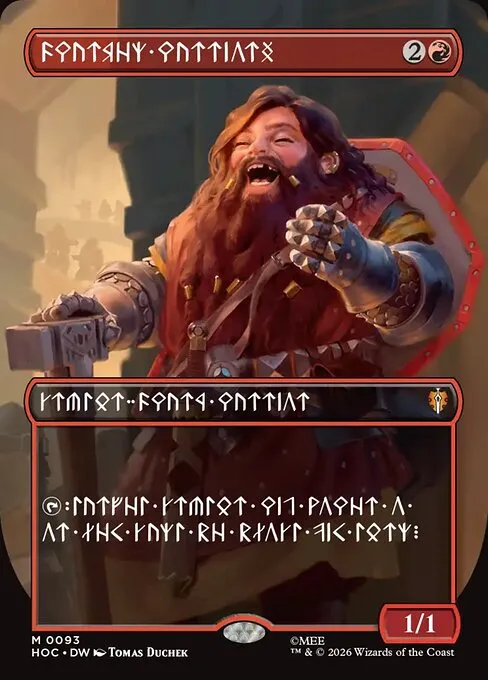
Applying that to the five: Mox Amber is a real Legacy and Commander card with actual demand, and I’d guess its Dwarvish printing holds most of what it’s asking. Arcane Signet is in every deck in the format but it’s also the single most reprinted artifact in Magic, and $54.93 for a card people own forty copies of is asking the runes to do a lot of work. Dwarven Warriors at $75 is the one I’d stay away from entirely. It’s a functionless 1993 common whose entire case is that it’s a Dwarf in a Dwarf set.
Pull rates, since they matter for supply. A Collector Booster has two non-foil Booster Fun slots at 1.5% each for a Dwarvish card, plus a foil slot at 1.6%. That’s about 4.5% per pack, so roughly one Dwarvish card every 22 packs, and about one specific card every 110. A twelve-pack Collector Booster box averages a bit over half a Dwarvish card, and something like 57% of boxes will contain zero. The Collector-Booster-only distribution is doing most of the pricing here.
You cannot read these, so read the bottom instead
Here’s the part that made me want to write about this at all rather than just noting the preorder numbers.
The card has no English on it. None. The name is runes, the type line is runes, the rules text is runes. If you hand a Dwarvish Mox Amber to someone at a Commander table they have no way to know what it does, and if you photograph it, any text-based recognition has nothing to grab. Foils at least fail for a reason you can fix by tilting the card. This fails because the words aren’t there.
What is there, in Latin characters, is the bottom left corner. On the Mox Amber it reads M 0096 and underneath that HOC · DW. Rarity, collector number, set code, and a language code of DW. That’s the whole identity of the card in eleven characters, and it’s the only part of the frame you can actually use. I wrote a longer piece on reading the bottom of a card a while back and this is the most extreme case I’ve come across.
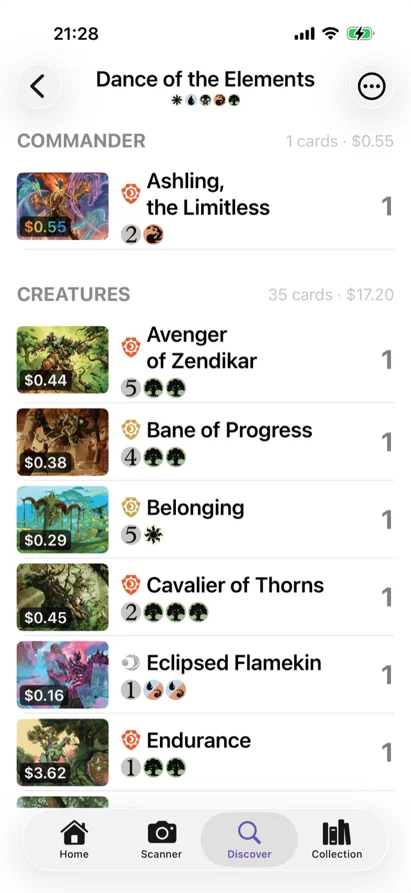
Practically, if one of these lands in your box, log it by collector number and check that whatever you logged it into recorded HOC and not some other printing of Arcane Signet. That’s the failure mode. You scan a card, the app matches the art, and you end up with a fifty-cent precon Signet in your collection total instead of a fifty-five dollar one. I’ve had this happen with foreign-language printings more than once, where the art is identical across the English and the Japanese and only the set code tells them apart.
So yeah. Five cards. Runes. You can’t read them, the app might not either, and the collector number is doing all the work. Log them carefully, is what I’m saying.
The other thing nobody’s mentioned yet, and I’m not sure it matters, is that these are legal in Commander and Legacy. Someone is going to sleeve up a Dwarvish Mox Amber and play it at a table, and their opponents are going to have to take their word for what it says. Judges will presumably have a ruling on this. I’d love to be at that table.
If you’re chasing one, my order would be Mox Amber, then Reaver Cleaver once it prices, then nothing. The Signet and the Warriors are both asking you to pay a premium for novelty on cards that are otherwise worthless, and I’ve already run that experiment personally for fourteen dollars.