I once watched two grown men argue for a solid fifteen minutes over whether a Time Vault could untap normally. Garage, Vintage proxy night, somebody’s space heater doing nothing against a Michigan February. One guy had the card in front of him and read it out loud like scripture. The other guy had a printout from his phone and kept saying “that’s not what it does anymore.” He was right. The card on the table was lying, sort of, and the printout was the truth.
That gap between what a card says and what a card does has a name, and it’s about to matter for a brand new card a lot of you are going to open.
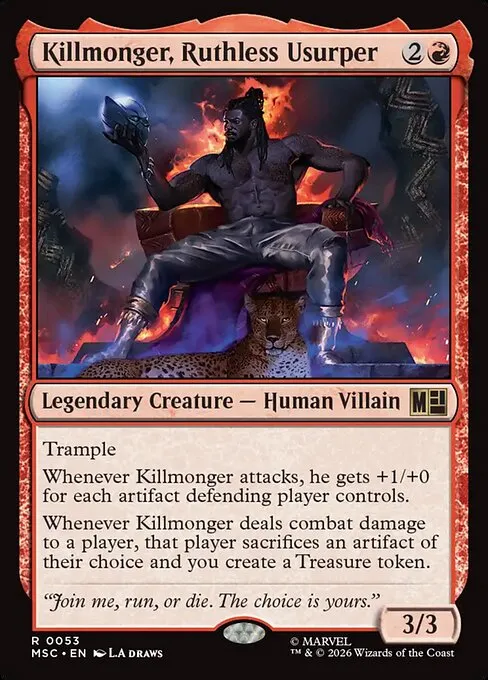
Killmonger, Ruthless Usurper got previewed in the Doom Prevails Commander deck for Marvel Super Heroes, and players caught a problem almost immediately. His attack ability reads “Whenever Killmonger attacks, he gets +1/+0 for each artifact defending player controls.” Which, as printed, never turns off. The buff would just sit there forever, re-checking the artifact count every time anybody looks at it. Mark Rosewater confirmed on Blogatog that the card needs “until end of turn” tacked onto the end, and that the errata lands when the set releases on June 26. So the physical cards are going to ship with the shorter, wrong sentence, and the official text is going to say something else.
Naturally the first question in three different group chats I’m in was some version of: is the misprinted one worth more?
No. And the reason why is worth understanding, because people mix up two completely different things and it costs them money in both directions.
The card you own didn’t change
Here’s the part that trips people up. The words printed on a Magic card are not the rules of that card. They’re a snapshot. The actual rules live in something called the Oracle text, which is a database Wizards maintains, and the Oracle text is what governs at a table, in a tournament, on Arena, everywhere. When a judge rules on your card, they’re not reading your card. They’re reading the Oracle entry for it.
Errata is just Wizards updating that database. Every single Killmonger ever printed, foil or nonfoil, Collector’s Edition surge foil or the plain Commander deck copy, points at the same corrected Oracle text the moment it’s published. There’s no “error version” sitting in some binders and a “fixed version” in others. The fix is digital. It applies to all of them at once, retroactively, for free.
So your copy is exactly as playable, exactly as legal, and exactly as valuable as it would’ve been if the card had been printed correctly the first time. Nothing physical distinguishes a “pre-errata” Killmonger from a “post-errata” one, because they’re the same piece of cardboard. The only thing that moved was a line in a spreadsheet you’ll never see unless you go looking on Gatherer or Scryfall.
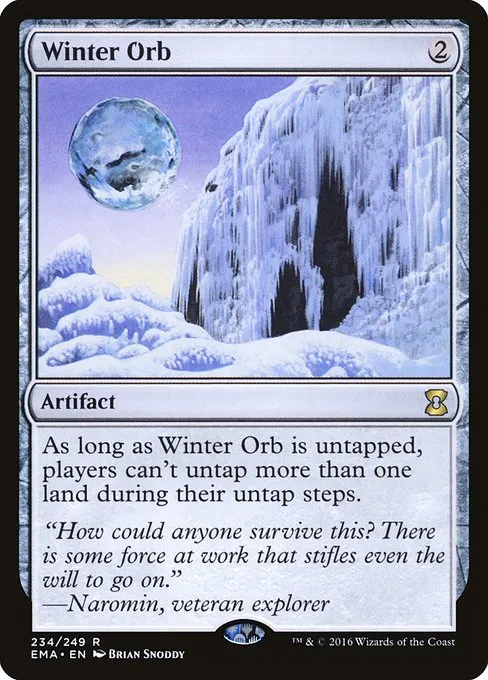
This is older than most of us realize. Winter Orb spent years with errata that made it read “if Winter Orb is untapped,” which let you tap it down to turn it off, a whole interaction the original card never intended. Then Wizards reversed course, undid the functional errata, and Winter Orb went back to its original meaning. Same cards in everybody’s collection the entire time. The Eternal Masters reprint sits around sixteen bucks today and nobody’s paying a premium or taking a discount based on which era of errata it lived through. Time Vault got re-errata’d so many times it’s basically a running joke, and it’s still one of the most expensive cards in the game for reasons that have nothing to do with its text being a moving target.
Errata is not a misprint, and that’s the whole ballgame
This is where the money actually is, and where people get it backwards.
A misprint is a physical anomaly. The card came off the press wrong. Miscut so the border’s off-center, the wrong mana symbol, a foiling process that smeared, a holo stamp that landed in the wrong spot. Those can absolutely be worth more, sometimes a lot more, because they’re scarce and weird and collectors of that niche will chase them. I wrote a whole thing about the Strixhaven Star Wars holo stamp misprint for exactly this reason. The defect is the product. Scarcity does the rest.
Errata is the opposite of scarce. It’s a text correction that hits every copy equally. There’s nothing rare about a card whose Oracle text got tidied up, because all of them got tidied up. You can’t sell “the errata version” because there is no version. That’s the distinction that matters, and it’s the one I see flubbed constantly on marketplaces, where somebody lists a perfectly normal card as a “rare error printing” because they read a headline about errata and assumed it meant their card was special.
There’s a fun edge case here that complicates my tidy little rule, and I’d be lying if I pretended it didn’t. Sometimes a printing error is bad enough that Wizards both issues errata and prints a physically corrected version later. Now you genuinely have two different objects: the original flawed run and the fixed reprint. The Secret Lair Circular Logic that came out as a sorcery instead of an instant is the recent poster child. It got an errata note saying yes, it’s still an instant, play it like one. But because that one’s a physical goof baked into a specific limited drop, the original could carry a curiosity premium that pure errata never would. So is it the errata driving value there? Not really. It’s the misprint. The errata’s just the paperwork stapled to it.
Killmonger isn’t that. Killmonger is a text omission getting patched in the database before the card even hits shelves. Every copy’s identical. Move along.
What this means when you’re actually pricing your stuff
So, practically. You pulled a Killmonger, or you bought the Doom Prevails deck, or you’re staring at a binder wondering if some card you own quietly got errata’d at some point and whether you’ve been undervaluing it. Couple of things.
One, the printed text on the card is not how you price it and not how you play it. If you want to know what a card actually does, check the Oracle text. When I scan something into Eldwyn, the entry it pulls is the current Oracle version with the current market price attached, so I’m not sitting there trying to remember whether some twenty-year-old enchantment got reworded in 2008. The cardboard is the cardboard. The rules are the database. Keep those separate in your head.
Two, when you’re valuing a card, the question is never “did this get errata.” It’s “is there anything physically unusual about this specific copy.” Off-center cut, wrong back, a stamp where it shouldn’t be, a genuine printing flaw. That’s the lottery ticket. A clean card with updated Oracle text is just a clean card. Knowing how to read what’s actually on the bottom of the frame, the set code and collector number and finish, tells you ten times more about value than any errata announcement ever will.
And three, don’t let the word “error” in a listing do your thinking for you. Same energy as the people who think every slightly-off card is a six-figure misprint or every weird foil is a counterfeit. Most errata is boring housekeeping. The one in maybe a thousand that overlaps with a real physical misprint is the one worth getting excited about, and that excitement comes from the printing, not the text fix.
Look, I get the instinct. New card, immediate “mistake,” your brain goes straight to is mine the special one. It almost never is. The Killmongers are all going to be the same Killmonger, worth whatever Doom Prevails singles settle at once the set’s actually out and people stop preordering on hype. The errata changes nothing about that. It just means the version on your phone reads correctly and the version in your hand reads short, and at the table, the phone wins.
I do sort of love that the card’s going to be physically wrong forever, though. Decades from now somebody’s going to pull a Killmonger out of a bulk box, read it literally, and build a deck around a buff that never ends. And technically, holding only the cardboard, they’ll have every reason to think they’re right.