There’s a column I keep in the corner of my desk: a stack of about twenty-five Strixhaven cards I pulled from a Collector Booster box three weeks ago, sleeved into top-loaders, and have been meaning to triage ever since. Some of them are worth real money. Some of them were worth real money in late April and aren’t anymore. I haven’t checked which is which.
Marvel Super Heroes drops June 26. That’s just over six weeks out, not a long time, but it’s the discrete moment when whatever Strixhaven cards I haven’t sorted yet stop being “the new thing” and start being “the previous set, now competing for shelf space with a giant Universes Beyond release.” Whatever I plan to do with those top-loaders, I’d rather do it before then.
The MTG collection audit I run before each set is short. I tried doing the full pre-set checklist a couple of years ago (count sleeves, check storage capacity, sort by color, the works) and I quit halfway through every time. So now I do three things, and I skip the rest.
What the calendar actually does to prices
The new set drops the floor on the old set, but not for the reason you think. It’s not that supply spikes. Strixhaven supply doesn’t suddenly increase the day Marvel releases. It’s attention. The MTGGoldfish front page changes. The Pro Tour format moves on. EDHREC’s “new” section flips to Marvel. Local trade activity shifts. The card you wanted to move at $14 in May is the card sitting at $9 in mid-July with no tailwind.
Marvel is also a Universes Beyond release, and Universes Beyond does something specific to in-Magic-IP sets that came right before it: it pulls the casual buying audience away. The people who’d normally pick up a Strixhaven Collector Booster at the LGS counter on a Saturday are buying Spider-Man instead. Strixhaven precons sit on shelves a little longer than they otherwise would. Demand for Strixhaven singles outside of competitive play softens.
I can argue against my own thesis here. None of that’s really new — every set replaces the previous one in the spotlight, that’s just how the calendar works. What makes a Marvel-shaped event different from, say, a Lorwyn-to-Strixhaven handoff is that crossover sets pull harder. They drag in lapsed players, casual buyers, MCU fans who haven’t bought a pack since War of the Spark. Bigger event, bigger gravity well.
The three things I actually do
Snapshot the current price of the cards I might sell. Not all of them. Just the ones over $5 that I’ve already mentally flagged as “I don’t think this is going to hold.” For me right now that’s seven Strixhaven cards and a couple of Lorwyn Eclipsed leftovers. I scan them, write down the market price, and move on. The point isn’t to act on it, it’s to have a reference point for whether I should kick myself in three months. If you’ve never written down a real number for your collection, even just for the chase rares, this is a low-effort starting point.

Reconcile the decks I’m actually playing. Pull every deck off the shelf I haven’t sleeved up in two months. If a card in one of those decks is also in my “might sell” pile, decision time. Usually I keep the playable copy and sell the spare. Sometimes I realize a deck I haven’t played in eight months is hostage-holding $80 worth of cards I’d rather have as cash. Last month I broke up a Korvold deck that had been sitting in my Commander rack since March 2024, and that was about $40 of mana base I forgot I had.
Make the buy list before I see Marvel previews. This is the one most people skip. Once Marvel spoiler season starts in earnest, I will not have clear judgement about my own collection. The Mind Stone was already revealed last week and that’s just the appetizer. Everyone wants the new shiny. So before that brain rot kicks in, I write down: here’s what I actually need for decks I’m building, here’s the budget, here’s what I’d buy if a card on my list happened to spike a little. Then when Marvel hits and I’m chasing Infinity Stones, I can look at the list and remember Past Me was being more sensible.
When this kind of audit pays off, and when it doesn’t
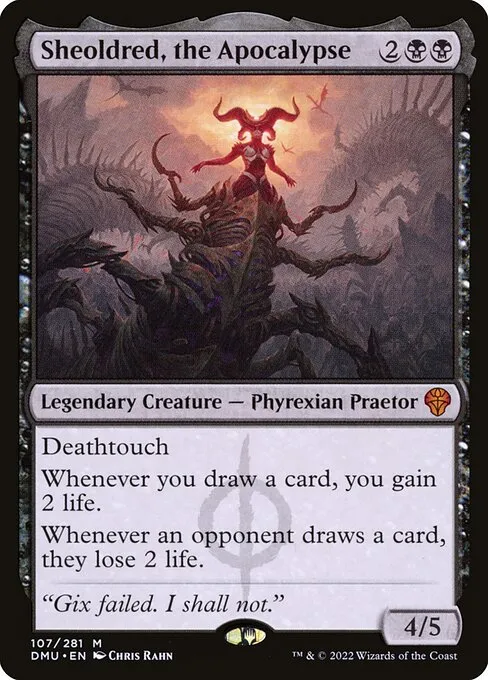
Last summer I had three copies of Sheoldred, the Apocalypse sitting in a deck I wasn’t playing, decided not to sell them before the rotation churn, and they’re worth roughly what they were a year ago. The audit didn’t make me right; it just gave me a reference point for the decision. The summer before that I had a playset of Wedding Announcement going into Crimson Vow’s rotation window, fully aware of the price, fully aware it was probably going to drop, and watched it drop anyway. Same audit, same data, different outcome. The audit doesn’t pick the move. It just makes sure you know what you’re choosing.
So yeah. Sometimes I run the audit, the audit gives me good information, and I ignore it. The audit isn’t a crystal ball. It’s the part where you check the receipts before you decide.

Things I deliberately don’t audit
Sleeves. Storage. The bulk commons bin. The dollar rares. The white box of “stuff I’m keeping for sentimental reasons” that includes my first Counterspell from sixth grade. None of that needs to happen before Marvel. None of it changes value because of the new set’s release. The dollar rares didn’t get cheaper because Marvel exists, and the bulk commons aren’t suddenly worth listing.
I also don’t audit my draft chaff. There’s a plastic box on top of my closet with every common from every Strixhaven draft I’ve done since launch, and it’s going to keep being that exact box on June 27. Auditing it would be self-care theater.
The one thing I almost added to the audit and decided not to: sleeve condition. There’s an argument for catching warped cards in playables before you sell them, sure. But sleeve audits balloon. You start with twenty cards and end up resleeving an entire deck because you “might as well.” Two hours later you’ve done one of nine things you meant to do that day. Skip it. If you do have foils that are misbehaving, there’s a separate fix for that and it’s a different evening’s project.
The Marvel-specific thing
Six Infinity Stones across the headliner slot, with the Cosmic Foil treatment exclusive to Collector Boosters, is going to do weird things to Marvel CB pricing in the first weeks. People are going to chase Stones. The non-Stone mythics, the actual hero cards, the supporting roster, may end up underpriced for the first month relative to where they settle a quarter later.
That’s a Marvel-side observation, not really an audit step. But it does affect my own collection in one specific way. If I have non-staple Strixhaven CB mythics gathering dust, the time to move them is before the Marvel CB conversation starts dominating finance feeds, which will probably be the last week of May, not the week of release. By release week the chase is already on and casual buyers will be reading about Stones, not browsing Strixhaven listings.
What this looks like for me, specifically
This weekend I’ll scan the top-loader column plus the Lorwyn Eclipsed leftovers I still haven’t dealt with from when I wrote the three-month retrospective. Set baseline prices. Pick three or four cards I want to move. Post them on TCGplayer with patient pricing and let them sit. If they sell by mid-June, great. If not, I eat the holding cost and revisit in August.
The buy list I haven’t made yet. I think it’s mostly going to be replacements for cards I’m reluctantly trading away — a fetchland I never sleeved, two copies of Bloom Tender I keep meaning to swap into an elf deck. And probably a board wipe or two for the Korvold deck I’m rebuilding from spare parts.
If you play mostly Commander, a lot of this audit collapses. Commander cards don’t care about set release pressure, except for reprint risk, and Marvel is original IP so the reprint pressure on Magic-original cards is essentially zero. Building a deck from what you already own sidesteps the whole pre-set scramble.
Audit. Six weeks. Three steps. Skip the rest. The fourth-step temptation is always there (sort by mana value, log everything in a spreadsheet, color-code your binder) but I’ve never finished one of those and I’m not going to start now.