I’ve cracked enough Secret Lair envelopes to know what’s supposed to be inside. Four foiled-up cards, sometimes a token, a sticker if the drop’s having a good day. The format is the format. You order it for the alt art, you tell yourself the value will hold, and then six months later you find the box in your closet still half-sealed because life got in the way.
So when EDHREC posted on April 29 about a TikTok video of someone pulling an actual printing plate from the current Secret Lair Superdrop, my first reaction was “that’s not a thing.” Because as far as I knew, MTG printing plates had never, not once, shown up in a sealed retail product. They’ve always lived in a totally separate channel, auctioned by Wizards, handed to artists, given out at convention raffles. They don’t sit in envelopes you order online for thirty bucks.
But there it was.

What a Secret Lair printing plate actually is
If you’ve never thought about how a Magic card gets printed, here’s the short version. Cards are printed using the CMYK process, the same four-color offset method that makes grocery store circulars and comic books. Cyan, magenta, yellow, and a black plate (the “key,” which is where the K in CMYK comes from). Every Magic card that ever entered a print run has four physical metal plates associated with it, one per ink color, and those plates exist whether or not anyone ever sees them again.
Wizards has been releasing plates into the wild since around the mid-2000s. I forget which set kicked off the buy-a-box plate sweepstakes, but it was somewhere in the Tarkir-to-Battle-for-Zendikar window: one lucky winner per participating shop got a plate. After that, plates started showing up at MagicCon raffles, in artist hands (the artist usually gets one of the four for the cards they painted, though policy has bounced around), and occasionally at official Wizards auctions. There’s also a steady trickle on eBay from artists thinning their collections.
Each plate is a thin metal sheet, roughly card-shaped, with the ink-relevant portion of one CMYK channel visible as a kind of ghostly half-image. The cyan plate of Chance for Glory shows you the cyan-only contribution. On its own it looks washed out, partial. But you flip it in your hand and it’s unmistakable that you’re holding the physical thing that once kissed paper to make a card you’ve owned.
Each plate is a 1-of-1. Four exist per card per print run, in four different colors. If a card got reprinted in a later set, that’s a different print run with a new set of four. The supply is, by collector standards, microscopic.
Why this Secret Lair drop is weird
Because Wizards already made a separate product line for unique production-derived collectibles. Artist proofs. White-back. Same general vibe of “thing that comes out of how the cards are made, distributed outside normal retail.” There was no obvious reason to drop printing plates into a Superdrop’s normal pull pool, and no announcement that I can find anywhere on Wizards’ site.
When I first read the EDHREC piece, I assumed it was a misidentification. I figured someone got a particularly thick foil with an unusual back, or a misprint slab insert, or the kind of error that pops up once a quarter and gets sorted out by Wednesday. But the photos looked right. Thickness, metallic finish, the partial-image artifact you only see on real plates. Honestly, I’m still not 100% sure it isn’t a hoax somebody went to surprising lengths to pull off, but treating it as real is the prudent move because the consequences if it’s real are bigger than the consequences if it isn’t.
If Wizards quietly seeded a tiny number of plates into this drop, that’s a meaningful change to how Secret Lairs work as a product. The whole appeal has always been “you know exactly what you’re getting.” Four cards, listed, foiled, delivered. The chase was alt art, not pull rate. Now there’s a chase rate, or at least there is for whatever subset of drops they’ve decided to do this with, and Wizards hasn’t told us which subset that is.
OK but what if you pulled one
Stop. Don’t sleeve it. Standard penny sleeves and even most semi-rigid sleeves aren’t sized for the slightly thicker, slightly stiffer feel of a metal plate, and they’ll either deform or scrape it. What you actually want is a rigid magnetic holder, the kind grading services use as a pre-slab housing. Schwalbe and Ultra Pro both make UV-resistant magnetics in trading-card thicknesses, and a printing plate fits comfortably in the chunkier sizes (130pt or 180pt). Your local LGS probably has them by the register.
Authenticate it next, before you talk to anyone about value. Identify which card it’s from (this is harder than it sounds; partial CMYK channel images take some staring) and post the photos in a Discord with active artists in it, or email Wizards directly through their contact form. Don’t post it on r/mtgfinance first. The market has long memory and if your plate ends up listed there three months later, the comments thread will follow it forever.
Photograph it before any of the above, though. Multiple angles, both faces, ruler in frame for scale, clean white background. Those photos are going to live in your insurance file, your sale listings, and possibly your kid’s “why is this thing in a frame on the wall” inheritance documentation. I logged a few weird collection oddities last weekend just to get them timestamped, and the whole process took me maybe twenty minutes for a binder’s worth. A printing plate would be even easier because you only have one.
Last thing: figure out what it’s worth, and accept that the comp data is thin. Sold eBay listings for printing plates run from under a hundred bucks for a yellow plate of an obscure common to several thousand for a black plate of a marquee card by a popular artist. The variance is brutal. Drivers I’ve seen actually move price: which color (black is generally the most desirable because it carries the most line work), which card (chase commanders and iconic creatures clear higher), whether the artist signed it (multiplier), and condition (these things were industrial tools, they often have ink residue or scuffs, which is part of the appeal but only when the wear looks honest).
A small thing about tracking
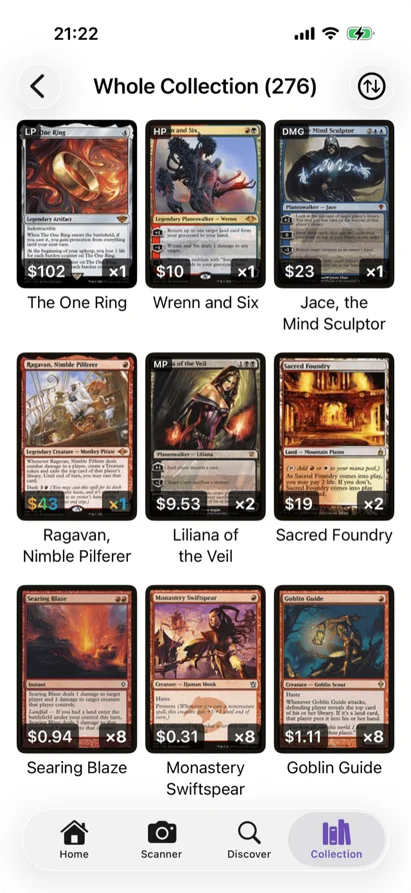
Here’s the part that nags me as someone who logs everything. A 1-of-1 pulled from a randomized retail product isn’t really trackable through normal channels. Scryfall doesn’t have an entry for it. TCGplayer has no market price. Even grading services treat plates as a custom job, not a standard slab. So if you pull one and want to know what you have, you’re going to need to maintain your own record. Photos with EXIF dates. A note about the Superdrop and order date. The packaging if you still have it.
I logged my proxy of a Lotus Petal once, the one I won at an FNM at Ridgeline Games in 2018, with more documentation than this. Folder, five photos, written-up provenance with the date of the draft and the names of the people I beat to get it. The proxy was worth nothing. The folder is still there. If I ever had to prove I’d had the thing for years, I could. The same instinct applies here, except the thing is real and possibly worth a car payment.
And if it never happens to you
So yeah. Plates. Out of a Secret Lair. Most of us aren’t pulling these. Even with the current drop, the math suggests the ratio is something like one plate per ten thousand-plus orders. I’d love to know the actual number. We’ll never get it.
What you can do is look at the rest of your sealed Secret Lairs with slightly different eyes. The surprise wasn’t “rare card.” It was “wrong category of object.” If Wizards is willing to seed printing plates in a thirty-dollar envelope, what else might they slip in? Test prints? Numbered artist signatures? A fragment of original art on cardstock?
Probably nothing. But “probably nothing” is the bet you place when you click pre-order on a Superdrop in the first place.