I pulled a serialized card exactly once and it was an anticlimax I still think about. Winter of 2023, a Brothers’ War collector box I’d talked myself into over a slow weekend. Somewhere in the back half of the packs there was this card with a little gold-stamped number near the bottom, and for about four seconds I was convinced I’d hit something. Looked it up. It was a serialized land, the number wasn’t special, and the going rate was below what one of those packs cost me. I sleeved it anyway. Felt weird to bin it.
That’s the part nobody tells you when these things get hyped. A serialized card is a normal-ish card with a unique number stamped on it, usually formatted like 047/500, telling you it’s the 47th of 500 copies in existence. Wizards started doing this with a mirrored Viscera Seer back in 2021, basically as an experiment, and then leaned all the way in. The Brothers’ War turned it into a whole bonus-sheet thing in 2022, 500 serialized copies each across a big list of cards. March of the Machine added serialized Praetors. By the time Lord of the Rings rolled around they were printing serialized Sol Rings and, famously, a single serialized copy of The One Ring numbered 001/001.
The number is doing more work than the card
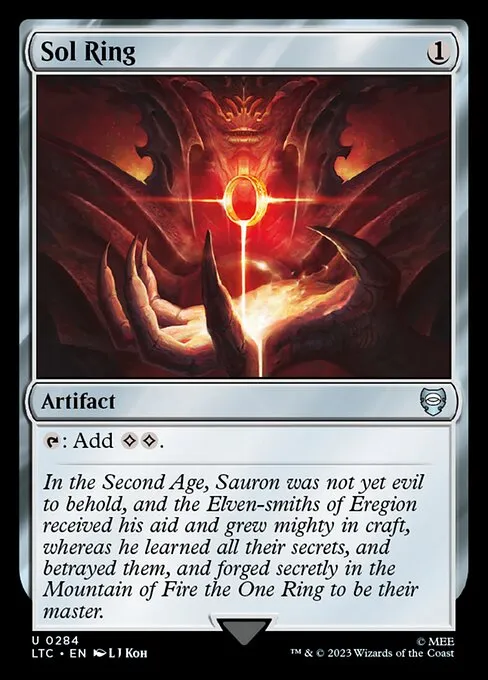
Here’s what took me a while to get through my head. The value of a serialized card has almost nothing to do with how good the card is in a deck. It’s the scarcity and the novelty of the stamp, full stop. A serialized Sol Ring is the same Sol Ring you’ve got eight copies of in various Commander decks. What you’re paying for is “one of 900 with this art and a number on it,” not the mana rock.
And even within a single serialized run, prices fan out wildly based on the number itself. The 001/500 sells for a fortune. The 500/500 sometimes gets a bump as the “last one.” Anything that spells out a meme number, your 069s and 420s and 666s, gets bid up by people who think it’s funny. Everything in the boring middle, the 312s and the 477s, those are the ones that quietly disappoint. When Star City Games cracked the 001/500 serialized Ragavan out of March of the Machine, it was the most expensive card in the set. The other 499 Ragavans were worth a real but much smaller fraction of that.
So when MTGGoldfish flagged this week that a serialized Lord of the Rings Sol Ring had roughly doubled to around $900, that’s the kind of headline that needs an asterisk the size of a billboard. Some serialized Sol Rings from that set trade around $350. Some push past $1,400 depending on which of the variant arts you pulled and what the number is. “A serialized Sol Ring hit $900” is true and also tells you almost nothing about whether the one in your binder is worth $350 or $1,400.
Pulling one is not winning
The thing the marketing photography never shows is the downward slope. Brothers’ War serialized cards debuted at well over $1,000 each in the first frenzy of openings. Auctions were going for multiple thousands. Then more packs got cracked, the supply caught up with the hype, and a lot of those same cards settled in around $50 to $100. A serialized Mox Amber numbered 388 reportedly still moved for around $1,600, but that’s the exception that got remembered, not the rule. For every story like that there are a few hundred serialized cards sitting in dealer cases marked down month over month.
I go back and forth on whether that’s a bad thing, honestly. Part of me thinks the floor dropping out is the whole problem with treating these as investments, that Wizards manufactured artificial scarcity and the market correctly priced most of it as a gimmick. But then I look at the ones that did hold, the low numbers, the iconic cards, the genuinely beautiful alternate arts, and I think maybe the market is just doing what collectible markets always do. The 1/1 is forever rare. The 388/500 was never going to be. That’s not a scandal, that’s just what a print run of 500 means.
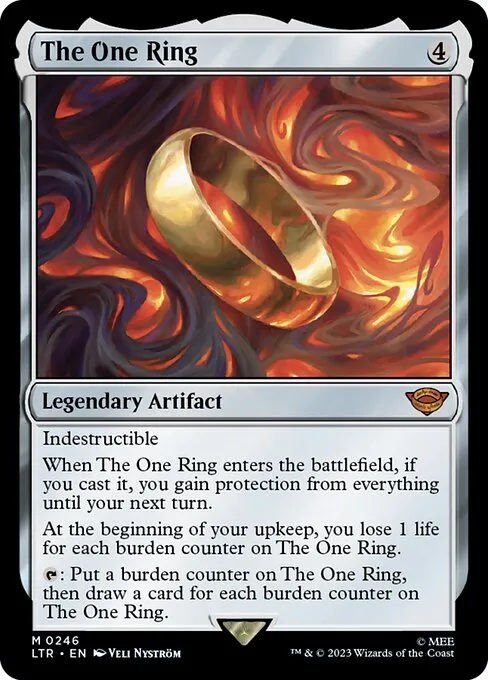
The One Ring is the clean version of this. There’s exactly one serialized copy, 001/001, and it reportedly sold for north of $2 million after a long bidding saga and eventually landed in Post Malone’s collection. One copy on Earth. Meanwhile the regular, non-serialized The One Ring that any of us can actually buy still runs about $100 because it’s a genuinely powerful card people want for decks. Two completely different value engines wearing the same name.
Tracking the weird ones
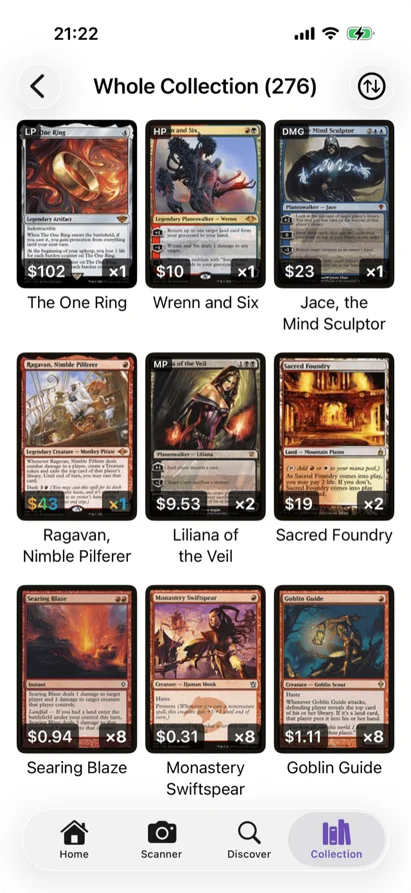
If you collect long enough you end up owning a couple of cards that don’t fit neatly into any price tool, and serialized cards are the worst offenders. A normal price database wants to give you “the price of Sol Ring.” It does not have a clean answer for “the price of my Sol Ring, which is 247/900, with the dwarven art, lightly played corner on the bottom left.” The number is half the value and most tools don’t even track it as a distinct thing.
What I do, and what I’d tell anyone holding one of these, is record the actual serial number somewhere permanent the moment it comes into your collection. Not “serialized Sol Ring.” The full 247/900, the variant, the condition. When I scan stuff into Eldwyn the card gets logged with its printing and I add the serial in a note, because if I ever sell it the buyer’s first question is going to be the number, and the price I can ask swings on it. This is the same reason the collector number and set code on the bottom of a card matter so much for pricing in general, just turned up to eleven.
It also makes them a nightmare to insure or value in bulk, which is a real consideration once you’ve got a few. I wrote a whole thing about when a binder becomes an asset worth insuring, and serialized cards are exactly the category where “I have a Sol Ring” undersells you by a thousand dollars or oversells you by eight hundred, depending. You need the specifics written down or you’re guessing.
So yeah. The stamp. People see it and their brain goes jackpot. And sometimes, the 001, the meme number, the one-of-one, yeah, it really is. But most of the time you’ve pulled the collectible-card equivalent of a limited-edition print where the edition was, you know, not that limited. Nine hundred of something is still nine hundred.
I don’t actually know where this trend goes next, whether Wizards keeps cranking the serialized dial every set until the novelty wears all the way off, or whether they pull back. They’ve shown exactly one speed so far. If you’re chasing them, chase the cards you’d be happy to own even if the number was 450/500 and the resale never materialized. That’s the only version of this that doesn’t end with a serialized land in a sleeve you can’t bring yourself to sell.