There’s a stack of three Cori-Steel Cutters in the reject pile of my trade binder, the slot I keep for cards I overpaid for and haven’t quite forgiven yet. I preordered them at something like $24 each the same week Izzet Prowess won a Standard Challenge, completely sure I was being clever. You can probably guess how that went. They’re wedged behind a foil Siege Rhino I also can’t move, if that tells you anything about the back pages of my binder.
Tarkir: Dragonstorm came out April 11, 2025. Fifteen months is enough time for a set to stop being news and start being a data point, and the Tarkir: Dragonstorm value picture right now is a tidy little lesson in what actually holds. So I pulled the current numbers and lined them up against what I remember paying, or wishing I’d paid, when the set was new.
Quick refresher if you skipped this one: return to Tarkir, the Khans clans back in their wedge colors, a pile of three-color Spirit Dragons, and a new Dragon-flavored Mox. I could not tell you the name of the set’s marquee mechanic without looking it up, which is maybe the most honest thing I can say about how much of a set survives a year in your memory versus how much just quietly leaves.
What held value in Tarkir: Dragonstorm
The top of the set is boring in the best possible way. Ugin, Eye of the Storms is still the most expensive card in Tarkir: Dragonstorm at around $43, and it’s basically parked where it started. Elspeth, Storm Slayer sits right behind it near $39. Two splashy mythic planeswalkers, both playable in a pile of Commander decks, both still worth real money with nothing dramatic attached.
This is the same shape I see every time I do this. The marquee mythic that crosses into Commander holds. It held for Lost Caverns of Ixalan two years out, it held here, it’ll hold for whatever set I’m writing this about next summer. Broad-appeal planeswalkers with a big ultimate are about as close to a savings account as cardboard gets.
I’ll poke a hole in my own point, though, because holding value isn’t the same as making value. A $43 Ugin you bought on release and never sleeved into a deck is $43 you parked in a card instead of in other cards, or in your bank account. If you’re not playing it and not selling it, “it held” is mostly a story you tell yourself. Still, when the question is just “will this be worth something in a year,” the answer for the top mythics was a clean yes, and most of the set can’t say that.
Craterhoof Behemoth got reprinted again here, and it’s sitting at $22 in the Tarkir frame, within a dollar of what every other printing of Craterhoof costs. The card’s been printed so many times that Commander demand just absorbs the new supply and the price barely flinches. That’s worth noticing on its own: the reprints that tank a card are the ones propped up by scarcity, and Craterhoof ran out of scarcity a long time ago.
Voice of Victory is the quiet winner nobody circled. A white rare that showed up on no one’s preorder radar and just kept turning up in Standard lists until it settled around $18. Nobody brags about calling Voice of Victory. That’s usually exactly where the money hides.
The Cutter, and everything I got wrong
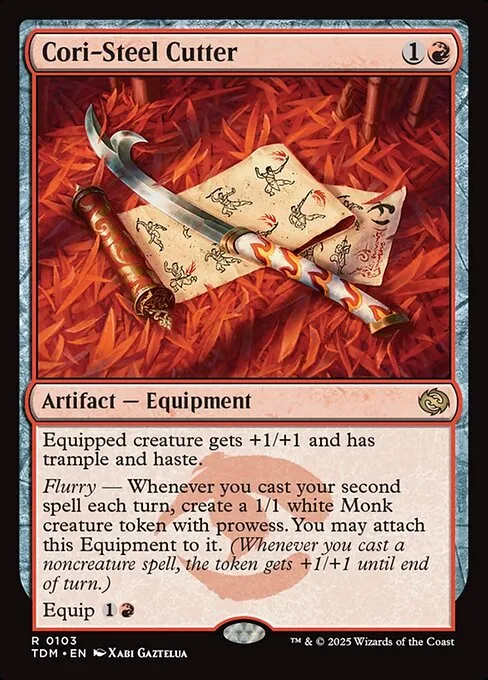
So, the Cutter. I sat on those three copies for months. Kept telling myself Izzet Prowess was too good to touch, that even if Standard cooled off the card had Pioneer and Modern underneath it, that it was safe. Then Pioneer banned it. So much for the floor. It’s a $5 card now, and $5 feels charitable.
The thing I should have had tattooed somewhere before dropping $70 on three rares: a card whose whole price is “it’s the best card in a winning deck” is one banlist update from being a common. Cori-Steel Cutter was north of $20 when its deck was tier one, and the power was completely real. Competitive-driven prices are just the least durable prices there are, and I knew that, and I bought in anyway because winning-deck FOMO is a genuinely powerful drug.
Mox Jasper is the gentler version of the same movie. Brand-new card, the word “Mox” stamped right on it, so naturally it opened somewhere near $30 on preorders while people saw those three letters and stopped reading. It’s a Dragons-matter rock, which is a real but narrow job, and it’s drifted to about $13. Gravity doing its work on a card that got priced for a deck that isn’t played in the numbers to hold it up.
The rest of the middle is unremarkable. Dracogenesis hovers around $14, Betor, Kin to All near $7, the Mistrise Village dual around $8. The full set across every printing, foils and serialized and all, adds up to something like $3,800, which mostly reflects how many versions of each card exist now more than what any single copy is worth.
Re-pricing a year-old set
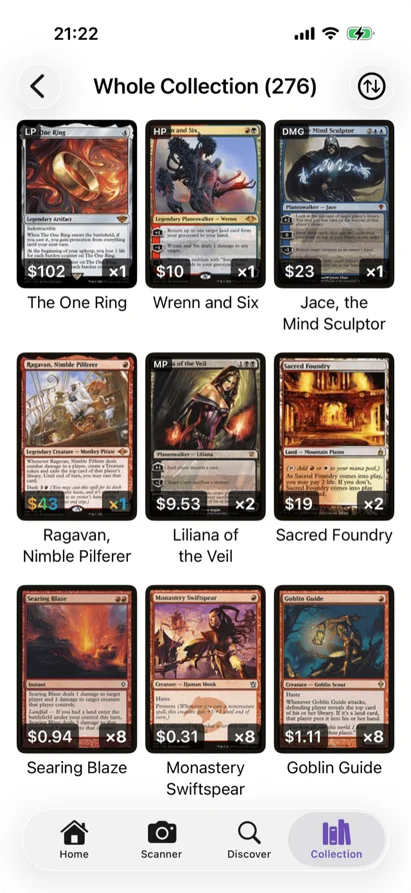
“Held value” is invisible unless you actually go look. I didn’t register that the Cutter had collapsed until I ran my Tarkir cards through a re-price a few months after the ban, and by then the window to bail out at $12 or whatever it was mid-fall had already closed. If you buy singles on release, the follow-up check matters as much as the buy, and almost nobody does the follow-up.
I scanned the whole TDM binder in one sitting, maybe twenty minutes, and got the current spread back against what I’d logged at purchase. Ugin flat. Elspeth flat. Voice of Victory up a hair. Cutter down about 80 percent. Mox Jasper down more than half. Seeing the entire set’s arc in one screen is the only way I’ve actually held onto the lesson instead of relearning it from scratch every spring.
There’s a bigger thing sitting under Tarkir: Dragonstorm too. It might be the last plain in-universe Standard set for a good while. Everything after it in 2026 is Marvel and the Hobbit and Star Trek, crossover sets carrying their own strange demand. Tarkir had no Spider-Man to prop up a weak rare. What held here held on ordinary Magic merit, which makes it a cleaner test than anything with a licensed logo on the box.
Blunt scorecard: the top mythics were safe, the reprinted staple sat still, the sleeper rare quietly won, and the two cards the internet lost its mind over on preorder night are the two that bled the most. That’s more or less the result every time I run this. And I will absolutely fall for the next shiny competitive rare anyway, probably by August.