I have a friend who quit selling cards online because, in his words, the prices are all made up. He’d list a card at the number TCGplayer showed him, it wouldn’t sell, he’d check back a week later and the number had moved, and somewhere in there he decided the whole marketplace was rigged against him. It isn’t rigged. He was reading the wrong number, which is what almost everyone does for the first few hundred times they look at a card page.
Pull up any single on TCGplayer and they’re all stacked there waiting for you. A TCGplayer Market Price, a low price, a median, sometimes a Direct price, and depending on the view a couple more. Four numbers for one card. They don’t agree with each other, and nobody bothers to explain which one is the “real” one, because there isn’t a real one. Each number is answering a different question. The whole game is knowing which question you’re actually asking when you glance at it.
Market Price is the only one built from actual sales
Start with Market Price, because it’s the one that matters most and the one people understand least. TCGplayer’s own help page describes it as the value based on recent completed sales, averaged across many transactions, with the outliers thrown out. So it’s not what anyone is asking for the card right now. It’s what people actually paid, recently, with the weird $90 listing and the someone’s-grandma $2 listing filtered out of the math.
That backward-looking part is the whole thing. Market Price tells you what the card has been worth. It says nothing about whether you can buy or sell one at that price this afternoon.
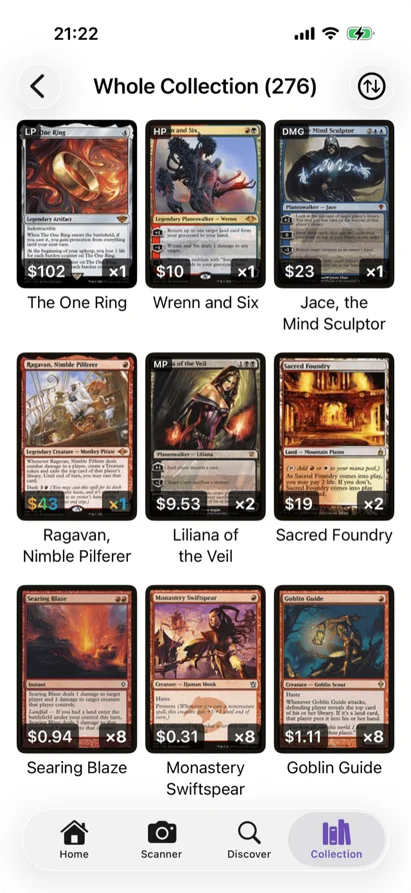
It’s also the number that quietly runs most of the tools you already use. When Scryfall shows a USD price, that’s TCGplayer Market Price. When a collection app totals up your binder, including the one I work on, that’s almost always the number doing the adding. So when your scanned collection says you’re sitting on $1,800 of cardboard, what it really means is “the cards in here have recently been selling for about $1,800 combined.” Which is true, and also not the same as $1,800 in your pocket, but I’ll get to that.
The low price is lying to you about cheap cards
The low price is the cheapest copy currently listed, near mint or lightly played, counting the item price only. No shipping. That last part is where it gets people.
A Sol Ring from a recent Commander deck shows a low somewhere around $1.25. You will never, not once, buy a Sol Ring for $1.25. The seller sitting at the bottom of that list has a minimum order, or charges a dollar-something for the envelope, or both. By the time the card is in your mailbox you’ve spent four or five bucks. The “low” was real in the narrow sense that the number on the listing said 1.25, and completely fictional in the sense that mattered to you.
I learned this the dumb way, obviously. Early on I tried to fill out a Commander deck by grabbing thirty-odd cheap pieces off the lowest listings, feeling very clever about how little the deck was going to cost. Then the cart hit me with shipping from eleven different sellers because I’d matched each card to whoever had the rock-bottom price, and the “$40 deck” came out closer to ninety. The low price is great for one expensive card. For a pile of commons and uncommons it’s a trap, and the cheaper the card the worse it lies.
Median sits above low. It’s the middle listing, the seller standing exactly in the center of the lineup. TCGplayer moved to median years ago because the old “mid” was a mean average, and a couple of sellers who forgot to update from when a card was $90 would drag the whole number off a cliff. Median ignores those stragglers. It’s a decent gut-check on what a card lists for, less useful than Market for knowing what it’s worth.
Market Price goes stale, and foils are the worst about it
Here’s where I’ll partly argue against myself. I just told you Market Price is the trustworthy one. Most of the time, sure. But Market Price is only as good as the sales feeding it, and some cards barely sell.
Take a card with thin demand, an oddball reprint or a foil nobody’s chasing. Maybe it sold three times in the last month. The Market Price is an average of three transactions, one of which might’ve been a mispriced impulse buy, and it’ll sit frozen at that number for weeks because nothing new is coming in to correct it. You look at it, you trust it because it says Market, and it’s basically a fossil.
Foils are the poster child. A foil’s listing pool is a fraction of the nonfoil, the sales are rarer, and the prices are all over the place because condition and curl and print run matter more. I’ve watched foil Market Prices that hadn’t budged since before a reprint that should’ve tanked them, purely because no copies traded hands to update the figure. If you’re scanning foils and alternate-art cards into a collection and the totals look suspiciously high, this is often why. The number’s stale, not generous.
So is Market the number you trust? Yes. Except when the card’s too quiet to generate trustworthy sales, at which point you check how recently it actually moved before you believe it. Both things are true and you kind of have to hold them at once.
Direct is a different animal
TCGplayer Direct is the one people skip over. These are cards TCGplayer warehouses and ships itself, vetted to near mint, and they combine into a single order that qualifies for free shipping once you clear the threshold. So a Direct price usually runs a touch higher than the absolute low, but it’s a real, deliverable price for a clean copy that shows up in one package instead of nine envelopes from nine sellers.
For building an actual deck, Direct is frequently the honest number. It costs a little more per card and saves you the shipping math I fumbled above. Whether that trade is worth it depends on how much you value not babysitting eleven separate orders, which, after the deck incident, I do.
Which number you actually use
Depends entirely on what you’re doing, which is the unsatisfying answer, but it’s the right one.
Valuing your own collection: Market Price, with a mental haircut. If you ever plan to sell, what you’ll really see is buylist money (roughly half to maybe seventy percent of Market at a shop) or, if you sell singles yourself, Market minus the fees and shipping that eat fifteen-plus percent off the top. The binder says $1,800. The cash-out is a good bit less, and pretending otherwise is how people convince themselves they’re richer in cardboard than they are. I wrote more about that gap in pricing your collection without lying to yourself.
Buying a single expensive card: low price is fine, just remember to add shipping. A $40 Cyclonic Rift at low plus shipping is still basically a $40 card. The percentage that shipping adds shrinks as the card gets pricier, which is the mirror image of why low is poison on bulk.
Buying a stack of cheap cards: don’t trust low at all. Look at Direct, or find one seller who has most of your list, or go to your LGS and pay a few cents more to skip the envelope tax.
Trading in person: median or Market, agreed on out loud before you start moving cards, so nobody’s quietly pricing their side at low and yours at Market. That trick is older than I am and people still try it.
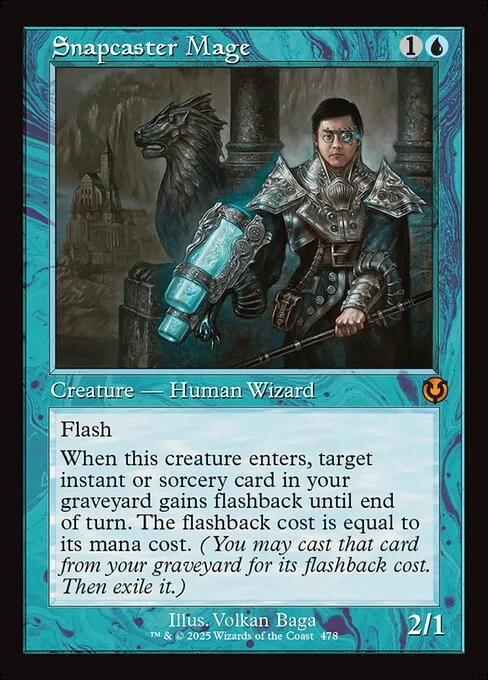
So yeah. Four numbers. None of them wrong, exactly. Snapcaster Mage shows a Market around $17 and a low under that and a Direct a hair above, and all three are accurate descriptions of three different transactions you could have. My friend who rage-quit selling wasn’t wrong that the prices kept moving. He was wrong that any single one of them was supposed to be the price. There’s no the price. There’s just which question you’re asking, and whether the number you’re staring at happens to answer it.