I still have the Tyranid Swarm precon on a shelf, in one of those flimsy deckboxes that came free with a booster box, sleeves gone a little cloudy. Exactly one game of wear on it. I bought it the week the Warhammer 40,000 Commander decks dropped in October 2022, paid something like fifty bucks for a forty-dollar deck because every shop within an hour of me had sold out, sleeved it up, lost with it at a kitchen table, and then never touched it again. It’s been staring at me from that shelf ever since.
Which is why I was mildly annoyed to work out, three-and-a-bit years later, that the thing is worth more in pieces than I paid for it whole. There are real Warhammer 40K Commander cards worth money hiding in those four decks, and mostly they’re not the big-name characters on the box.
EDHREC ran a piece last week counting up the most-played cards from the 40K decks across all of Commander, and it’s a useful list to hold next to a price chart, because the two don’t line up the way you’d expect. The cards people jam into decks aren’t automatically the expensive ones, and the expensive ones aren’t automatically the ones getting played. Somewhere in the gap between those two lists is the stuff actually worth pulling.
The cards that broke containment
Here’s the thing that makes the 40K set weird as a collectible. A normal Commander precon is full of cards that only make sense inside that precon. You break the deck down, and 90 of the 99 cards are format staples you already own six copies of, plus a fistful of build-arounds nobody wants unless they’re running that exact commander.
The 40K decks leaked. A bunch of the new cards were good enough, and generic enough, that they escaped into decks that have nothing to do with Warhammer.
Sceptre of Eternal Glory is the cleanest example. It’s a mana rock that, in a mono-color deck, taps for a genuinely silly amount. It doesn’t care whether your commander is a Necron or Niv-Mizzet. So it gets slotted into mono-red, mono-black, mono-green lists all over the place, and the demand pool for it is basically “everyone playing a one-color Commander deck,” which is a lot of people. It sits around $20 now, and it’s never had a printing outside this set. If you’ve been hoarding weird mana rocks in your bulk box, this is one to actually look up.
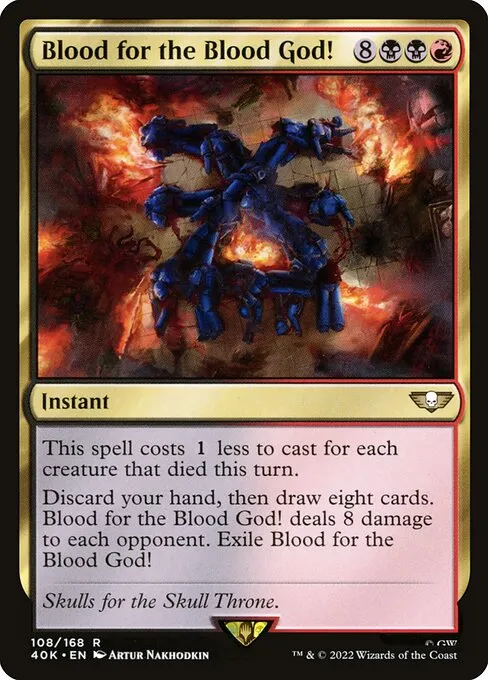
Exalted Flamer of Tzeentch is the same story from a different angle. It’s a spellslinger payoff, a little card-advantage engine that pings opponents when you cast instants and sorceries, and it plays in any blue-red spells deck regardless of theme. About $25. Blood for the Blood God!, which topped EDHREC’s most-played list at north of 46,000 decks, is a splashy Rakdos finisher that shows up in decks that want to cast things from anywhere but their hand. Roughly $10, so it’s the cheap one, but it’s also the one you’re most likely to actually have a home for.
Then there’s Canoptek Spyder and Biophagus and a handful of others in the $14 to $18 band, all doing the same thing: quietly being good enough for real decks. None of them scream “chase card.” Add them up across a deck, though, and it’s real money.
The named characters are a different bet
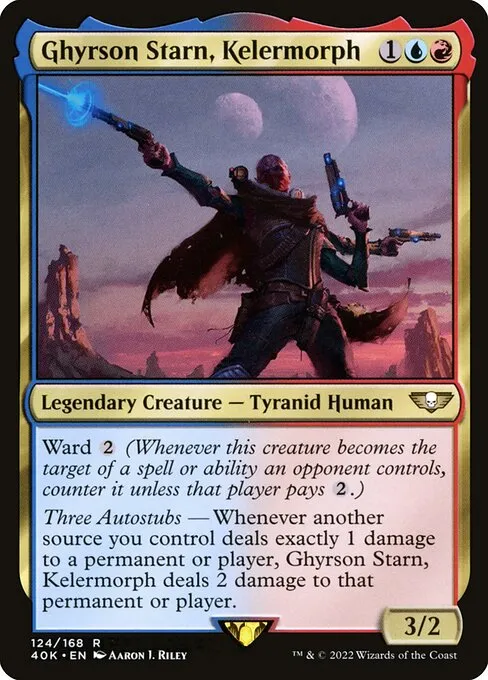
Now the expensive stuff. Ghyrson Starn, Kelermorph is the priciest single in the set, about $38, and the foil is up around $110, which is a number I had to read twice. Bloodthirster is around $31. Celestine, the Living Saint is $28. Magnus the Red sits near $18.
These are the cards on the box art, more or less, and they cost what they cost because people want to build those specific decks. Which is great, until you’re the one trying to sell. A card that’s only good as a commander has exactly one buyer profile: someone who wants that commander. When I say Ghyrson Starn is a $38 card, what I mean is that’s the sticker. Whether you can turn it into $38 in a reasonable amount of time is a separate question, and for a niche legend from a crossover set, “reasonable amount of time” can mean months on a marketplace.
So I’d flip the usual instinct here. The $20 mana rock that forty different archetypes want is, weirdly, more liquid than the $38 legend that six hundred people want. Not more valuable on paper. More likely to actually sell this month.
Actually, let me walk that back a little, because I don’t want to oversell it. Foils complicate the picture. That Ghyrson Starn foil at $110 is a genuine chase for the people who collect this set, and there aren’t many of them floating around, so if you pulled one, that’s a real card and you should treat it like one. The foils across this set carry big premiums generally. Sceptre’s foil is more than double the non-foil. So “the legends are illiquid” is true for the paper non-foils and much less true once you’re holding shiny ones.
Why any of it held up
Normally I’d expect a three-year-old Commander precon to have bled out by now. Reprints crush Commander spec cards constantly, and a set full of new legends is exactly the kind of thing Wizards loves to raid for the next Masters set or Secret Lair.
Except the 40K set has never been reprinted. Not once. Every card I’ve named above exists in precisely one printing, the October 2022 original, and that’s it. There’s no Commander Masters slot, no The List appearance, no Universes Beyond do-over. Partly that’s licensing, Warhammer 40K is Games Workshop’s IP and reprints presumably mean renegotiating, and partly it’s just that Wizards moved on to the next fifteen crossovers.
Whatever the reason, the practical effect for you is that the supply has been fixed since 2022 while EDHREC’s deck counts kept climbing. Blood for the Blood God! is in more decks now than it was two years ago. That’s the setup where a card slowly grinds upward instead of sinking, and it’s the same reason people argue Universes Beyond is quietly becoming a Reserved List of its own. Print it once, license it from someone else, never touch it again.
I don’t actually know whether that holds forever. Games Workshop and Wizards clearly still like each other, there’s more 40K product coming, and a “40K Remastered” or a Secret Lair full of these could land tomorrow and knock twenty percent off everything I just listed. I wouldn’t build a retirement around a stack of Exalted Flamers. But right now, today, the reprint pressure that killed every other precon just hasn’t arrived here.
Before you dismantle an old deck
So yeah. The 40K decks. If you’ve got one gathering dust like my sad little Tyranid box, don’t just scoop the whole thing into a bulk bin when you decide to move on. That was going to be my move, honestly, before I actually looked. Scoop, box, forget. And I’d have buried forty or fifty dollars of singles under a pile of draft chaff.

The workflow that actually makes sense: pull the deck apart, scan it, and let the values sort themselves. I ran my Tyranid deck through Eldwyn one evening while half-watching something, and the total came out higher than I’d guessed, concentrated in maybe eight cards. The Sceptre, a couple of the spellslinger pieces, the commander itself. Everything else was, fairly, bulk. This is the same math as any precon-versus-singles decision, just run backwards: instead of asking whether the deck is worth buying whole, you’re asking which pieces are worth keeping loose.
One more thing worth saying, because it’s easy to get greedy reading a list of prices. Most of the 168 new cards in this set are not worth your time. The top ten or so carry the value, the next twenty are couple-dollar cards, and the long tail is exactly what you’d expect from a precon. Don’t sleeve up every Ork and Space Marine expecting a payday. Check the handful that matter, keep the foils regardless, and let the rest go be bulk in peace.