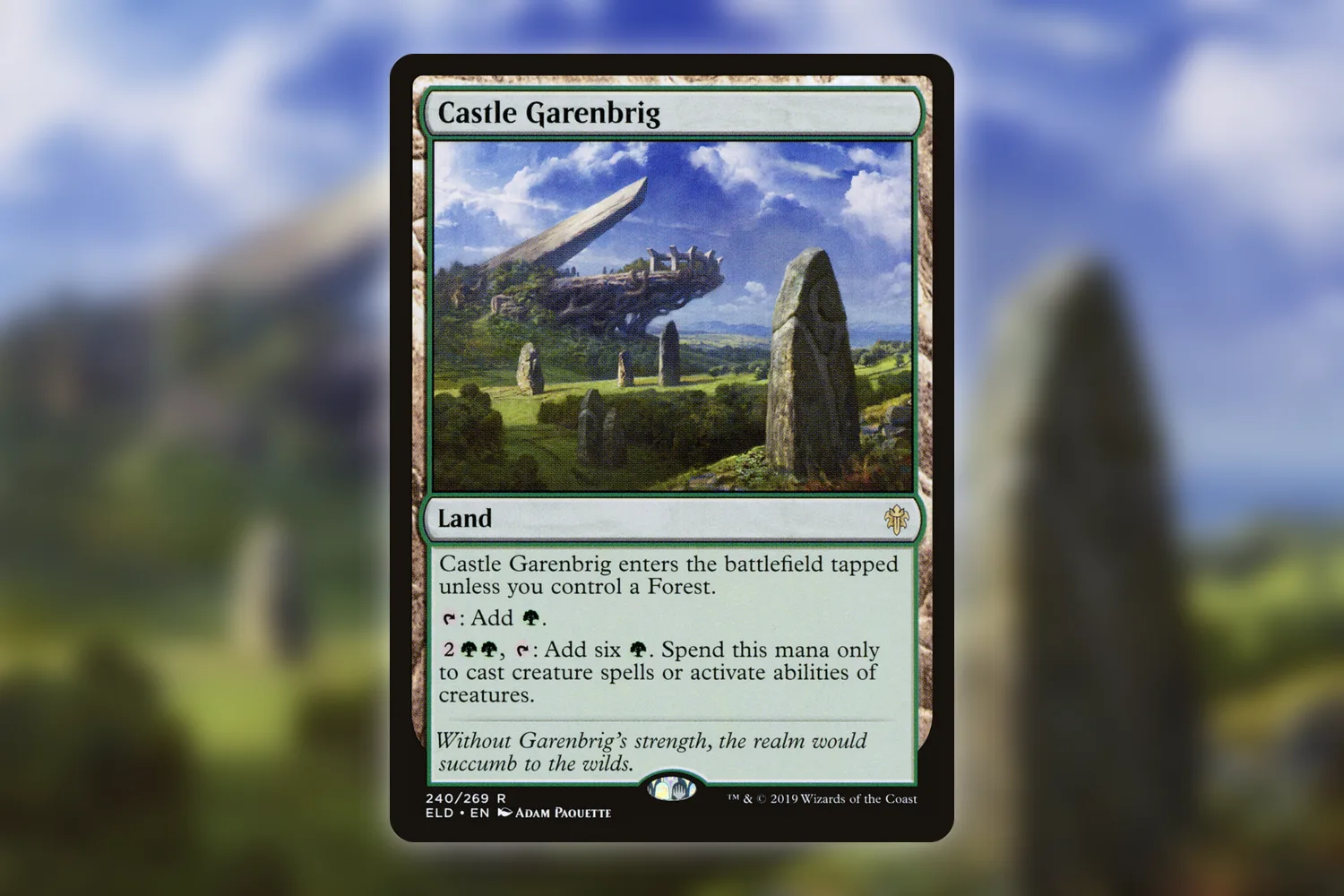
Castle Garenbrig is the card I’d probably miss in a Throne of Eldraine box. A green-producing rare land, ordinary frame, sitting among all the other lands I meant to file properly. Its regular non-foil is $10.83 on Scryfall today. The regular foil is $9.54. Already this is a more annoying sorting job than “pull the shiny ones.”
I checked the original ELD printings on October 11, 2026, and I’d make two passes through the box: one for cards worth separating from the loose stack, another for treatments that need their own price lookup. The obvious expensive mythic is still expensive. A couple of lands and an unassuming black artifact are easier to overlook.
These are Scryfall’s USD reference prices, with each number tied to a specific printing and finish. They’re useful for deciding what deserves a closer look. A buylist offer or the proceeds from selling a played copy can be considerably lower, especially after fees and shipping.
The Throne of Eldraine cards I’d pull first
Castle Garenbrig is number 240. You pay four mana and tap it to produce six green mana, with a restriction: that mana can only cast creature spells or activate abilities of creatures. It also enters tapped unless you control a Forest. I’d check it against creature-heavy green decks before assigning it to the sell pile, because buying it back later would be irritating.
There are limits to the appeal. The six mana won’t pay for your big enchantment, and a land that sometimes enters tapped needs to earn that inconvenience. Still, it has a clearly identifiable job. The ordinary non-foil’s price is higher than several mythics in the same set.
Here’s the short pull list. Every row below is the regular-frame ELD printing, with its collector number included so an extended-art copy doesn’t quietly slip into the comparison.
| Card | ELD number | Non-foil USD | Foil USD |
|---|---|---|---|
| The Great Henge | 161 | $64.44 | $70.93 |
| Castle Garenbrig | 240 | $10.83 | $9.54 |
| Embercleave | 120 | $9.85 | $13.24 |
| Ayara, First of Locthwain | 75 | $8.44 | $9.95 |
| Castle Locthwain | 241 | $3.69 | $5.43 |
| Wishclaw Talisman | 110 | $2.71 | $11.12 |
| Deafening Silence | 10 | $2.42 | $4.34 |
The Great Henge is doing most of the financial work here. Its casting cost comes down with the greatest power among creatures you control; once it’s down, it produces mana and life, and rewards nontoken creatures entering with a counter and a card. If there’s one loose in the box, sleeve it while you’re sorting. I’m leaving the exact sale decision to whoever has to choose between keeping the card and paying for the next deck.
Embercleave’s flash, cost reduction for attacking creatures, and double strike still make its text easy to get excited about. Ayara is more particular about the deck: three black mana to cast her, a drain trigger for black creatures entering, and a tap-and-sacrifice ability that draws a card. Those are useful effects to check against your own lists. The current prices alone don’t tell us which format or group of buyers accounts for each dollar.
Castle Locthwain offers card draw from a land slot, with a life payment determined by your hand size after drawing. At $3.69 regular, it falls into the awkward middle where I’d definitely keep track of a copy but wouldn’t necessarily list one by itself online. Your choice of selling venue changes how much work that sale is worth.
Deafening Silence is the uncommon in this list. Each player gets at most one noncreature spell per turn. That can make it useful in the right deck and actively inconvenient in another. I’d pull it from the uncommon stack at $2.42, then check whether I have duplicates before deciding how many stay.
I wouldn’t price every common in the box as part of this first pass. Actually, that feels slightly reckless when the whole point is finding overlooked cards. If the box is small, sure, scan everything. If it’s several thousand cards, I’d rather finish the rare and foil check than spend the afternoon producing a beautifully documented list of cards I still haven’t put away.
Wishclaw is where I’d stop trusting the name alone
The regular Wishclaw Talisman is $2.71 non-foil and $11.12 foil. Its extended-art version, ELD number 357, is $17.13 non-foil and $163.53 foil in the same check.
That last number deserves a second lookup before anyone starts spending imaginary sale proceeds. I haven’t verified completed sales for the extended-art foil, and Scryfall’s price field doesn’t establish how quickly your copy would sell at that figure. I’d compare the exact version and condition against current listings and recent sold copies before treating it as cash.
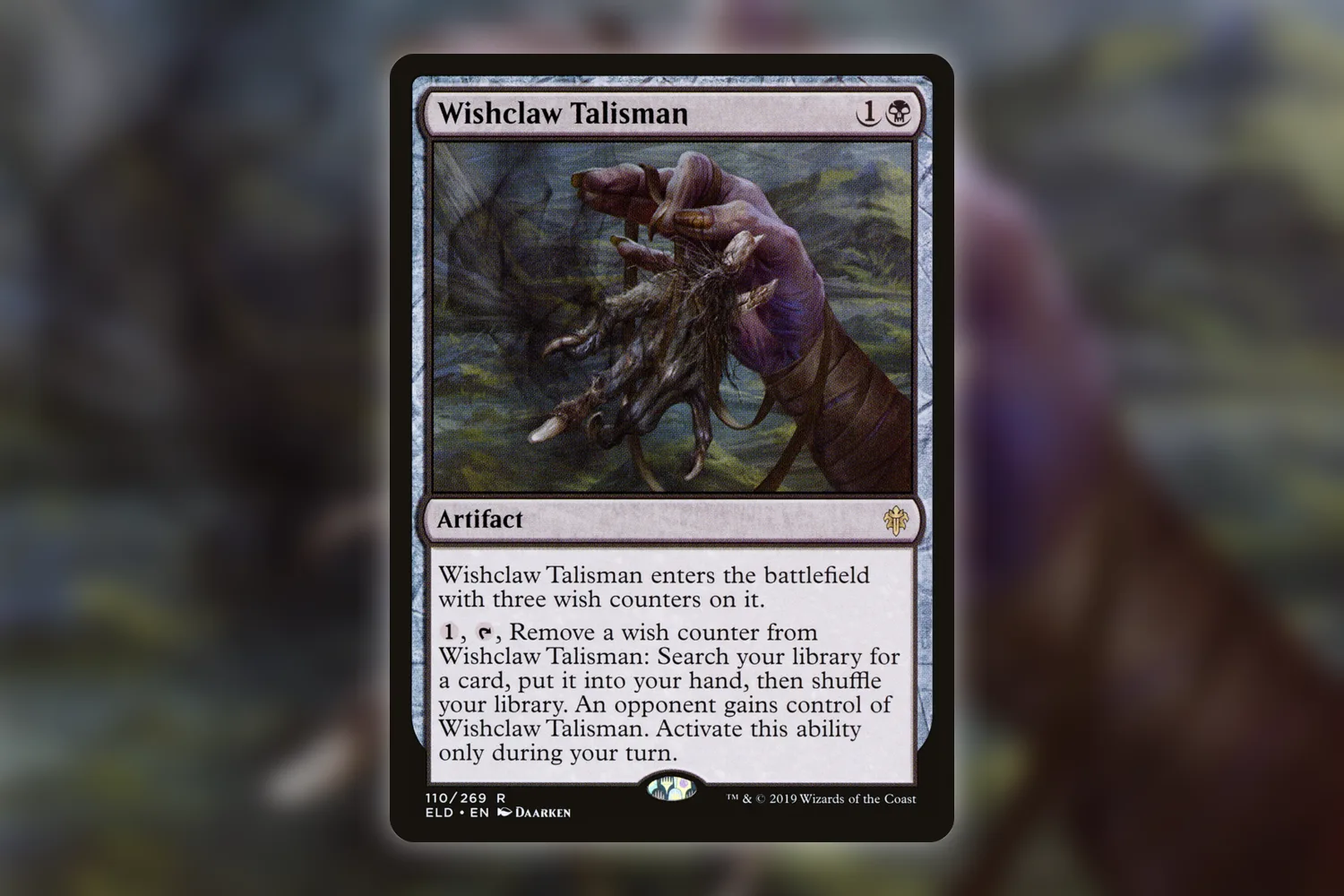
The card itself lets you search your library for a card, then gives the artifact to an opponent. There’s plenty to think about in when you activate it and what happens afterward, but I’m more interested in the bottom-left corner for this particular sorting job. Number 110 and number 357 need separate entries. Calling both “foil Wishclaw” loses the detail responsible for almost all of that price gap.
Wizards’ original Project Booster Fun explanation described extended-art rares and mythics as a Collector Booster treatment for Throne of Eldraine. The illustration extends toward the left and right edges; the treatment uses the same underlying art as the regular card. Storybook showcase frames were a separate treatment associated with Adventure cards. These distinctions are easier to spot with the copies side by side than from a half-remembered product name.
Castle Garenbrig has its own extended-art printing, number 388. It’s $16.24 non-foil and $49.61 foil. Compare those with number 240’s $10.83 and $9.54. The regular foil is below the regular non-foil, while the extended-art foil carries a substantial premium.
So, yes. Tilt the card. Check the shine. Then check the number. I know, another tiny number, and you already have a pile balanced on the edge of the table. Put the pile down first. This is exactly how a foil ends up logged as the cheap version because you were trying to hold six things at once.
The wider argument about modern foil premiums shrinking still leaves room for examples like these. I’d avoid applying a blanket foil multiplier to this box; the actual comparisons point in different directions even within one land.
ELD on the bottom doesn’t guarantee it came from a draft pack
Chulane, Teller of Tales, number 326, is $5.84 non-foil and $6.78 foil. It belongs to Throne of Eldraine’s Brawl release, which Wizards lists separately in the original card gallery. The original Collector Booster configuration also had a slot for new cards from associated products, including the Brawl decks.
If your “Eldraine box” includes leftovers from several products, Chulane belongs in the audit. If it’s strictly a box of draft leftovers, its presence shouldn’t become something you expect. I like keeping supplemental cards in the same physical set section, but I’d record their actual collector numbers so a later set-completion project can distinguish those boundaries. Deciding what counts as a full set gets messy enough without rediscovering the Brawl cards halfway through.
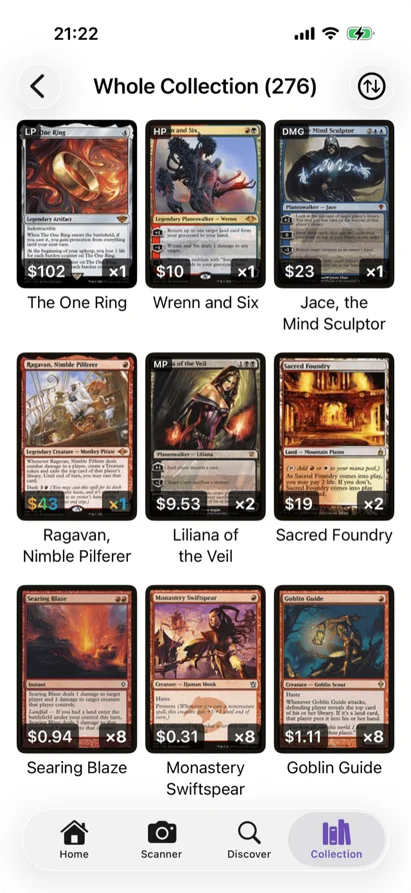
For the copies you pull, record the set code, collector number, finish, and condition before merging them into the rest of your collection. In Eldwyn, I’d check the recognized printing as each card goes in, especially the extended-art copies. The name being correct is only part of the check.
I’d also give the loose cards a location: the box they came from, the trade binder, or the deck that claimed them during sorting. Otherwise the newly discovered Castle Garenbrig becomes a card you definitely own and definitely can’t find. Leave the box label on until the last pile has a home.