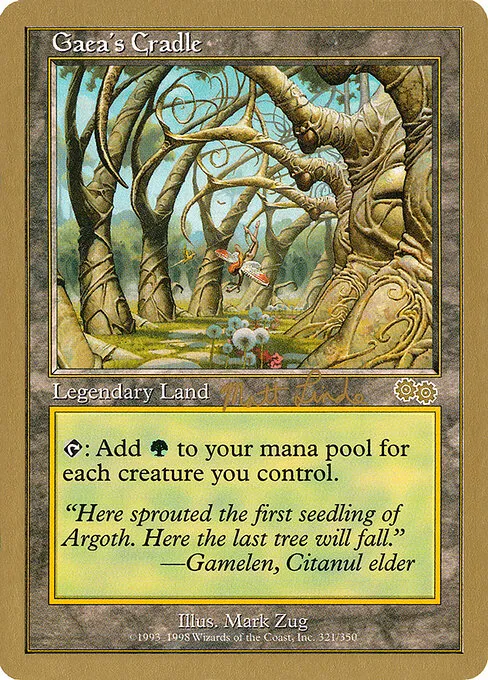
The first gold-bordered Magic card I ever held, I was maybe fifteen and completely convinced I’d found treasure. Some guy at a flea table in a mall in Paramus had a shoebox of dollar rares, and buried in it was a Gaea’s Cradle with a gold frame and somebody’s name printed across the bottom. Paid a dollar for it, walked away sure I’d robbed him, got home, looked it up on some forum, and found out it wasn’t tournament legal and wasn’t the “real” one. I was crushed. Turns out that dollar was one of the better buys of my teenage collecting career, but at the time it felt like being handed Monopoly money.
That gold border is the thing I get asked about most when someone shows me a card they found in a relative’s closet. So here’s the whole deal.
Where the gold border comes from
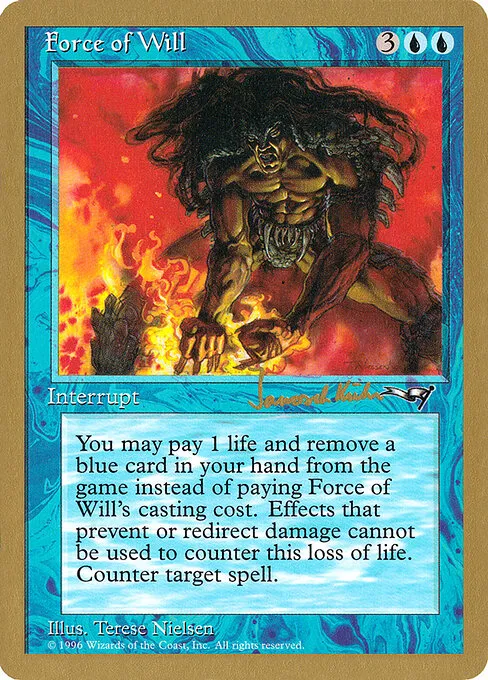
Almost every gold-bordered card you’ll run into is from the World Championship Decks. From 1997 through 2004, Wizards took four of the top-performing decks from that year’s World Championship, boxed them up as preconstructed sixty-card decks, and sold them. Every card got a gold border, plus the winning player’s name, the event location, and the year printed along the bottom. So the card literally says something like “Seattle 1997 (Paul McCabe)” on it. That’s your tell.
They stopped after 2004. The reason I’ve seen cited is that Fat Packs ate into demand for preconstructed product, so the line just wasn’t pulling its weight anymore. Whatever the reason, nobody’s printed a card in this style in twenty years, and Wizards is very unlikely to ever do it again.
The border is functional. It’s how a judge can tell at a glance that the card was never legal for sanctioned play, the same way silver borders flag the Un-set cards. Different color, different reason, same job.
So is it worth anything
Depends entirely on the card. Most gold-bordered cards are worth a couple bucks, because most of the cards in any given tournament deck are lands, removal, and filler nobody’s chasing. But the marquee cards can carry real weight.
Gaea’s Cradle is the king of the category. The gold-bordered 1999 printing sits around $310 right now. Sounds steep until you look at the black-bordered Urza’s Saga original, which is north of $1,500. So the gold-bordered copy is, functionally, a Gaea’s Cradle for a fifth of the price. It won’t be legal in a sanctioned event, but Commander doesn’t care, cube doesn’t care, and your kitchen table definitely doesn’t care.
That’s the whole appeal of the expensive end here. A lot of the chase cards from these decks are Reserved List staples, which means the black-bordered versions can never be reprinted and just keep climbing. Force of Will gold-bordered is around $26. City of Brass from the 1998 decks is about $15. Stifle out of the 2004 San Francisco decks runs $7 or so. None of those replaces a “real” copy in a tournament, but for formats that don’t require sanctioning they’re a genuine discount.
One oddity worth knowing: each World Championship deck also shipped with a small stack of blank white proxy cards, meant to stand in for basic lands. Those have their own tiny collector market now, which is very on-brand for this hobby. Even the filler that came in the box eventually became a thing people buy.
I’ll admit I go back and forth on whether these are actually a good buy. Part of me loves them as budget Commander pieces, real cardboard versions of cards I’d otherwise never own. Part of me knows that the second you want to sell, the gold border cuts your buyer pool in half, because plenty of players just don’t want a card reading “Tokyo 1999” across the bottom in their deck. Liquidity is worse than the sticker price suggests. I still think they’re underrated. I won’t pretend the discount is free.
The Collectors’ Edition cousins
There’s a second family of not-legal cards that trips people up, older and weirder. Back in 1993, right at the start, Wizards put out Collectors’ Edition and International Collectors’ Edition. Boxed sets that reprinted the original Limited Edition cards, dual lands, the Power Nine, all of it, as a keepsake product.
The tells are different here. Collectors’ Edition cards have square corners instead of the rounded ones every real card has, and the back carries a gold-stamped border where a normal card back doesn’t. The front looks almost exactly like a Beta card, black border and all, which is exactly the problem.
Because here’s where it gets ugly. A Black Lotus from Collectors’ Edition is worth around $3,000. A genuine Beta Black Lotus is worth more than a used car. That gap is big enough that people have, for decades, taken CE cards, rounded off the square corners with a cutter, and tried to pass them as the real thing. An Underground Sea from Collectors’ Edition runs about $480; the Beta version is many multiples of that. Same trimming trick, same scam. If you’re ever handed an old dual land or a piece of Power that looks too clean and has slightly-off corners, check that first. I wrote a whole thing on spotting counterfeit and doctored cards that goes deeper, but square-corners-filed-round is the classic tell for this specific family.
The difference between the US Collectors’ Edition and the International one comes down to a copyright line on the back and which market it sold in. Collectors care about the distinction. For value they’re close, with the International version usually a touch scarcer.
The part nobody warns you about: logging them
Here’s the practical annoyance if you actually own a few of these and want them in your collection tracker. They don’t behave.
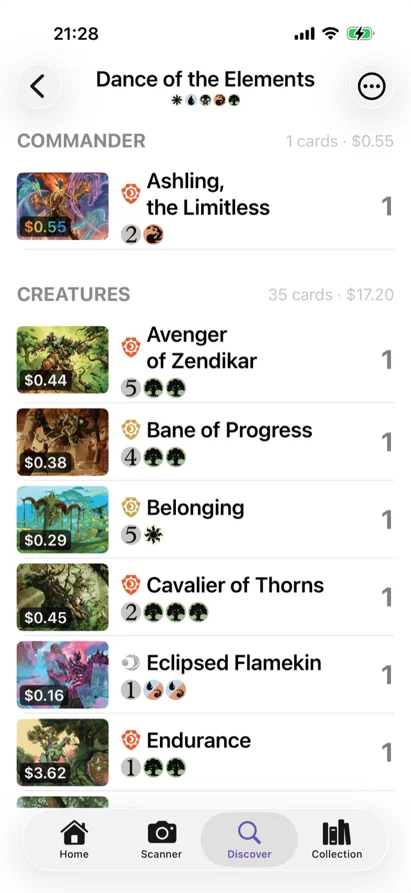
Scan a gold-bordered Gaea’s Cradle and most recognition apps, Eldwyn included, will match the front art and hand you back a regular Gaea’s Cradle entry, because the front image is basically identical minus the border color. The app isn’t wrong exactly. It just can’t read the border color as a separate printing the way it reads, say, a foil. So you scan it, it logs a Gaea’s Cradle worth $1,500-plus, and your collection total is suddenly very wrong.
What I do is scan it to get the card identified, then manually correct the printing to the World Championship version and tag it so I remember it’s the gold-bordered one. It’s fiddly. Same problem I have with artist proofs and other blank-backed oddities, where the front tells the truth but the printing won’t line up with anything the scanner expects.
Pricing them cleanly is its own headache, because the market is thin. TCGplayer carries some, Card Kingdom’s buylist is honestly one of the more reliable references for what these actually move at, and eBay sold listings tell you more than any single “market price” number. For anything gold-bordered I treat the listed price as a loose estimate and nothing firmer.
A quick word on the other not-legal stuff
While we’re here. Oversized cards, the big ones from Commander products and old Vanguard promos, were never meant for a real deck and aren’t legal. The 2022 30th Anniversary Edition proxies shipped with a different card back on purpose and aren’t legal either. Silver-bordered Un-cards, mostly relegated to joke events. There’s a surprising amount of Magic cardboard out there that you can own but can’t sleeve up for FNM.
So yeah. If it looks off, there’s usually a reason. Gold border, means World Championship, means not legal, means check the name printed on it. Square corners, means Collectors’ Edition, means check the back and the corners before you get excited. Different card back entirely, probably a proxy or a promo. Not complicated once you’ve seen each one a couple times. It just feels complicated the first time a weird one lands in your hands.
The card I still can’t get over is that flea-market Cradle. Traded it away years ago for something I genuinely can’t remember, which is the kind of thing you only regret in hindsight. If you’ve got one sitting in a box, at least now you know it isn’t Monopoly money.