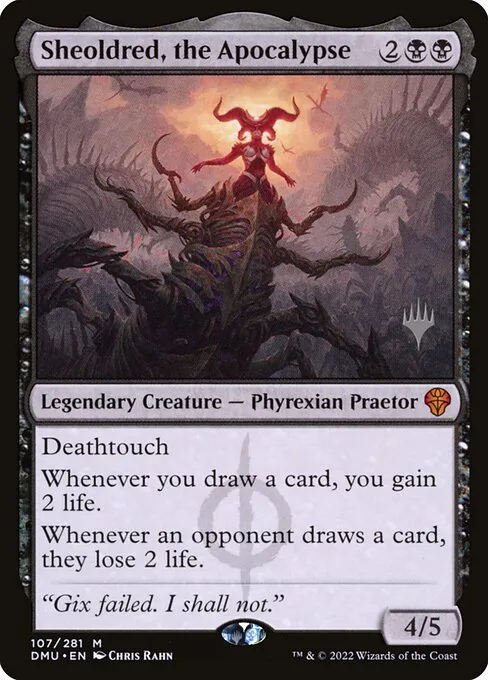
I traded away a foil Sheoldred once. Not a clean one. It was the prerelease copy, the one with the date stamp sitting right there in the middle of the text box, which I’d cracked at a Dominaria United prerelease and been extremely proud of for about a week. A guy at my LGS offered me a clean pack foil plus a couple of shocklands for it, and I took the deal figuring I’d robbed him. Turned out the stamped version sold for a few bucks under the clean one. So I’d essentially paid him a couple of shocks to take my worse-feeling card off my hands. Good night all around.
That’s the whole problem with MTG promo cards. The category is enormous, it’s confusing, and two versions of the exact same card can be worth wildly different amounts depending on where the card came from and whether somebody printed a little logo on it. Some promos are worth twenty times the normal copy. Some are worth less than the version you can pull out of a pack. And when they’re all sitting in the same binder, they look basically identical until you know what you’re looking at.
The MTG promo cards that are actually worth money
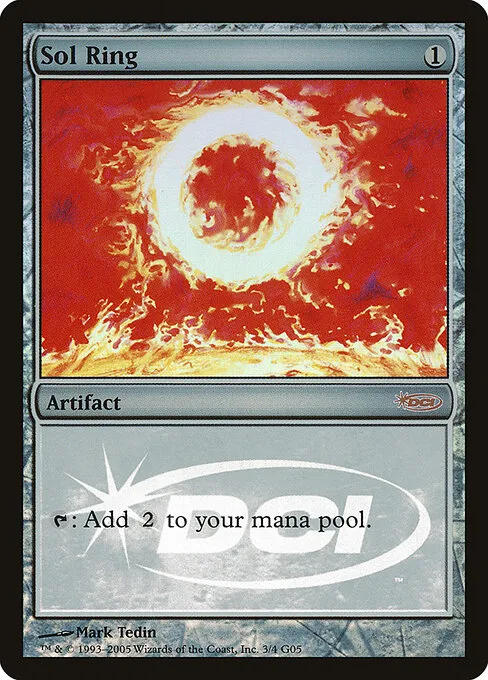
Judge promos are the big one. These got handed out to certified judges as a thank-you for working events, they’re always foil, and they’ve never been available any other way. That scarcity does a lot of work. A regular Sol Ring is worth about $2, the kind of card you have nine of and can’t give away. The 2005 judge foil Sol Ring is around $459.
And that’s not even the ceiling. The 1998 judge promo Gaea’s Cradle sits near $3,999 right now. Four thousand dollars for a card that a judge got for free for spending a weekend answering rules questions about whether Humility turns off your own creatures. Wasteland’s judge foil from 2010 runs about $88, against roughly $28 for the Eternal Masters copy most people own. The pattern holds across the whole program: take a card people actually want, make a foil version that basically never entered circulation, watch the price do something silly.
The other tier that carries real money is the old San Diego Comic-Con exclusives. Back in the mid-2010s Wizards did these all-black-background planeswalkers as convention giveaways, and they look incredible in person, genuinely some of the best-looking cards they’ve ever made. The SDCC 2015 Liliana, Heretical Healer goes for about $173. Her normal Magic Origins printing is a $5 card. Same rules text, same everything, one of them just happened to be given out in a hall in San Diego to a few thousand people.
If you’ve got a judge foil or an SDCC card floating around in a bulk box, that’s the one to pull. It won’t announce itself. It just looks like a slightly fancier version of a card you already recognize.
The stamp in the middle of your card
Now the other direction. Most of the promos you actually own are the ones everybody got, and those mostly don’t do anything.
Prerelease promos are the classic example. Every prerelease, you crack a pack, and one of the cards has a date stamp printed over the art or in the text box. For a long time I assumed the stamp made a card more special, more collectible, a little proof-of-attendance thing. It does not. For most collectors the stamp is a downgrade. The clean pack foil is the one people chase, and the stamped version trades at a small discount to it. My Sheoldred was a perfect illustration: the promo-pack stamped copy runs about $95 right now, while the clean set foil is closer to $111. Not a huge gap. But it’s a gap in the wrong direction from where my brain expected it to be.
Promo-pack cards fall in the same bucket. Those are the ones from the little sealed promo packs that used to come with FNM participation, the modern replacement for the old FNM foils. Perfectly nice cards. Usually the cheapest foil printing of whatever they are, because there are a ton of them and the stamp keeps the picky collectors away.
So yeah, buy-a-box promos. You know the ones. You preorder a box, you get the bonus card, it’s usually some mid Commander card with alternate art that nobody was clamoring for. Herald’s Horn, that kind of thing. Fine to play. Basically never worth anything, because everyone who bought a box has one, and everyone who bought a box is the exact population that already has too many cards. I don’t think I’ve ever sold a buy-a-box promo for more than a dollar.
There’s one famous exception, and it’s worth knowing because it flips the logic. Nexus of Fate was a buy-a-box promo for Core Set 2019, and for a while it was the only way to get the card at all. It never appeared in packs. It was also a genuinely strong card in Standard at the time, so you had real demand meeting artificial scarcity, and it spiked to something like $25 to $30 despite being a “free with purchase” card. Then Wizards reprinted it a bunch and it’s back down around $8. The lesson isn’t that buy-a-box promos are valuable. It’s that scarcity plus playability is the thing, and the promo label is almost beside the point.
Knowing which one you’re holding
Here’s where it gets practical, and honestly a little annoying. All of these versions share a name. Your judge foil Sol Ring and your bulk Sol Ring both say “Sol Ring.” The difference lives at the bottom of the card, in the set code and collector number, plus whatever stamp or watermark is on the frame. A judge card has a little star or a “DCI” mark. SDCC cards have their own set code. Prerelease cards have the date.
This is the part that trips up anyone cataloging a big collection, and it’s the reason I care about it beyond just trivia. If you’re logging cards and you tag your $173 SDCC Liliana as a regular $5 Liliana, your collection total is quietly wrong by a lot, in a way you won’t notice until you go to sell. It cuts the other way too. You don’t want to price a stamped promo-pack card as if it were the clean foil and then get a lowball “offer” that’s actually fair.
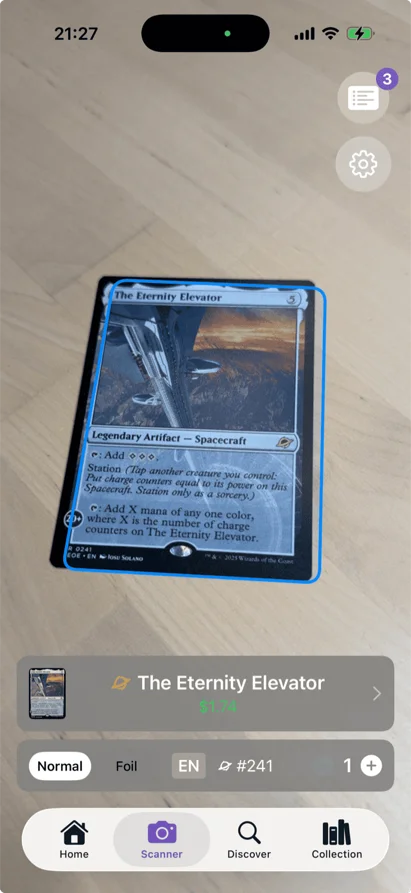
When I scan promos, the printing is the whole ballgame. A scanner that just reads “Sol Ring” and stops hasn’t told me anything useful. I need it to catch that this is the 2005 judge foil, and price it as that. Foils and alt-art cards are already the fussiest things to scan, and promos add another layer of “which exact one is this” on top. It’s worth slowing down for, because the gap between right and wrong is sometimes four thousand dollars and sometimes fifty cents.
I’ll admit I’m a little inconsistent about all this. I keep my prerelease foils even though I know they’re worth less, because I was there, I opened them, and a card with a date stamp is a tiny receipt for an afternoon I enjoyed. That’s not a financial decision and I’m not going to pretend it is. But when I’m actually valuing the collection, I make myself separate the sentimental pile from the “what is this genuinely worth” pile, and promos are where those two piles diverge the hardest. What actually makes a card a chase card has almost nothing to do with whether it’s a promo, and almost everything to do with how few exist and how many people want them.
So: judge foils and SDCC cards, pull them and check the price. Prerelease and buy-a-box, enjoy them, sleeve the ones you like, and don’t count on them for anything. And when in doubt, read the bottom of the card before you read the name.