A guy at my old LGS once sold me a Revised Underground Sea for $400 and told me, with a completely straight face, that I’d just bought “a Reserved List card, so it can only go up.” This was years ago. He was wrong about one of those things, and it took me embarrassingly long to figure out which.
The Underground Sea has gone up, sure. But the Revised printing he sold me isn’t actually on the Reserved List at all. I owned a card I’d been told was reprint-proof, and it wasn’t. The price had nothing to do with the promise I thought I was paying for.
That gap between what people think the MTG Reserved List protects and what it actually protects is where most collectors get tripped up. So here’s the version I wish someone had given me back then.
What the Reserved List actually is
Back in the mid-90s, Wizards reprinted a pile of old cards in Fourth Edition and especially in Chronicles, and the prices of the originals cratered. People who’d been treating their collections like a savings account were furious. Some of them were loud about it. The story that gets passed around is that lawyers got involved, though I’ve never seen the actual paperwork, so take the “they got sued” part with a grain of salt.
What’s not in dispute is that on March 4, 1996, Wizards published a reprint policy with a list attached. The promise was simple: the cards on that list would never be printed again in a tournament-legal paper form. That’s the Reserved List. It covers cards from Magic’s earliest sets, the original ten dual lands, the Power Nine, and a long tail of rares from Arabian Nights through the Urza’s block.
The list got edited a couple of times. In 2002 they trimmed it, pulling off the commons and uncommons from the early sets and declaring that nothing from Mercadian Masques onward would ever be added. So anything printed after autumn 1999 was never eligible in the first place, which is why your foil Onslaught fetchlands have nothing to do with any of this. Then in 2010 they closed the last loophole. The original policy had quietly allowed premium foil reprints, and when From the Vault: Relics shipped with foil versions of Reserved List cards, the backlash got bad enough that they swore off even that.
Since then, nothing. Thirty years and the list has held.
The printing trap
Here’s the part my LGS guy got wrong, and the part that actually matters when you’re looking at your own binder.
The Reserved List protects specific cards, but for the dual lands it only ever covered the Alpha, Beta, and Unlimited printings. Revised duals, the ones most people actually own, were printed in 1994 and are not on the list. Wizards could legally reprint a Revised-frame Volcanic Island tomorrow. They won’t, because the community would set the office on fire, but legally there’s nothing stopping them.
So why does a Revised Underground Sea still run about $945 if it isn’t reprint-protected? Because reprint immunity was never the only thing holding the price up. These cards are thirty years old, they got opened in tiny print runs, half of them got played to death without sleeves, and Legacy players genuinely need them. Scarcity and demand do most of the work. The Reserved List just guarantees Wizards won’t dump new supply on top.
This is the thing to internalize: the list doesn’t make a card valuable. It removes one specific risk to value. A Beta dual costs multiples of the Revised one not because Beta is “more on the list” but because Beta is older and rarer and collectors pay a premium for the frame. Knowing exactly which printing you’re holding is the whole ballgame with old cards, and it’s the single easiest place to lose money or leave it on the table.
A floor, not an elevator
I keep seeing the Reserved List described like it’s a guaranteed upward escalator. It’s closer to a floor. It puts a ceiling on supply, which puts a soft floor under price, and that’s it. Plenty of cards on the list are worth almost nothing.
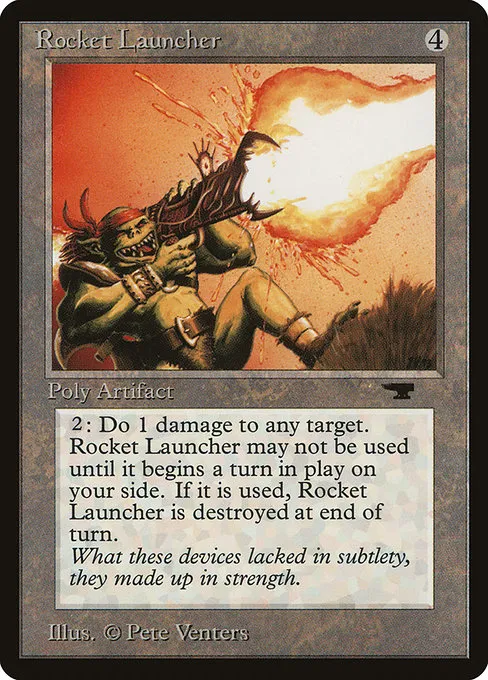
Rocket Launcher, from Antiquities, is on the Reserved List. Wizards has formally bound itself to never reprint it. It’s worth about $5. You can buy a card Wizards legally cannot ever print again for less than the price of a draft booster. Sentinel out of Legends is another one, roughly $10. There are dozens like these. Reprint immunity plus nobody wanting the card equals a bulk rare that happens to have a legal force field around it.
And even the protection isn’t as airtight as the word “never” suggests. Wizards can’t reprint the card, but they can print a card that does almost exactly the same thing. Harmless Offering is a red copy of Donate with one mana symbol changed, and it sailed right past the policy because it’s technically a different card. They’ve done this kind of color-shifting and functional-reprint move more than once. If you’re holding a Reserved List card purely because it has a powerful effect, that effect can absolutely show up again on a card that isn’t protected, and the original can soften.
Now, does that actually crash the originals? Mostly no, in my experience. The collector demand for the real Donate is basically zero either way, and for the chase cards, the dual lands and the Power Nine and the Legacy staples, a functional reprint in a different color doesn’t dent the people who want the actual artifact. The Tabernacle at Pendrell Vale is pushing $2,900 and nothing Wizards has printed has come close to replacing it. So I’ll walk back the doom a little. The floor is real for cards people genuinely want. It’s just not a floor under everything with the Reserved List stamp.
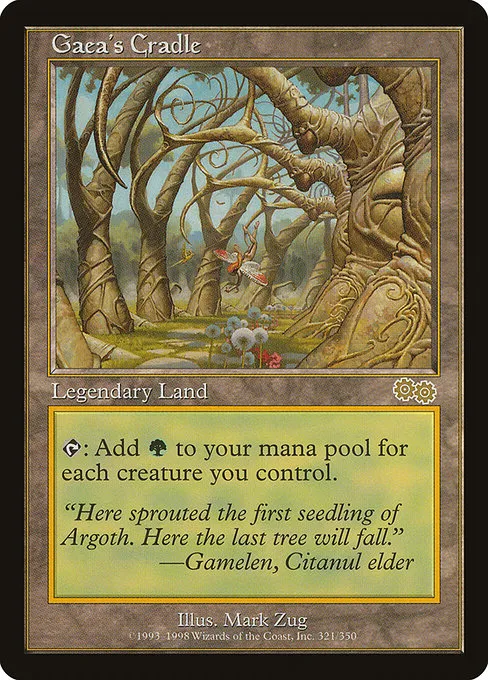
Where it gets genuinely interesting is the top end. Mishra’s Workshop sits around $3,000, Gaea’s Cradle around $1,500, and those numbers move on Legacy and Vintage and Commander demand, not on any promise from Wizards. The promise is the reason new supply can’t show up to cool them off. The demand is the reason there’s a price worth cooling in the first place.
So what do you do with this
If you’ve got old cards, the move is to figure out which printings you actually own before you assume anything about value. So yeah. Pull the box down. Check the set symbol, check whether it’s Beta or Unlimited or Revised, because for the duals that’s a five-hundred-dollar question and people eyeball it wrong all the time. I’ve definitely mislabeled an Unlimited as a Beta once and only caught it because the border was off. Don’t trust the seller’s word. Don’t trust your own memory either.
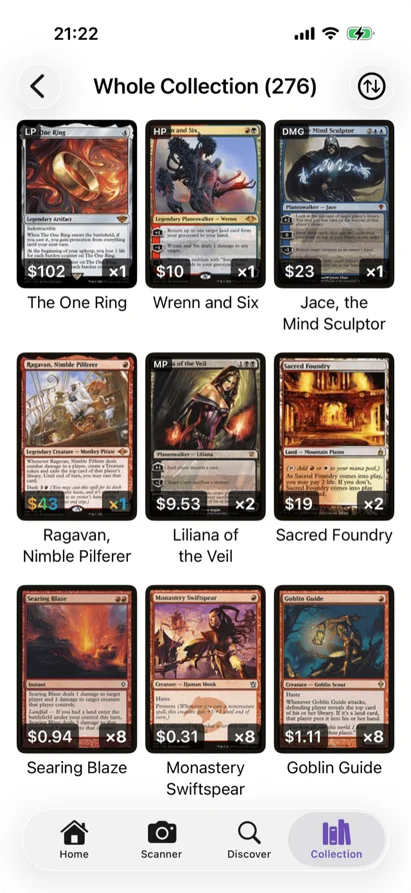
I scanned my whole old binder a while back partly to settle exactly this, because I had three duals and genuinely couldn’t remember which editions they were, and the printing detection sorted it in a couple of minutes per card. That’s the boring practical use for knowing your printings: the difference between a Revised and an older dual is the difference between two very different cards, and the Reserved List status is only one input among several.
The Reserved List is one of the few things in Magic finance that’s stayed genuinely fixed for three decades, which makes it weirdly comforting in a game where Wizards reprints everything else into oblivion. Just don’t read more into the label than it carries. It tells you Wizards won’t print more. It doesn’t tell you anyone wants the card. If you want the second half of the picture, you still have to actually price the thing.