I drafted Teenage Mutant Ninja Turtles exactly once, at my LGS on a Friday back in March, and I went 1-2 with a Donatello deck that did nothing except make Mutagen tokens and lose slowly. Genuinely fun set to play. The sneak mechanic is clever, the Turtles all feel distinct, the art is great. But I remember opening my prize pack at the end of the night, pulling a foil Triceraton Commander, and thinking, okay, what is this actually worth. The answer was “not much,” and three months later that’s still mostly true.
So this is the part of the Universes Beyond cycle where I check back in on a set once the preorder hype has drained out and prices have settled into whatever they’re going to be. I did the same thing with Lorwyn Eclipsed and with Lost Caverns of Ixalan. Teenage Mutant Ninja Turtles is a more interesting case than either, because the value is spread so unevenly across the set.
The base set is two cards and a cliff
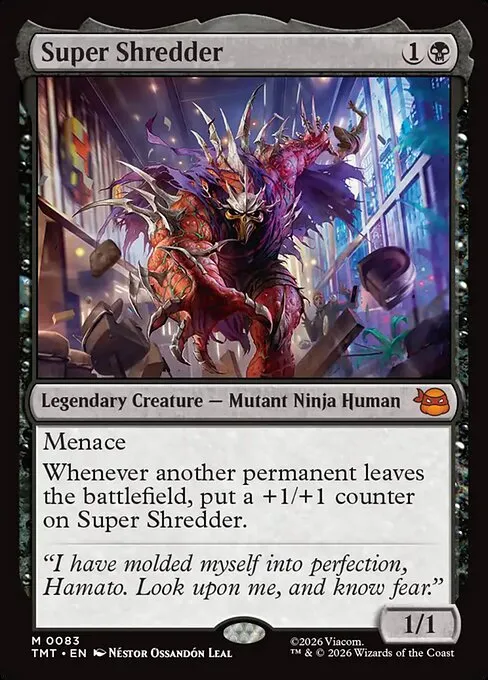
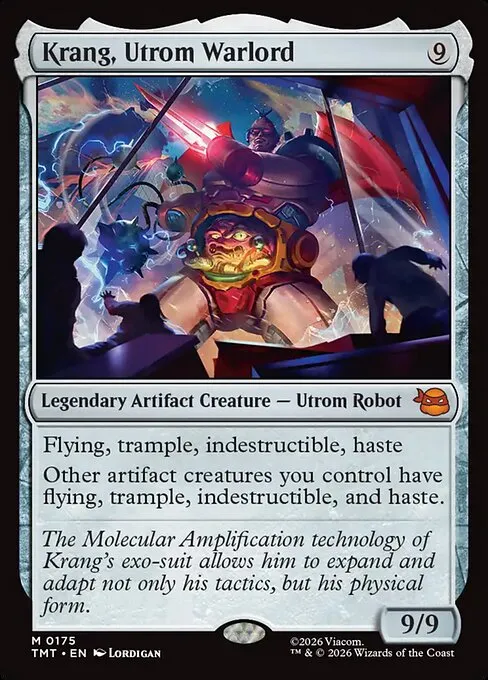
Pull up the singles list for Teenage Mutant Ninja Turtles and sort by price. Two cards sit above ten bucks. Super Shredder at around $18, and Krang, Utrom Warlord at about $17. That’s the top of the set. Both are cards with genuine Commander demand, which is the only reason they’re propping up the rest.
After those two, you fall off a cliff. Cool but Rude is under $6. Dark Leo & Shredder is around $5. Michelangelo, Weirdness to 11 in its normal printing is about $4. And then it’s a long gentle slope of two-dollar rares down into the bulk pile, where the vast majority of a 252-card set lives.
If you cracked a box of Play Boosters hoping to hit singles value, the math was never going to love you. A draftable set front-loads value into a small handful of chase rares and mythics, and TMNT front-loaded harder than most I’ve tracked. Two cards carry the entire base set on their backs, and one of them is a villain most casual buyers didn’t even come for. People bought this set for the Turtles. The Turtles, in their plain printings, are mostly two-to-four-dollar cards.
I keep wanting to call that disappointing, and then I remember nobody buys a TMNT crossover for EV. You buy it because you were eight years old watching the 1987 cartoon eat an entire Saturday morning. That’s a different kind of value, and not one a price tracker can measure.
Where the money actually went
The base printings being cheap doesn’t mean the set is cheap. It means you’re looking at the wrong column.
Super Shredder is about $18 in its normal frame. The borderless foil version runs north of $70. There’s an extended-art foil treatment that clears $300. And then there’s the Spotlight Series printing, the serialized special-frame one, sitting around $345 in nonfoil and well over $1,000 in foil. Same card. Same name on the type line. A fifty-fold spread depending on which version came out of the pack.
Michelangelo, Weirdness to 11 does the same trick. Four dollars in its base printing. Twenty-seven in borderless foil. And the top treatment, the one seeded in well under one percent of boosters, sits around $150.
This is the modern Universes Beyond collecting reality, and TMNT is a textbook case. The chase isn’t “which card.” It’s which treatment of which card. The named-character cards, the Turtles and Shredder and Krang, hold a premium in their fancy frames that their gameplay would never justify, because people want the cool version of a character they grew up with. I got into the weeds on this when a serialized Sol Ring hit $900, and the same engine is running here.
The tracking problem nobody warns you about
So here’s the actual headache. You pull a foil Super Shredder. Great. Is it the $24 main-set foil, the $73 borderless, or the four-figure Spotlight serialized one. They look different if you know exactly what to look for. But if you’re sorting a stack of forty TMNT cards at 11pm, you are not looking that closely. I have mis-shelved a borderless card as a base printing before. More than once. The collector number down at the bottom is the tell, and I wrote a whole thing about reading the bottom of the card, but you have to actually check it, every time, which nobody does by hand.
This is exactly where logging your pulls properly matters more than the cards themselves. A pile of TMNT singles where you don’t know which treatment is which is a pile where the four-figure card and the eighteen-dollar card are sitting in the same row looking like the same thing. Scanning each one and letting the app pin the exact printing is the difference between knowing you’ve got a Spotlight Shredder and finding out two years from now when you finally get around to the box. If the treatments confuse you as much as they confuse me, I went deeper on telling them apart in this piece on borderless, extended, and showcase frames.
Maybe I’m overstating the tracking thing. If you only opened a couple of packs, you can eyeball your six rares and be done in a minute. The treatment problem only really bites once you’re dealing in volume, or once you start buying singles online and a seller can quietly ship you the cheap printing of a card you thought you were getting the nice version of. But once you’re at that point, it bites hard, and it bites in dollars.
What I’d actually hold
If I had TMNT singles in a box right now, the two base cards worth sleeving and tracking are Super Shredder and Krang. Full stop. Everything else in plain print is a play card, not a hold, and I’d happily throw it in a deck or a trade binder rather than baby it.
The treatments are the other story. A borderless foil Turtle, or a Spotlight serialized anything, is worth identifying, sleeving, and absolutely not chucking in the bulk box because you assumed it was a four-dollar card. Universes Beyond sets don’t get reprinted the way normal sets do. The licensing makes it complicated, which is part of why people keep asking whether UB is the new Reserved List. The fancy versions of these cards might be the only versions that ever exist. That isn’t a guarantee they climb. Plenty of UB chase cards have drifted down as the novelty wore off, and TMNT could easily do the same once the next crossover sucks up everyone’s attention. But the supply side, for once, isn’t actively working against you.
Three months is early, to be fair. Prices on a set this young are still finding their floor, and a TMNT card that’s $5 today could be $3 or $8 by winter depending on whether something breaks out in Commander. I’ll probably check back at the one-year mark. For now the shape is clear enough. A thin base set, a stack of genuinely valuable treatments hiding inside it, and a whole lot of two-dollar Turtles that are worth keeping for reasons that have nothing to do with money.