I traded my stamped Badgermole Cub away the same night I opened it. November, Avatar prerelease, one of those stores in a shopping center where the lighting is bad and the pairings printer jams every third round. I cracked the promo, looked at a two-mana green 2/2 that turns a land into a creature, decided it was a perfectly nice limited card and nothing else, and swapped it for a Wan Shi Tong and a stack of foil commons I have never once put in a deck. The guy across the table did not have to work hard on me. I think he was worried I’d notice.
That stamped copy is $124.69 today. Wan Shi Tong is $35.18.
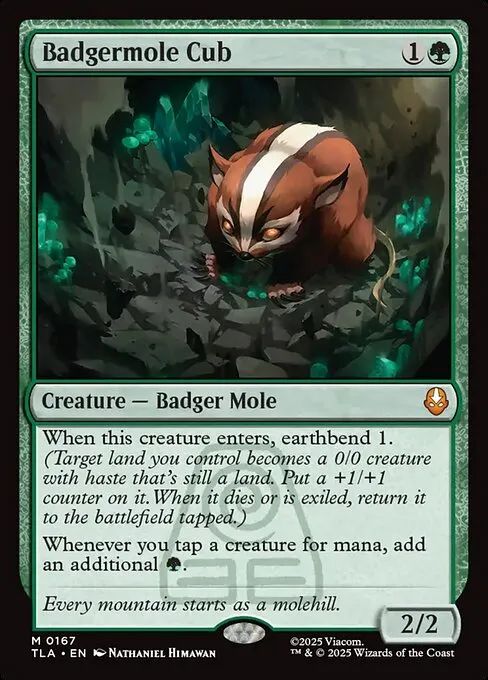
Wizards banned Badgermole Cub in Standard yesterday morning, alongside Gran-Gran and Stormchaser’s Talent, and put The Fantasticar on the Legacy banned list and the Vintage restricted list while they were in there. Selesnya Offense was running about a 57% win rate on Arena. That’s the kind of number that removes a card whether or not anybody was having fun.
Usually a Standard ban on the most expensive card in a set is a simple story. The card falls. This one isn’t simple, because Badgermole Cub doesn’t have a price. It has four of them, and they were only ever moving together by accident.
Four printings, one card
Here’s where the Cub actually sits as of this morning.
The regular Avatar printing, collector number 167, is $51.90 in non-foil and $57.53 in foil. The borderless version at 326 runs $69.61, or $93.53 foiled. And the prerelease promo, the date-stamped foil in its own little promo set, is $124.69.
The gap between the cheapest and the most expensive version of this card is bigger than most people’s entire Standard deck.
I wrote about that stamp yesterday, which is either good timing or terrible timing depending on how you look at it. Short version for anyone who missed it: Wizards killed the prerelease date stamp starting with Lorwyn Eclipsed. There are 4,041 date-stamped printings in Magic’s entire history, that number is now permanently frozen, and Badgermole Cub is the last card that ever got one.
So the stamped copy was carrying two separate premiums stacked on top of each other. It was an expensive Standard mythic, and it was the closing entry in a category that shut its doors. Yesterday, one of those two things stopped being true.
What happened to The One Ring
The obvious comparison is sitting right there and I keep going back and forth on whether it’s a real comparison or one I want to be real.
The One Ring is banned in Modern. Has been for a while. Its regular Tales of Middle-earth printing is $104.75 non-foil, $131.79 in foil, and the prerelease date-stamped promo is $275.90. That’s better than double the set foil, on a card that got thrown out of the format it broke.
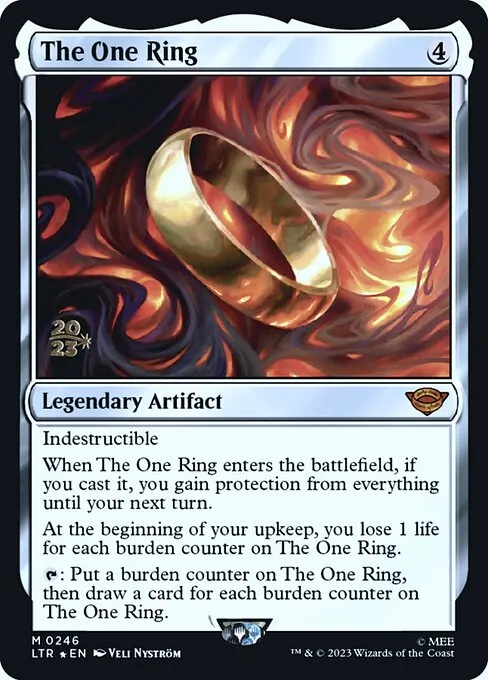
If you squint, that’s a tidy little proof. Competitive ban lands, collectible premium shrugs, stamped copy keeps its multiple. Go put your Cub back in the binder and stop reading.
Except The One Ring is a Commander card and always was. Modern was never what held that price up. It’s in an absurd number of decks, it goes in literally any of them, and the ban barely dented demand because the demand was never coming from Modern in the first place. The stamped promo held its premium because the underlying card held. That’s not the same as a stamp premium being independent.
Badgermole Cub is in about 112,000 Commander lists on EDHREC, which is more than I assumed when I started poking at this, and honestly more than I’d have guessed from the card. Green mana doubling is sticky. People jam it in elf decks and forget it’s there. But 112,000 is not The One Ring money, and the Cub’s price was mostly Standard players buying playsets.
Which makes me think the stamped copy falls too. Not as far, maybe, but it falls, because a scarcity premium is a multiplier on how much people want the card underneath it, not a floor that holds the card up. Multiply a smaller number by the same 2x and you still get a smaller number.
Although. If the stamp premium really is proportional, then the stamped Cub and the regular Cub should fall by roughly the same percentage, and that’s not what the Lutri printings did when that card moved. The promo versions there went their own way entirely. So maybe I’m wrong about the mechanism and the right answer is that nobody knows, which is an unsatisfying thing to build an article around.
The price you’re looking at is not today’s price
Something worth knowing on a ban day specifically.
I pulled Badgermole Cub’s price from Scryfall three times in about ten minutes while I was writing this and got $53.53, then $36.64, then $51.90. Same card, same printing, same session. Some of that is caching across their infrastructure and some of it is that the underlying TCGplayer market price is a trailing average of completed sales, so on the morning after a ban it’s averaging a bunch of pre-ban transactions with a handful of panicked post-ban ones. I don’t actually know how heavily TCGplayer weights recency in that calculation. I’ve never found a straight answer.
So yeah, ban day. Every price you see is wrong, in both directions, and everyone’s screenshotting them anyway. The listings move first because sellers reprice in minutes, but market price is a lagging thing, and the gap between those two numbers is at its absolute widest right now. Give it a week and a half. Two weeks.
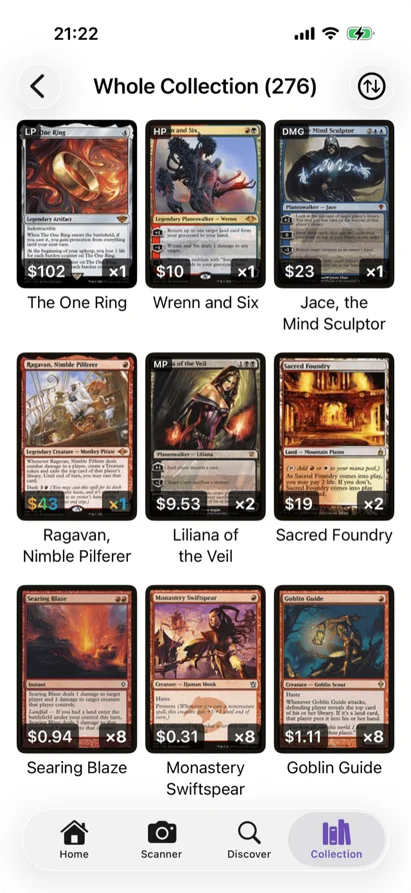
This is exactly the situation I had in mind writing about when to re-price a collection. Bans are the event that actually moves numbers, but the day of the announcement is the worst possible moment to record anything, because you’ll capture a value that’s half stale and feel like you’ve documented something. Wait for it to settle, then rescan.
If you own some, the printing matters more than the ban
The practical bit, and then I’ll stop.
Go check which Badgermole Cub you actually have. The regular 167, the borderless 326, and the stamped promo are three different rows with a $73 spread between the extremes, and if you logged yours as a plain Avatar mythic in November you may be looking at a number that’s badly understated even after a ban knocks the top off. Reading the collector number and set code is the whole job here, and the promo is the easy one to spot because it’s the only one with a year printed in the text box.
Then don’t sell for a couple of weeks. I know that’s the boring answer, and I know the four questions worth asking about a banned card mostly point toward holding anyway. But the specific reason here is that the Cub still has a real Commander home and the stamped version has a story attached to it that didn’t exist eight months ago. Both of those things need time to show up in a price, and neither will do it during a week when everyone’s attention is on The Hobbit dropping on Friday.
Gran-Gran, meanwhile, is $0.33. She was banned in the same announcement, from the same set, for being a key piece of a deck that made up 15% of the format. Nobody is writing anything about her printings.