I bought a “Near Mint” dual off TCGplayer last month and it showed up with a thin white halo running all the way around the back border. The front was gorgeous. Pack-fresh, even. But the back looked like somebody had dragged a thumbnail down every edge, and that’s the side the seller apparently never bothered to flip over. It was a few bucks of difference so I let it go. But that little halo is exactly why knowing how to read MTG card condition matters before you buy, sell, or trade anything worth more than a draft common.
The vocabulary is the easy part. Most of the market runs on five grades: Near Mint, Lightly Played, Moderately Played, Heavily Played, and Damaged. TCGplayer uses all five. Star City Games collapses the middle into one “Played” bucket and runs four. The exact wording shifts site to site, but everyone’s pointing at the same spectrum, from “looks unopened” down to “you can still tell what it is and that’s the only promise.”
What nobody tells you when you start is that grading a card is mostly about the back.
Flip the card over first
Both TCGplayer and SCG grade primarily off the back, and once someone says that out loud it seems obvious. The front is the busy side. Art, text box, mana symbols, a black border on most modern cards that politely hides edge wear. The back is one flat field of brown and white, and any whitening, any softened corner, any scuff shows up against it like a coffee ring on a white shirt.
So flip it. Hold the card under a real light, daylight or a bright LED, and tilt it slowly so the reflection crawls across the surface. You’re looking for whitening along the four edges, fraying or rounding at the corners, and hairline scratches that catch the light. Then check the front the same way. Then hold the whole thing flat at eye level and sight down the surface for any bend or crease.
The whole pass takes maybe ten seconds once it’s a habit. Front under the light, back under the light, sight down the edge for bends, and when you’re stuck between two grades, assign the lower one. Back whitening is the single most missed defect, and it’s missed because people grade the side that’s fun to look at.
A crease is its own category of heartbreak. There’s no such thing as a minor crease. If light breaks across a line in the card, if the surface is actually split and not just bent, that card is Damaged. Not Heavily Played with an asterisk. Damaged. A flawless card with one creased corner is a Damaged card, full stop, and I’ve watched people argue this at tables for twenty minutes like the rule was up for debate.
I learned that one the slow way. Years ago I traded for a Tarmogoyf at an FNM, eyeballed it under the store’s awful fluorescents, called it Lightly Played, felt great about myself. Got home, put it under a desk lamp, and there it was: a shuffle crease running right through the art, the kind you only catch at the exact wrong angle. I’d handed over a genuinely clean Snapcaster Mage for it. Still annoyed about that, honestly, and it was probably eight years ago.
The rule that would have saved me is the one every buylist grader already lives by. When a card sits on the line between two grades, call the lower one. Nobody has ever been upset that a card arrived nicer than the listing said.
What MTG card condition is actually worth
Here’s the part that changed how I sort. Condition doesn’t matter evenly across a collection. It matters enormously in a narrow band near the top and barely registers everywhere else.
Most of the value swing happens between Near Mint and Lightly Played. Roughly, NM is your 100%, LP lands somewhere around 80-90% of that, MP drops to 60-70%, HP to 40-50%, and Damaged is a coin flip between 20% and 30%. Those are loose numbers and they wobble per card, but the shape holds: the cliff is steepest right at the top, then it flattens.
Which means two very different cards barely care about condition at all, for opposite reasons.
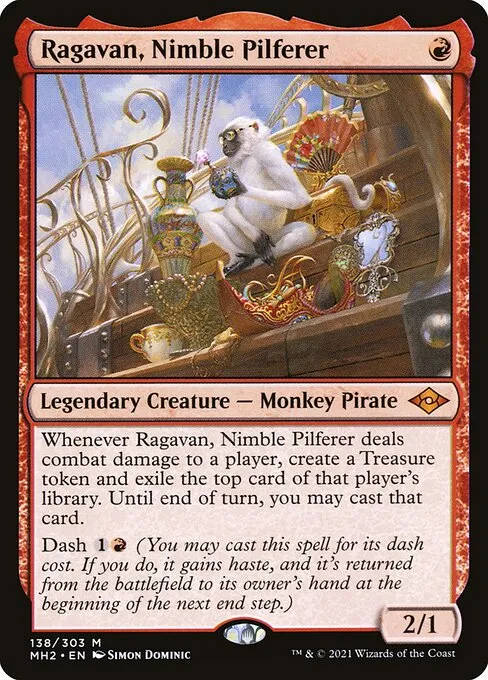
A modern tournament staple is the first kind. Take Ragavan, around $45 in Modern Horizons 2. Competitive players sleeve that thing the second they get it and never look at the back again, so a Moderately Played copy can move for 75-85% of NM without much fuss. The card’s a tool. Tools get used. As long as it’s sleeve-legal nobody’s docking it much.
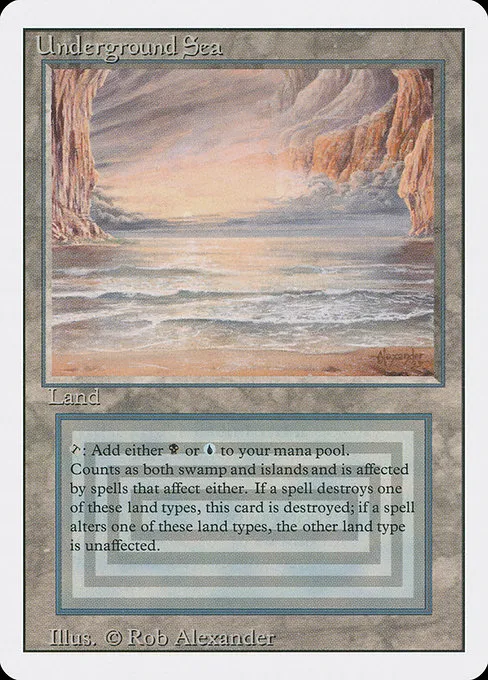
The other kind is the old, scarce stuff. A Revised Underground Sea runs north of $900 in NM, and a genuinely beat-up copy still clears a few hundred dollars, because there’s a hard ceiling on how many of them exist and that ceiling never moves. Reserved List cards hold value in any grade for the same reason a damaged first-edition anything still sells: scarcity outweighs scuffs.
So yeah, condition. Look. For the cards I actually jam in decks, I stopped sweating it ages ago. They’re sleeved, they’re getting shuffled four nights a week, they’re going to wear, who cares. It’s the stuff sitting in the binder doing nothing but holding value where careful grading pays off, and that’s a much smaller pile than most of us want to admit.
Although, even as I type that, I know it’s not fully true. I’ve talked myself into “eh, it’s a player card” about something I later decided to sell, and then the LP haircut stung more than I expected. So maybe the real rule is just to know which pile a card belongs in before you decide how careful to be with it.
Foils, old stock, and the stuff that fools you
Foils get judged harder, and they earn it. The reflective layer shows every scratch, so a foil with a clean front and a scuffed back drops a grade faster than a non-foil would. They also curl, which is its own condition headache I’ve already ranted about over here. A little curl most graders tolerate. A lot of curl, or curl stacked on top of any other wear, and you’re out of NM.
Older card stock is the great trap. Cards from the 90s were cut and finished differently, and a perfectly well-kept Revised card can look rough sitting next to a modern one straight from the pack. Don’t grade a 1994 card against a 2024 card. Grade it against its own era. A little edge softness on an Ice Age common is just what thirty-year-old cardboard looks like.
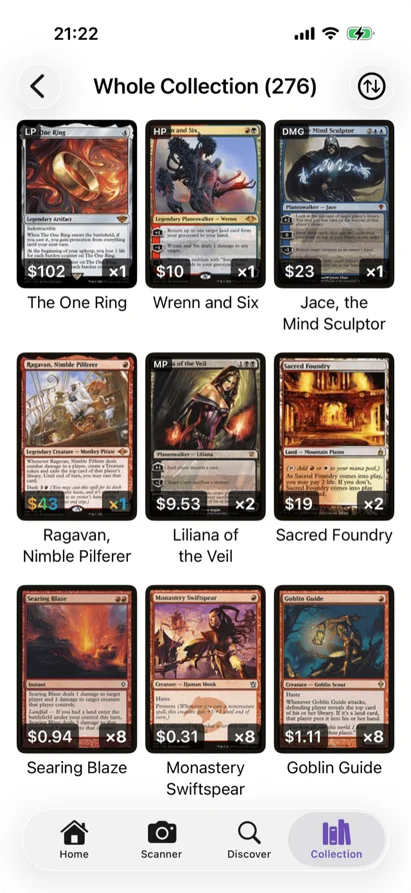
When I’m logging a box into Eldwyn I set the grade as I scan, while the card’s already in my hand under the lamp, because handling every card twice is how grading turns into a chore you abandon halfway through a long box. Default the played-looking ones to LP, save NM for the ones that genuinely went pack-to-sleeve, and the running total at the end actually means something. That number is what you lean on later when you price the whole collection or figure out where to sell.
Condition and grading are two different animals, by the way. Self-reported NM/LP/MP is what you and every TCGplayer seller slap on raw cards. Sending a card off to PSA or BGS for a numeric 1-to-10 is a slower, pricier bet, and most cards aren’t worth the fee. If you’re weighing that, I put the whole math in the slab-grading post.
One last thing, because I genuinely don’t have a clean answer for it. Cards that are NM on the front and MP on the back leave me stuck every time. The grading rules say take the lower of the two sides, so MP. But a sleeved card only ever shows its front at the table, and plenty of buyers grade the same loose way I used to. I usually list those honestly and eat the lower price. Doesn’t mean I feel good watching the dollar figure drop for damage nobody will ever see in a game.