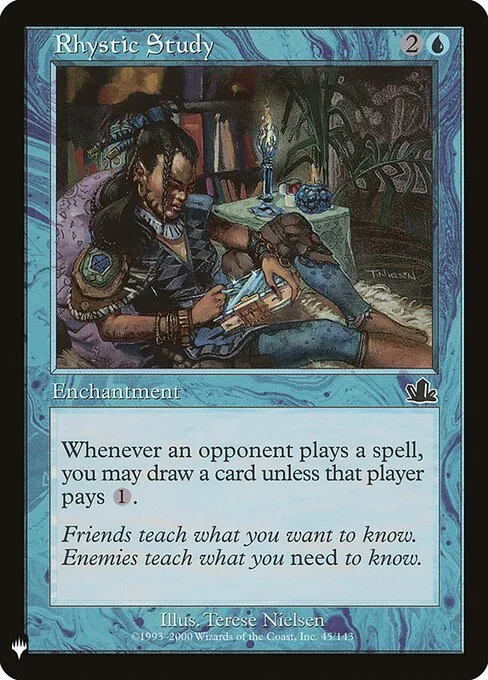
There’s a Rhystic Study in my trade binder I’ve been mildly suspicious of for about four years. Not counterfeit-suspicious. It’s real, it’s old-frame, it’s got the Terese Nielsen art with the guy reading in bed by candlelight. But the bottom of it is wrong in a way I couldn’t articulate for a long time. It says “45/143” and a copyright line and nothing else, which is correct for a card from 2000, and then down in the bottom-left corner of the black border there’s a tiny white planeswalker glyph sitting where nothing should be.
That glyph means it came from The List. If you’ve opened a Magic pack at any point between late 2020 and early 2025, you probably own a few of these and have never once thought about it.
What The List actually was
The List was a rotating catalogue of old cards that Wizards slotted into booster packs. It started in Set Boosters with Zendikar Rising in 2020, moved over to Play Boosters when those became the standard pack in 2024, and then got retired in early 2025. Roughly one Play Booster in eight had a List card in it instead of a seventh common, and that ratio is why so many of these are in circulation without anyone paying attention.
The cards themselves were pulled from anywhere in Magic’s history. Not reprinted with new art or a new frame, just reproduced as they originally looked, with the original set symbol and the original collector number. The whole point was that opening one felt like reaching into a shoebox from 2003.
Scryfall files all of them under the set code PLST, and there are 5,117 of them. That’s an absurd number for a product most players think of as a bonus slot. It’s bigger than most Masters sets by an order of magnitude. Some of that is because The List absorbed the original Mystery Booster convention cards along the way, and if you query Scryfall for the old mb1 code today it just redirects you to PLST. Two different products, one set code, and I don’t love that but it’s not my database.
The bottom of the card lies
Here’s the practical part. Everything you’d normally use to identify a printing is wrong on a List card, on purpose.
Take Esper Sentinel. The List copy has the Modern Horizons 2 set symbol in the type line, and the bottom-left corner reads 012/303 R and MH2 · EN. That is the exact collector line an actual MH2 Esper Sentinel has. If you read the bottom of the card the way I keep telling people to, you will conclude you own a Modern Horizons 2 card, and you’ll be wrong.
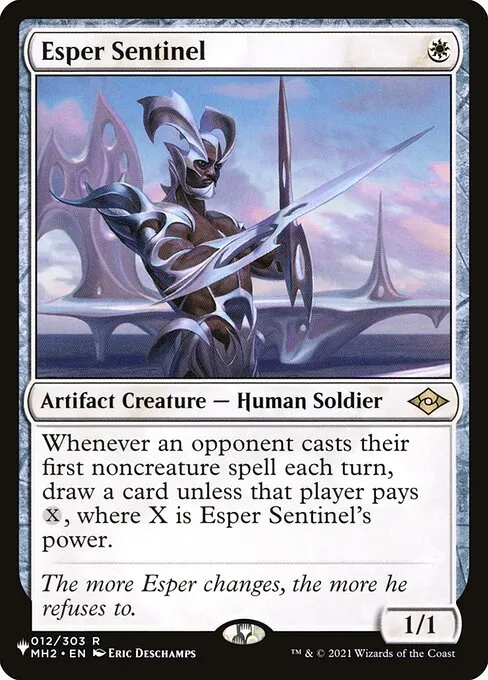
The only difference is the planeswalker glyph on the bottom border. On modern-frame cards it sits in the middle of the bottom edge, between the collector info and the copyright text. On old-frame cards like my Rhystic Study it’s shoved into the bottom-left corner instead. Small, white, easy to miss under a sleeve, and it’s the entire tell.
Which means the collector number on Scryfall isn’t a number at all. It’s a string. Esper Sentinel from The List is MH2-12. Ancient Tomb is TMP-315. Rhystic Study is PCY-45. Original set code, hyphen, original number. Once you know that, sorting them gets much easier, because you can just look for the hyphen.
The pre-2003 ones are the genuinely nasty case. Cards from that era don’t have a set code printed on them at all, so there’s no line to cross-check. My Rhystic Study says 45/143 and that’s it. You have the glyph or you have nothing.
So is it worth more or less than a real one
This is the part I got wrong for years. I assumed a List printing carried some kind of penalty, the way a Duel Deck copy or a Planechase reprint usually does. It mostly doesn’t.
Ancient Tomb from The List is $127.16 right now. The Tempest original it’s imitating is $123.46. The List copy is the more expensive one, which is a strange sentence to write about a 1997 card. Rhystic Study is $62.74 on The List and $62.16 in Prophecy, a gap of fifty-eight cents, basically noise. Urborg, Tomb of Yawgmoth is $64.43 versus $63.83 for the Ultimate Masters printing it copies.
The market has mostly decided these are the same card, and honestly that tracks. It looks identical, it’s tournament legal wherever the original is legal, and outside of a raw-card grading context nobody’s paying a premium for provenance on a 2021 reprint.
The exceptions go both directions and they’re bigger than you’d expect. Esper Sentinel from The List is $67.61 while the actual Modern Horizons 2 copy is $58.76. Nine dollars of difference for the worse-looking card, and I can’t give you a clean reason for it beyond supply. Going the other way, the Demonic Tutor that copies the Duel Decks: Divine vs. Demonic art is $58.00 on The List and $74.47 as an actual DDC card. Vampiric Tutor splits $55.13 to $60.51 in favor of the Eternal Masters original.
Actually, let me push back on my own framing there. Calling these “exceptions” makes it sound like there’s a rule with edge cases, and I’m not sure there is. Five thousand cards priced across a dozen years of thin, illiquid secondary markets is going to produce noise in both directions no matter what story you attach to it. What I can say with confidence is that the List printing is almost never a big discount, and that assuming it is will cost you money the next time you trade in person.
The other number worth sitting with: of those 5,117 cards, 74 are worth twenty dollars or more and 3,736 are worth under a dollar. Roughly seventy-three percent of The List is bulk. The good stuff is real, Ancient Tomb and Rhystic Study and Demonic Tutor and Esper Sentinel all live there, but the base rate for any given List card you pull out of a bulk box is “this is a common with a weird stamp.”
The one that got me
I traded away a List Cavern of Souls in 2022 at a store in Lisbon, on a trip, in the twenty minutes before a Commander pod started. The guy across from me had a foil Dockside I wanted and he pointed at my Cavern and said “that’s the Avacyn one right, the cheap printing,” and I said yeah probably, because I had no idea and I was not going to admit that in a shop where I’d already asked three questions in bad Portuguese. He was wrong. It was AVR-226 on The List, which is not cheap, and I gave up a card that’s north of fifty dollars now for a Dockside that has since eaten a ban in half the pods I play in. Both of us were confidently incorrect and only one of us came out ahead.
So yeah. Check your binder. That’s it, really. Look for the glyph. It’s on the bottom border, it’s white, it’s about the size of a period. If you sleeve everything and never look at the bottom of your cards, which describes most people I play with, you’ve been sorting these into the wrong pile for years and it hasn’t hurt you yet because the prices happen to line up. Fine. But the day you sell, or the day someone offers you a trade based on which printing they think it is, it stops being free.
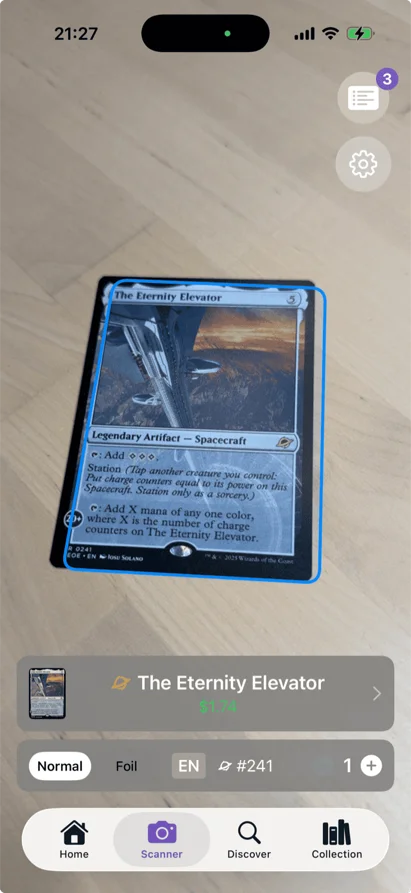
I ran the rare section of my own binder through a scan last week partly to write this, and Eldwyn kicked out four PLST cards I’d never flagged as anything special, including a Nykthos I’d have sworn was a Theros pull. That one’s about two dollars off the Theros copy, so nothing changes, but I’d rather the label be right.
One loose end I can’t resolve. Scryfall shows a batch of seventy cards added to PLST dated May 2026, sixteen months after The List supposedly stopped appearing in packs, and I have not been able to figure out what product those came from. Themed heavily red, mostly Goblins, and no paper set released that week. If somebody knows, I’d genuinely like to hear it, because right now my mental model says The List is dead and my price data says something is still feeding it.