The number on the form said $4,180 and I sat there for a solid ten minutes trying to work out where it had come from. I’d sold maybe fifteen cards that year, Modern staples I’d fallen out of love with, and my own mental accounting said something closer to three grand. The gap was shipping. Every buyer-paid shipping charge counted as money paid to me, and so did the fees that came off the top before I ever saw a dollar of it.
That’s the first thing to understand about taxes on selling MTG cards. The number a marketplace reports isn’t your profit, and it isn’t quite your revenue either. It’s gross payments, which is a third thing that nobody thinks in.
The $600 threshold is dead and nobody updated the help pages
The timeline is genuinely confusing, and I’ve now watched people get it wrong out loud at two different shops.
The American Rescue Plan Act of 2021 dropped the 1099-K reporting threshold from “$20,000 and more than 200 transactions” down to $600 flat, no transaction minimum. Everyone panicked. The IRS then delayed it, repeatedly, and in November 2024 published a phase-in schedule instead: $5,000 for 2024, $2,500 for 2025, $600 for 2026 and onward.
Then in July 2025 the One Big Beautiful Bill Act repealed the change outright, retroactive all the way back to 2022. The threshold reverted to more than $20,000 in gross payments and more than 200 transactions. The IRS confirmed it that October in a fact sheet and a set of FAQs.
Both conditions, not either one. You have to clear twenty grand and two hundred separate sales on the same platform before that platform is federally required to send you anything.
Which is a very different world from the one people are still describing to each other. TCGplayer’s own seller help page, as I write this, still walks through the old phase-in and tells you the threshold drops to $600 in 2026. That’s not really their fault, help pages rot everywhere, but it does mean the most authoritative-looking source you’d naturally check has been wrong for over a year.
Except your state might have its own number
The federal floor went back up. Roughly a dozen jurisdictions never came up with it.
Massachusetts, Vermont, Virginia, Maryland, and the District of Columbia all sit at $600 with no transaction minimum, and a few of them have been there since 2017. New Jersey is at $1,000. Illinois wants $1,000 plus at least four separate transactions. Missouri is around $1,200. Connecticut, Montana, and North Carolina also come in under the federal line.
Rhode Island is at $100.
A hundred dollars. That’s one decent single and a padded envelope. Sell a Rhystic Study, which is $70.10 for the Jumpstart 2022 printing, plus almost anything else, and a form is coming. The identical sale made from Texas generates nothing, because a state with no income tax has no return to match the form against and so doesn’t bother requiring one.
The form isn’t the tax
The thing that trips people up runs in both directions: receiving a 1099-K doesn’t mean you owe money, and not receiving one doesn’t mean you don’t.
Profit on a sale is taxable whether or not paper shows up in January. That’s been true the whole time and none of the threshold drama touched it. What the threshold changes is only how likely it is that the IRS already knows.
Going the other way, a $4,180 form doesn’t describe $4,180 of income. It describes $4,180 passing through a platform on its way to you. Off that comes what you paid for the cards, the cut the marketplace took, the postage you bought, the toploaders and mailers if you’re running the thing as an actual business. Whatever survives all of that is the number the tax applies to.
So, subtract what you paid for the cards. Great. With what records?
Which is why the boring spreadsheet exists
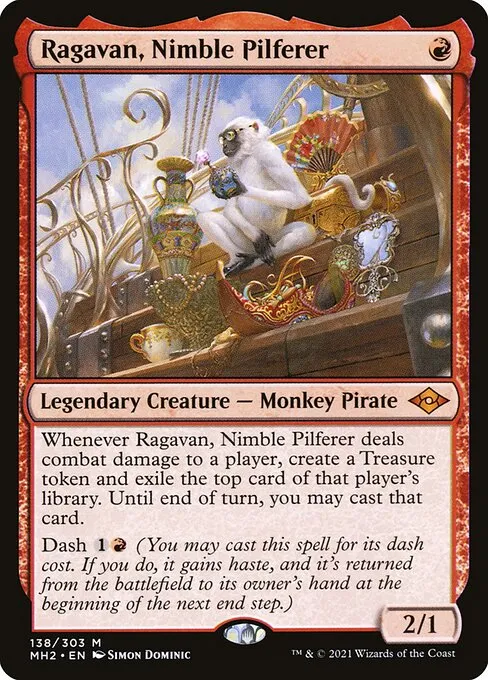
I bought two Ragavan, Nimble Pilferer in the back half of 2021, when Modern Horizons 2 had just landed and that monkey was the most exciting card in the format. No receipt, obviously. I have a fuzzy memory of paying somewhere north of $70 apiece, and the MH2 printing sits at $42.53 today.
If I sold them tomorrow, the distance between “I paid $75” and “I have absolutely no idea what I paid” is the distance between a documented loss and a sale where the default assumption is that your basis is zero and the whole sale price is gain. Zero basis is the fallback when you can’t substantiate anything, and it’s an expensive fallback to land on.
Basis is also more than the sticker price, which people consistently forget. It’s what you paid, plus the shipping you paid to get the card, plus grading fees if you sent it off to PSA, plus any buyer’s premium at auction. Under-counting all that is the single most common way sellers hand over more than they owe.
I wrote a while back about logging what you paid instead of only what things are worth, and I framed it then as a question about whether your collection is up or down over time. That’s the enjoyable version of the argument. The unenjoyable version is that the exact same field is the only thing standing between a gross-payments form and a bill considerably larger than it should be.
The bit I genuinely can’t tell you
Long-term capital gains on collectibles get capped at 28% instead of the 0/15/20% that applies to ordinary assets. Whether Magic cards count as collectibles for that purpose is, as far as I can work out, not actually settled anywhere.
The statute lists works of art, rugs, antiques, metals, gems, stamps, coins, alcoholic beverages, and “any other tangible personal property specified by the Secretary.” Trading cards aren’t named. The Secretary hasn’t specified them. Most tax professionals writing about the hobby treat cards as collectibles anyway and apply the 28% cap, reasoning that they obviously fit the spirit of the list, and that’s very probably correct. I’ve also read practitioners argue it the other way. I sort cardboard by mana value for fun. I am not the person to resolve this.
If you’re moving enough volume that eight percentage points is real money, go pay an accountant for an hour. That conversation costs less than being wrong about it, and they’ll also sort out the hobby-versus-business question, which carries its own self-employment tax surprise that I’m deliberately not going to try to summarize here.
Look, for most people reading this, none of it lands. You sold forty bucks of bulk rares to a buylist and got on with your weekend. Nobody’s coming for you. The federal bar is twenty thousand dollars and two hundred transactions and you did, what, five? It’s fine. I don’t want to make anyone nervous about a hobby whose entire point is not being your job.
Although I keep circling back to the fact that the people most likely to trip over any of this aren’t the flippers. Flippers know all of it already, usually better than I do. It’s the person who inherits a collection, or finally clears out the closet after twenty-odd years, and dumps something genuinely large in a single calendar year. That’s a one-time event that can clear $20,000 without much trouble, and it’s happening to precisely the person with the worst possible records, because half those cards came out of packs opened in 2004.
Unrelated, but the Ragavan thing reminded me. I sold a Gaea’s Cradle in 2019 to help cover a transmission, an Urza’s Saga copy with a soft corner, and I remember feeling pretty good about the price at the time. Didn’t write anything down, naturally. I looked up what those go for exactly once since then, maybe two years ago, and then made a conscious decision never to look again. Some numbers you just leave alone.
What I’d actually do about it
Nothing dramatic. Export your sales report from wherever you sell, once a year, before the platform buries it behind a date filter that only goes back eighteen months. Keep purchase records going forward and don’t waste a weekend trying to reconstruct the past, because you can’t. Note the acquisition date on anything expensive, since the one-year line between short-term and long-term rates is a genuine difference and it’s the easiest thing in this entire post to get right.
And if you’re about to liquidate something big, pull the export before you sell rather than after. Where you choose to sell determines which records you can get back out later, and buylists in particular are not built to hand you a tidy annual statement.
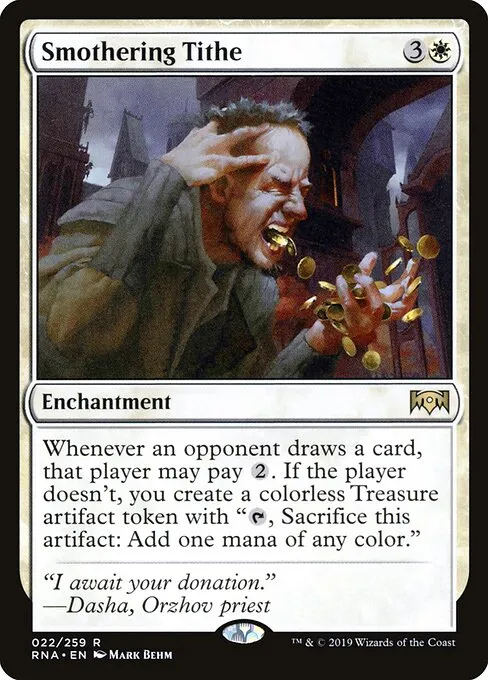
None of this is tax advice and I’m plainly not qualified to give any. It’s the shape of the thing, from someone who once had to explain to an accountant what a Smothering Tithe was and why anyone would pay $52 for one.