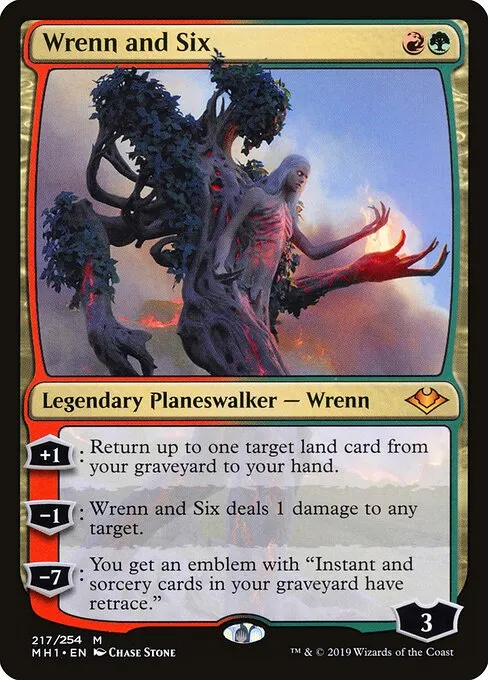
There’s a Wrenn and Six in the second-to-last page of my Modern binder, and every app I’ve ever pointed at it has told me the same thing: nine dollars and change. Modern Horizons, mythic, $9.02 as of this morning. Perfectly accurate. What none of them have ever told me is that I paid $68 for it in July 2019, at a shop that closed two years later, feeling genuinely clever about the whole transaction.
$9.02 is a fact. $68 is the other fact, and it’s the one that turns the first into information. If you never write down what you paid for your MTG cards, the total at the top of your collection screen is a number with no direction.
What you paid is the number nobody records
Every other asset class calls this cost basis. It’s what you paid per unit, ideally with shipping and fees folded in. Brokerages compute it for you. So do crypto exchanges, so does any half-decent inventory system. Magic never grew that habit, partly because for the first twenty years nobody was pretending a shoebox of Revised commons was a portfolio, and partly because the tooling grew out of deck builders rather than out of anything financial. Deck builders care what a card does. They don’t care what it cost you.
So you end up with a collection screen that tracks one axis. Current market price, summed. Which is fine right up until you try to use it for anything.
Two things break. The first is that you can’t answer the only interesting question, which is whether you’re up. I have no idea whether the last six years of buying cards has been a wash, a modest win, or an expensive way to feel organized on Sunday afternoons. My honest guess is a wash, and my honest guess is worth nothing, because I’m the person who bought the Wrenn and Six.
The second is subtler and it’s the one that actually costs money. Without a basis, every hold-or-sell decision gets made against a number you pulled out of the air. You look at a card sitting at $46 and think “I think I got that cheap?” and you hold. Or you panic after a ban announcement and dump something at a loss you never actually calculated, because the loss existed as a vibe rather than a figure. I’ve done both. The ban playbook I keep meaning to follow gets a lot easier to follow when the first question has an answer already sitting in the app.
Orcish Bowmasters is the cleanest example in my own collection. The Lord of the Rings printing is $46.09 right now. I bought two in the back half of 2023 when everyone was very sure about them. Did I do well? I want to say I paid something like $55 each, but I genuinely don’t remember, and the difference between “down twenty percent on a pair” and “roughly flat” is exactly the difference between a card I should think about and a card I should ignore.
Most of my basis is a guess, and that’s fine
The whole idea gets less tidy than I’d like about ten minutes after you try it.
I’ve been playing since Odyssey. A large chunk of my collection has no recoverable purchase price. Cards I opened. Cards I traded for. Cards that arrived in a box from a friend who quit. Cards from a 3,000-card bulk lot where the honest per-card basis is four-tenths of a cent and writing that down would be theater. If you demanded a real, documented acquisition price for every card before you’d let yourself track anything, you’d never start, which is roughly what happened to me the first two times I tried.
So yeah. Old cards. You just, look. There’s a Morningtide Bitterblossom I’ve had since roughly forever and I could not tell you where it came from. Traded for it? Opened it? Somebody left it at my house? No clue. And I’m not going to invent a number and then treat that number as real six months from now when I’m deciding whether to sell.
The compromise I’ve landed on is to be strict about basis going forward and relaxed about everything behind me. Anything I buy from here gets the real price. Everything older gets whatever the app defaults to, and I mentally file the older stuff as “unknown, probably fine.” That splits the collection into a part I can reason about and a part I can’t, which is less satisfying than one clean number but a lot more honest than pretending.
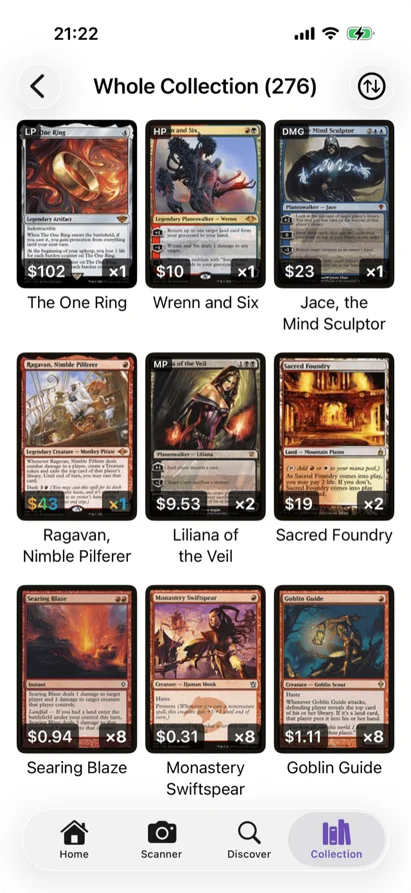
Which is where the default matters more than it sounds. Eldwyn stores a purchase price per card, and when you don’t give it one, it uses the market price on the day you added the card. That’s not your real basis for anything you’ve owned since 2014. But it’s a real, dated, non-invented anchor, and from the moment you scan a card forward it does the job: you can see whether the thing has moved since you started paying attention. For the bulk of a twenty-year collection that’s the best available answer, and it beats a blank field.
Up or down, and by how much
What I actually wanted out of all this was a single line that says whether the collection is worth more or less than it cost. Eldwyn shows the current price alongside the purchase price on each card, rolls both up, and tells you whether the total is up or down. It’ll also chart the total over time, so you get the shape of the thing rather than just today’s snapshot, which turns out to matter a lot for a hobby where half your cards move on announcement days and the other half never move at all.
The condition part I didn’t expect to care about and now check constantly. Every card in the collection carries a condition, and the total gets calculated against those conditions rather than against a fantasy where everything is Near Mint. My binder is not Near Mint. The Wrenn and Six is heavily played, because it spent two years in a Jund deck getting shuffled by a guy with a lot of enthusiasm and no sleeve discipline. A total that assumes NM across the board is off by a meaningful percentage for anyone who actually plays with their cards, and the gap widens the older and more played your collection is. If you’ve never audited what condition your cards actually are, that number is more optimistic than you think.
I’ll argue against myself for a second, because I’ve gone back and forth on this. There’s a real case that tracking cost basis makes you worse at the hobby. It turns a binder into a brokerage account. You start thinking about Magic cards the way you think about index funds, and that’s a genuinely miserable way to enjoy a game about elves fighting dinosaurs. I know people who deliberately don’t look, and they seem happier than I am.
And some cards don’t need it at all. Cavern of Souls has been printed five times across fourteen years and every single printing sits within a few dollars of the same number. Avacyn Restored is $49.38. Ultimate Masters, $53.16. Lost Caverns, $48.58. Whatever you paid, whenever you paid it, you’re roughly where you started. Recording a basis on that card tells you nothing you couldn’t guess.
But then, that flatness is itself only visible because someone kept the historical numbers. And the cards where basis matters most are exactly the ones you can’t identify in advance. Nobody in June 2019 thought Wrenn and Six was the cautionary tale. She was the format. So I’ve come around to logging it, mostly.
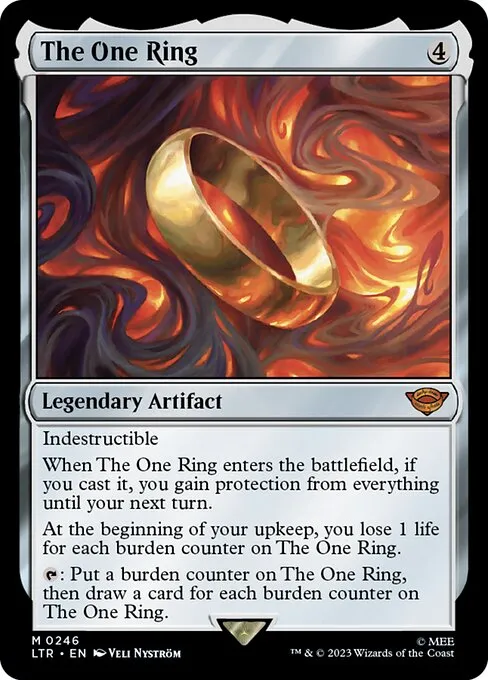
The reprint angle is the one that finally sold me. My One Ring, the Tales of Middle-earth printing, sits at $105.93 and I’m up on it by a lot. That is a very different card to hold going into a set that reprints it than a copy I’d bought at the top. Same card, same current price, completely different decision, and the only thing separating those two situations is a number I happened to write down.
Also, and this is unrelated, the same Wrenn and Six exists as a Secret Lair promo currently worth $144.55. Fifteen times the Modern Horizons copy. I bring it up only because I found out while writing this and had to go lie down for a minute.
Worth pairing with the other half of the problem, which is that the current-price side of the equation is softer than it looks too. Market price isn’t what you’d get. So the honest read on any collection total is a fuzzy number minus another fuzzy number. Still better than one fuzzy number by itself.
If you’re starting from zero, don’t try to reconstruct a decade of receipts. Set the basis on anything you buy from today, let the app date-stamp the rest, and check back in a year.