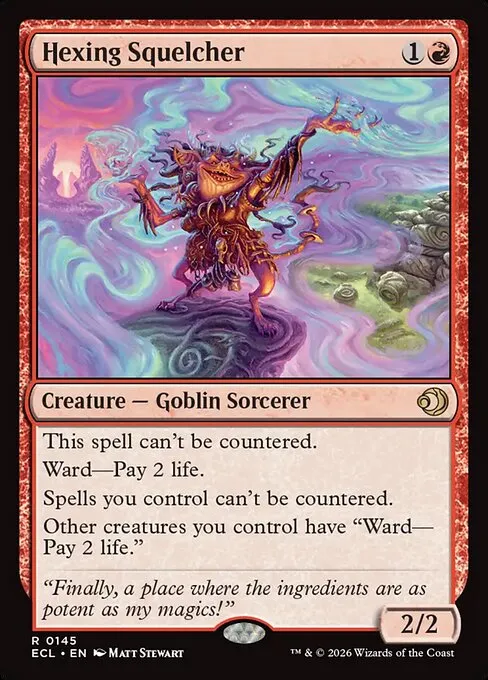
Back in April I wrote that Hexing Squelcher might settle at $8 by June, and that I wasn’t great at guessing which way these things go.
It’s $21.72 today.
That one stuck with me, because I wasn’t being reckless about it. Lorwyn Eclipsed had been out twelve weeks. The set had visibly deflated. Chronicle of Victory, the most expensive card in the box, had bled from about $30 in release week down to $19.05. Everything pointed one direction, I wrote down the obvious extrapolation, and the card went the other way and kept going.
So I went back through everything I’ve published this year where I put an actual number next to a card name, and checked what those cards cost this morning. Turns out I’ve been keeping a price journal by accident, and it has opinions about when MTG singles are cheapest.
Release week is not the floor
Everyone knows preorder prices are fiction. I’ve written that post more times than I’d like to count and I stand by all of it. Cards get previewed, content creators pick favorites, the number balloons, paper copies arrive, the number falls over.
What I had wrong was everything that happens after that.
Lorwyn Eclipsed released January 23. Here’s where its top cards sat on April 18, twelve weeks in, against where they sit now:
- Chronicle of Victory: $19.05 to $21.86
- Hexing Squelcher: $17.45 to $21.72
- Bitterbloom Bearer: $14.63 to $16.22
- Bloom Tender: $12.21 to $13.54
- Steam Vents: $10.30 to $10.78
All five went up. Not dramatically, and not in a way that makes anyone rich, but the direction is consistent and it’s the opposite of what I’d assumed in April.
Teenage Mutant Ninja Turtles tells the same story on a shorter clock. That set landed March 6. In mid-June I wrote that Super Shredder was around $18 and Krang, Utrom Warlord about $17, and that the pair of them were propping up the whole set. Super Shredder’s now $19.04. Krang is $22.44. Cool but Rude, which I described as being under $6, is $7.84.
So when are singles actually cheapest
Lining up everything I have, the bottom lands somewhere around week ten to fourteen. Release week is a fall, sure, but it’s a fall still in progress. The card keeps sliding for another month or two while boxes get cracked, draft nights burn through inventory, and everyone who wanted a playset for their new Standard deck already has one. Then the supply stops arriving and the slow climb starts.
Twelve weeks. That’s the number I’d give somebody who asked. About three months after a set hits shelves, the good cards are as cheap as they’re going to get, and after that you’re buying into a rising number.
I want to poke a hole in my own finding, because there’s an obvious alternative explanation and I can’t rule it out with what I’ve got. Magic has had an absurd year. Hasbro reported Magic revenue up 59 percent for 2025, more WPN stores, more players than ever. If the entire market is drifting upward, then “cards go up after week twelve” might just be “cards go up,” and I’ve dressed a rising tide in a chart and called it a finding. I honestly don’t know. The one thing that makes me keep believing it is that the cheap cards in those exact same sets didn’t participate at all, which is awkward for the everything-rises theory.
The cards that have no floor
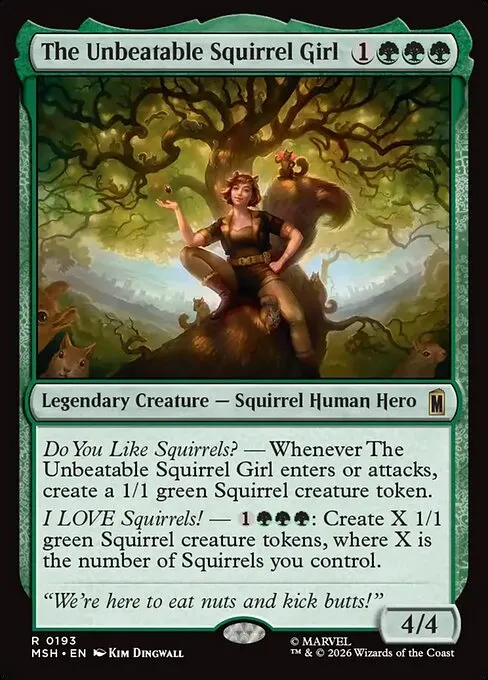
The Unbeatable Squirrel Girl was the top-priced rare in Marvel Super Heroes at about $7 when I looked in late June. She’s $2.02 now. People figured out the deck, and then they unfigured it.
She’s got company. Monica Rambeau went from a $90 preorder to $1.68 in release week to $1.43 today, which is a card locating the actual bottom of the ocean. Over in Secrets of Strixhaven, Flow State was trading around $7 the week before release on the back of some extremely confident Expressive Iteration comparisons. It’s $1.82.
And in the same Lorwyn Eclipsed that treated its mythics so kindly: Mirrorform was $2.88 in April and it’s $1.73 now. Morningtide’s Light went $2.15 down to $1.54. Both were preorder darlings for combos that never showed up.
So the week-twelve floor is real, but only for cards people actually play. You’re not waiting for a set to get cheap. You’re waiting to find out which cards in it are real, and then buying those. Anything still sliding at week twelve is sliding for a reason, and it’ll keep sliding as long as somebody somewhere is still cracking boxes.
Tangent, but the worst price call I’ve ever made was trading away a foil Valki, God of Lies at a kitchen table in 2021, for a Bonecrusher Giant and two snow-covered Islands, because I’d decided it was draft-chaff mythic filler. I was so pleased with myself at the time. My friend Dave has brought it up at least once a year since, which is completely fair of him.
The gap we just walked into
The calendar thing is what got me writing this down in the first place. The Hobbit came out three days ago. The next new product on the shelf is Mystery Booster Commander Edition on November 9, with Star Trek four days behind it on November 13.
That’s twelve weeks of nothing.
Every other gap this year ran six to nine weeks. January 23 to March 6. March 6 to April 24. April 24 to June 26. June 26 to August 14. And then a cliff.
Marvel Super Heroes hits its own twelve-week mark around September 18, sitting right in the middle of that dead zone with no new product pulling attention or money away from it. Secrets of Strixhaven is already past its floor but nobody’s talking about that set, and quiet is usually where the boring value hides. If the week-twelve pattern holds up, late September into October is about as cheap as 2026 Magic gets, and it’s the last window before the November double-release resets the whole board.
So yeah. September. Buy in September. That’s the post, you can stop reading. Except I know I won’t actually do it, because come September I’ll be looking at Star Trek spoilers and thinking about shock lands, and those Marvel cards I meant to pick up will still be sitting in a browser tab I forgot to close.
Writing the numbers down somewhere
None of this works without the old numbers, which is the only reason I could write any of it. I had dated observations sitting in a year of articles. That’s a genuinely stupid way to keep price history and I’d recommend more or less any other method.
I keep a running total in Eldwyn mostly because I like watching it move, and the practical benefit is that scanning a card stamps a price against a date without me thinking about it. Six months later the shape is just there. I also have a spreadsheet from 2019 with about forty rows in it before I quit, so I’m in no position to lecture anybody about discipline here.
The thing I’d genuinely change about my own buying: I keep buying cards during the week a set releases, because that’s the week I’m excited about the set. Which is roughly the worst week to buy. I’ve known this for years and I did it again with The Hobbit last Friday. Bought a Smaug. Not going to talk about it.
If you’ve got a want list you’re planning to run in September, check it against what you already own before then, because the deeply annoying truth about waiting for a dip is that a decent chunk of what you were going to buy is already sitting in a deck box in your closet. I have bought Command Tower more times than any adult should have to admit.