Every collection has a land drawer, and mine is embarrassing. A gallon freezer bag inside a shoebox inside a closet, mostly Forests, because I’ve played green for twenty years and green makes you pay for it in lands. Once a year I dig through it to build something, grab a fistful of the right color, and forget it exists again until the next deck.
Last spring I actually looked at what was in there. Stuck to the back of a Fifth Edition Swamp was a Forest I didn’t recognize. No expansion symbol in the little slot where the set symbol goes. Just a small bronze eye. I turned it over about four times before it clicked, and then I sat on the closet floor for a minute, because that eye means the card is worth around seven hundred dollars.
So here’s the thing worth knowing. Most of your basic lands are worth a penny, which is roughly what a buylist pays for a thousand of them. But a small number of basic lands are worth real money, sometimes four figures, and they hide in bulk precisely because they’re basic lands and nobody looks twice at a Forest.
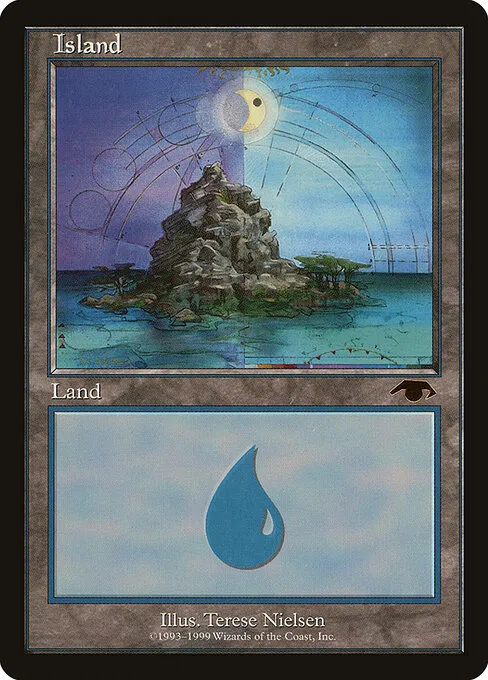
The Guru lands are the ones you dream about finding
The bronze eye is the tell for a Guru land, and Guru lands are the crown jewel of this whole category. They came out of a Wizards program that ran from 1999 to 2001, where experienced players signed up as “Gurus,” taught new people the game, and earned points they cashed in for promo lands and packs. Not many people did the whole rigmarole, so not many of these lands exist.
The art is the other tell. Terese Nielsen did all five, and each shows a different stage of the same double eclipse, so if you line the cycle up the sky moves across them. They’re genuinely beautiful. They also don’t carry a normal set symbol, which is why that first glance in the bulk box doesn’t flag them as anything.
Prices, since that’s why you’re here. A Guru Plains is the cheap one at around $575. The Island is the trophy at roughly $1,200, and the Swamp, Mountain, and Forest sit in between, call it $630 to $740 each depending on condition. And condition matters enormously here. A crease or a soft corner knocks a hundred dollars off fast, because the people buying a $700 Forest want it perfect, not shuffle-ready.
Honestly, I don’t fully understand why the Island specifically runs double the Plains. Supply, mostly, plus the eternal truth that blue players will overpay for their own vanity. But the gap has held for years, so I’ve stopped trying to explain it.
Alpha and Beta had basics too, and people forget
Everyone knows Alpha and Beta for the Power Nine and the dual lands. What gets forgotten is that those sets printed basic lands, and those basics carry the same old-border, thick-stock, rounded-corner look as the expensive stuff.
An Alpha Island runs about $73 right now. Alpha Mountain is closer to $49, the Forest around $31, and Beta versions sit a little under their Alpha counterparts, forty-ish dollars for the Island. None of that is Guru money. But it’s a lot more than a penny, and an Alpha basic is exactly the kind of thing that ends up in an “old cards” bulk lot from someone who cleaned out a relative’s closet and priced the whole box at twenty bucks.
The way to spot them: the Alpha card back has noticeably rounded corners compared to later printings, the front has no expansion symbol at all (sets didn’t have them yet), and the stock feels a little chalky. If you’ve handled a real Alpha card you know the feel instantly. If you haven’t, that’s where a second opinion or a scan earns its keep.
The regional promo lands nobody remembers ordering
This is the tier that trips people up the most, because these lands look almost exactly like normal basics until you notice the art.
In the late 90s and 2000, Wizards ran the Asia Pacific Land Program and the European Land Program, two sets of promo basics where the art depicted real-world places from each region. The APAC lands run anywhere from about $15 to $50 depending on which one and which artist. The Euro lands are similar, roughly $20 to $38. There are multiple APAC releases with different colored stamps, and collectors chase specific ones, so the range stays wide.
I traded a small stack of Euro lands away at a Grand Prix around 2015. Someone at the trade tables wanted “cool basics for a Commander deck,” I had maybe six of them loose in a side pocket, and I handed them over for a playset of some Standard rare I’ve long since forgotten. I didn’t know what they were. He absolutely did. That’s the trade I think about whenever I tell someone to look things up before they give them away.
Foil basics from the joke sets
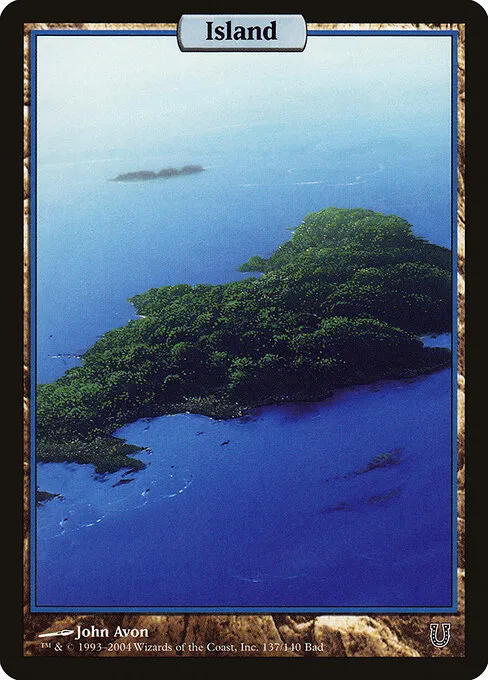
The silver-border sets, Unglued and Unhinged and Unstable, all printed gorgeous full-art basics, and the foils from two of them are quietly expensive.
An Unhinged foil Island is around $105. An Unstable foil is about $75. The nonfoils are much more reasonable, a played Unglued basic is maybe $10 and Unhinged nonfoils sit in a similar spot. The foils are the story. Commander players love them for the art, old foils were printed in small numbers, and the price crept up while nobody was watching. If you drafted Unstable when it came out and dumped your foil lands in a box, go find that box.
How to actually catch these before you bag them by color
I’m not going to tell you to inspect every Island you own with a loupe. I bag my plain basics by color and forget them like everyone else. But there’s a thirty-second habit that catches almost all of this, and it’s just: look at the set symbol slot.
Regular basics from the last twenty-five years have an expansion symbol sitting on the right side of the type line. The valuable ones usually don’t, or they have something odd there instead, like the Guru bronze eye. So when a land has no symbol, or old rounded corners, or art you can’t place, that’s your cue to stop and check what printing it actually is instead of tossing it in the color bag. That one signal covers Guru, Alpha, Beta, and a big chunk of the promos.
For the rest it comes down to the art, and this is where I lean on scanning. When I work through a big unsorted lot I run the whole thing through Eldwyn, and the lands that aren’t plain modern basics get flagged with a real identity and price instead of blurring past me. I sorted a 2,000-card garage-sale box that way a while back, and the thing that paid for the box was three cards, one of which was a promo land I’d have bagged without a thought by hand.
If you do find something, don’t sell it in a panic. Old promo and vintage basics are condition-sensitive, so grade it honestly first (my take on card condition applies to lands the same as anything else), then check a couple of sold listings rather than trusting one low ask. And if it’s a Guru land, know that fakes exist, so it’s worth running the same counterfeit checks you’d run on any four-figure card.
The rest of your basics? Still bulk. Still going in the freezer bag. I just glance at the set symbol slot on the way in now, which costs me nothing and one time turned a forgotten Forest into the best thing in my closet.