There’s a Rhystic Study in my Meren deck that has been in the same sleeve since roughly 2019. I know it’s there. I put it there. And for about four years it did not appear anywhere in my MTG collection total, because the cards in your decks are sitting in a box on a shelf, not in the binder you actually scanned.
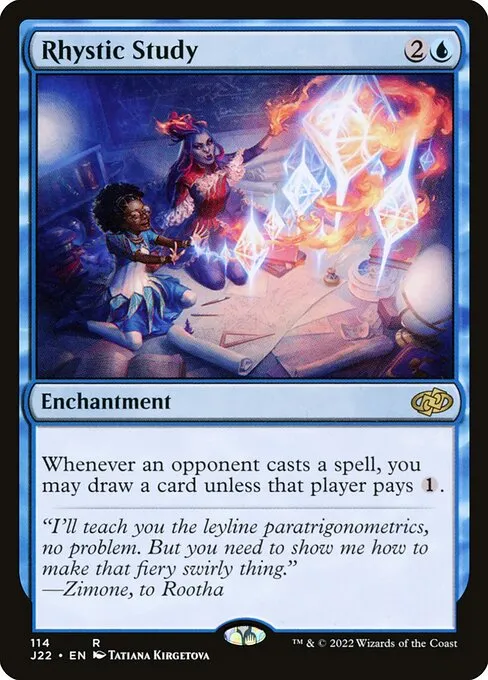
This is not a subtle rounding error. That single card is $70.27 right now.
Why the cards in your decks skew expensive
Think about how a deck gets built. You want a thing to work, so you go find the cards that make it work, and those cards are good, and good cards cost money. Nobody sits down and says “I’m going to fill this Commander deck with the eleven-cent uncommons I have the most of.” The selection process is explicitly biased toward the top of your collection. Every card you sleeve up is a card you decided was worth more to you than the alternatives.
So the loose pile, the stuff in binders and row boxes, is by definition the residue. It’s what didn’t make the cut. And that’s the part most people have actually inventoried, because it’s the part that’s easy to flip through.
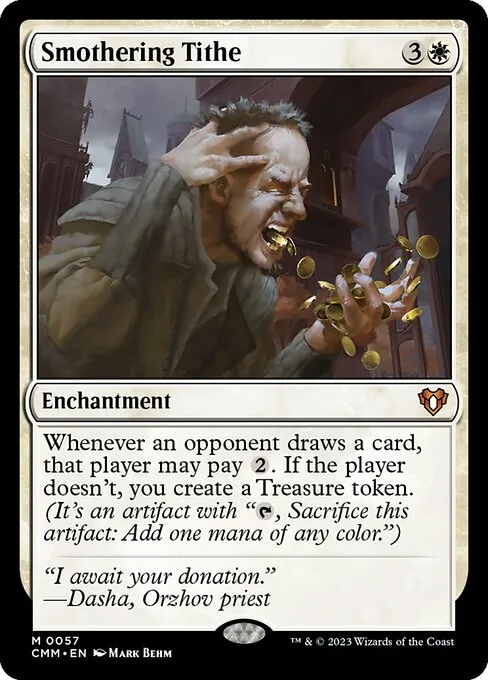
Five cards out of one of my decks, priced today: Rhystic Study at $70.27, Smothering Tithe at $61.66 in the Commander Masters printing, Vampiric Tutor at $55.11, Cyclonic Rift at $39.56, Misty Rainforest at $38.45. That’s $265 in five cards. The other ninety-five cards in that deck aren’t worthless either. Meanwhile I have a row box of Guilds of Ravnica commons that I would struggle to sell for twenty dollars total, and I know exactly how many cards are in it, because I counted them.
The cheap stuff is the stuff you notice. Command Tower is thirty-one cents. Arcane Signet is fifty-five. Sol Ring is about a buck sixty and you own eleven of them. Those cards are in every deck and they contribute basically nothing, which makes it very easy to assume decks are mostly filler.
Six decks and a number I’d been repeating for a year
So yeah. Six decks. I’d been telling people my collection was worth about two grand, which was the number the app gave me, which was the number for everything that wasn’t sleeved. When I finally added the decks it went up by something like forty percent. I didn’t check properly for another month or so because, honestly, I didn’t want to find out I’d been wrong at three different LGS conversations.
The other thing that shook it loose was unsleeving an old Karador list at about one in the morning to strip it for parts. I found a Prophecy-era Rhystic Study in there that I had completely forgotten I owned. I’d bought a second copy at some point. Which is its own problem, and one I’ve written about before, but the version where you buy a duplicate of a card that’s sitting in a deck twelve feet away is more annoying than the normal version.
The extreme version of this
Star City Games ran an interview a while back with Brian Canada, a player who has built nearly 900 Commander decks and is trying to build one for every legal legendary creature. His rule is strict: no proxies, no sharing cards between decks. Once a card goes into a deck, it belongs to that commander permanently. He mentioned his Angus Mackenzie deck sitting somewhere around $1,800.
Nine hundred decks at ninety-nine cards each is roughly 89,000 cards, and every single one of them is deck-locked by definition. His loose collection and his real collection are almost entirely different objects. He tracks it with a spreadsheet per set and a binder per set in collector number order, which is a level of discipline I’m not going to pretend I have.
Most of us are at six decks, not nine hundred. But the ratio problem is the same shape.
Does it actually matter
Here’s where I’ll argue against myself for a minute. If you never sell anything, if the decks stay built forever and you play them on Fridays until you die, then the number is a vanity metric and the fact that it’s wrong changes nothing about your life. I genuinely think that’s true for a lot of players. The collection total is a fun stat, not a portfolio.
Except the three situations where it stops being vanity are all situations where you’re not the one doing the math. If your stuff gets stolen, the claim is built from what you can document, and “my six Commander decks” is not documentation. Same for insuring a collection in the first place, where the underwriter wants a schedule, not a vibe. And if someone inherits the boxes, they’re going to look at six deck boxes and a binder and assume the binder is the valuable part.
So I’ve talked myself back around. Not all the way. If you’re a Standard player with one deck and a bulk box, ignore all of this. But past three or four Commander decks it gets weird fast.
Counting them without unsleeving anything
You don’t have to take the decks apart. That was the thing blocking me for ages, this vague sense that doing it properly meant a whole Saturday of unsleeving and re-sleeving.

If your decks are already on Moxfield or Archidekt, you’re most of the way done. Export each list, and import it into whatever you use to track the collection. Both export to CSV, which most trackers accept, though the formats aren’t identical and you will lose something in the middle. Set codes and printing info are usually the first casualties, which matters more than you’d think when your Rhystic Study is the $161 Enchanting Tales version and the import assumes it’s the $64 Prophecy one. I’ve been through that migration pain in more detail elsewhere.
If the decks aren’t on a deck site, scanning is faster than typing but slower than exporting, and you’re still handling every card. Sleeved cards scan fine as long as the sleeve isn’t badly scuffed. Reflective sleeves are worse than foils.
The part I’d actually push on: tag them by location. Whatever tool you’re using, mark deck cards as being in a specific deck rather than dumping them into one pool with everything else. Otherwise you get the opposite failure, where you go to build something from cards you already own and the app cheerfully tells you that you have a Cyclonic Rift, and you do, and it’s in a deck you’re not taking apart.
I do not have a good answer for the swap pile. The cards that live between decks, the ones you move around depending on what you’re playing, the little stack of removal spells sitting loose in a deck box. Those are neither in a deck nor in the collection proper and I’ve tried three ways of tracking them and none of them survived contact with an actual game night.
Overgrown Tomb is $9.50 in its Guilds of Ravnica printing. You probably own two or three across various decks. That’s the tier that adds up quietly, well below the cards you’d think to flag, and it’s most of what’s hiding in there.