The worst MTG trade binder I ever flipped through belonged to a guy at a store in Sacramento who’d put 360 cards in it, and I’d say 340 of them were rares from Ixalan that nobody wanted in 2018 and nobody wants now. The other twenty were good. He knew they were good, because every time I stopped on one he said “ah, that one’s kind of spoken for.”
I think about that binder every time I rebuild mine. A trade binder has one job, which is getting someone to stop flipping and say “what do you want for this?” Everything below is about what earns a slot in one, and how to keep the thing honest once it’s built, because a binder priced from three months ago is its own kind of problem.

What earns a slot
My rule is a price floor plus a demand check. The floor for me is around $3. Below that, a card is almost never what someone came to the table looking for, and every page of $1 rares is a page your trade partner has to get through before they reach anything interesting. People get bored. They close the binder at page six and say “cool, nothing I need,” and they might’ve wanted the card on page nine.
The demand check is the harder part. A card can be $8 and still be dead weight if it’s the kind of thing only one archetype plays and nobody at your store plays that archetype. Commander staples are the opposite. Something like Swan Song sits around $10 to $11 in most printings, every blue Commander player has heard of it, and somebody at a four-pod table probably needs one. That’s a trade-binder card. It moves.
And then I check reprint news, which sounds like overkill for a binder but it isn’t. The Secret Lair Corn Maze drop on October 12 has another Swan Song in it, plus Underworld Breach (about $10.78 for the Theros Beyond Death copy) and Trinisphere, which is sitting at $36.62 for the original Darksteel printing. If any of those are in my binder, this is the week I want them gone. Not because a Secret Lair necessarily tanks a price (they often don’t, honestly, since a lot of Lair copies get opened and kept), but because “there’s a reprint coming” is the first thing the other person says when you put a number on it.
What comes out:
- Bulk rares. They go in a box. If someone asks “got any random rares for my cube?” you can bring the box next time.
- Anything you’d be sad to lose. If you’d hesitate, it’s not for trade, and putting it in the binder just sets up the awkward “oh, not that one” moment.
- Heavily played copies of anything over $20, unless they’re clearly marked. People price off the NM number in their head.
I was going to say graded cards come out too, and I mostly believe that, but I’ve seen a couple of people at bigger events carry a separate little zip binder of slabs and do fine with it. At a 30-person Thursday night, though? Leave the slabs home.
How I lay it out
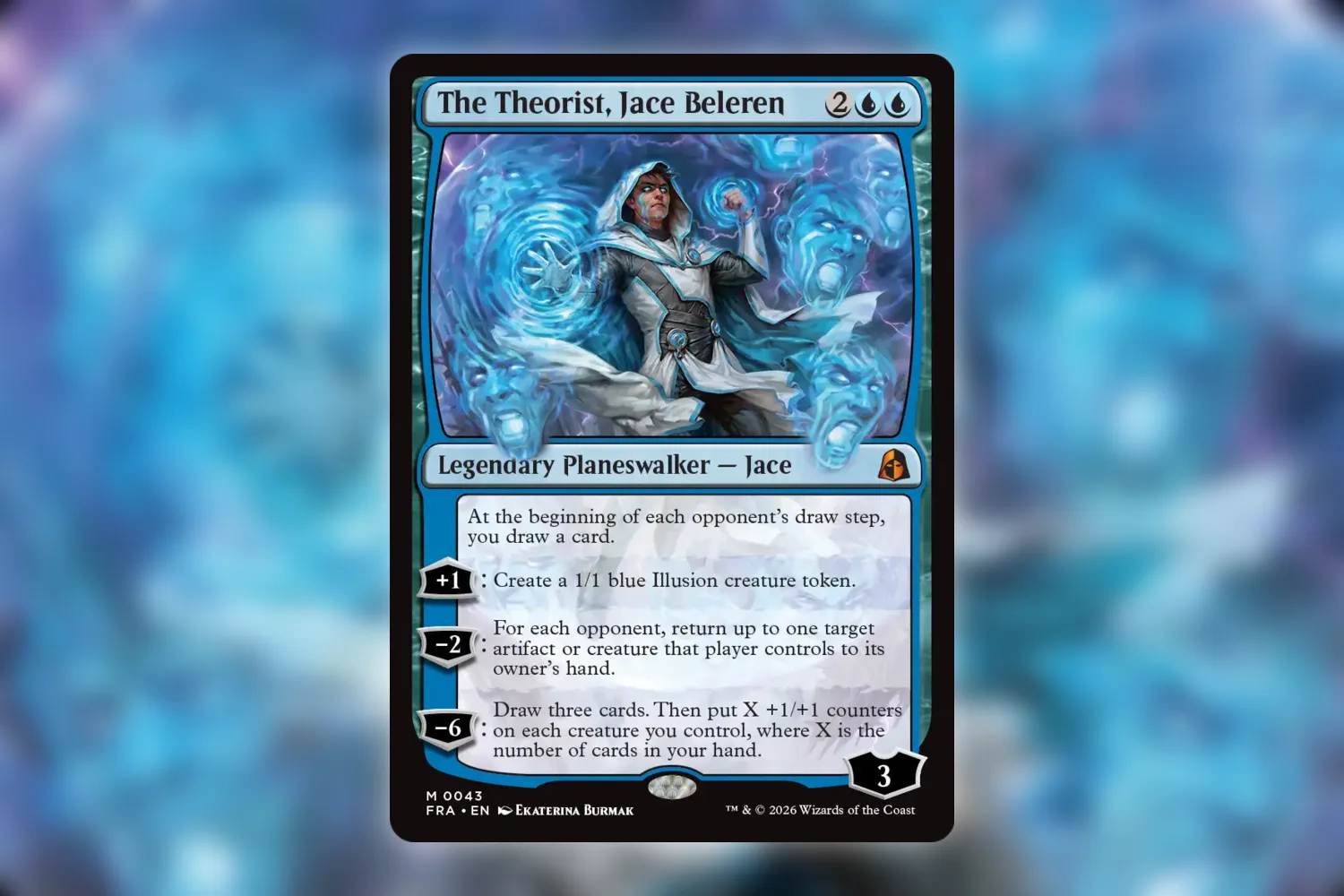
New-set pulls go up front. Reality Fracture came out two days ago, which means right now the binder’s first page is mine to decide, and I’m putting the best fresh cards there. The Theorist, Jace Beleren is $35.02 as I write this and Hexhaven Invigorator is $29.86. Both of those are probably the highest they’ll be for a while, since new-set cards almost always slide in the first couple of months, and people are also most excited about them right now. You want both of those things on page one.
After that, I sort by rough price band with a divider between each: $3 to $10, $10 to $25, $25 and up. Inside each band, by color. Some people sort by format instead (Commander section, Modern section, and so on), and that works better if your store leans heavily one way. My store is like 80% Commander so a format split would basically be one giant section and a sad little Pioneer page at the back.
The price-band thing matters because it lets people self-select. Someone with a $15 card to trade can flip straight to the middle band and not waste time on the cards they can’t reach.
Something I didn’t expect, and still don’t totally understand: binders with fewer cards get more trades. I cut mine from a 360-card 9-pocket to maybe 120 cards and started doing more trades per night. My best guess is that a thin binder reads as “this person actually curated this,” and a thick one reads as “this person dumped their pile in here.” But I can’t prove that, it might just be that I started bringing better cards at the same time.
Stickers or no stickers
People argue about this. Price stickers on the sleeves mean nobody has to ask and you don’t have to look anything up mid-conversation. They also go stale in about a week, and then you’re the person with a $12 sticker on a card that’s $7 now, and you either honor the sticker and lose five bucks or you don’t and look shady.
I used to be firmly no-stickers. Then I traded with a woman at a GP who had every card stickered, dated in tiny handwriting on the corner, and she’d re-stickered the whole binder that morning. It was the smoothest trade I’ve ever done. So, I don’t know. Stickers work if you actually redo them. Most people don’t, and I’m one of most people, so I go without and look things up at the table.
Keeping the binder and your collection list in sync
This is the part nobody does and it’s the part that bites you.
So okay, here’s what happens. You trade away a card at Thursday night. You don’t update anything. Three weeks later you’re building a deck, you search your collection, it says you have the card. You go to the binder. It’s not there. You check your deck boxes. Not there. You spend twenty minutes looking before you remember, oh, right, Thursday. And then you’re annoyed, and you buy another one, and.
The fix is boring. After every trade night, before the binder goes back on the shelf, I scan whatever came in and remove whatever went out. Takes five minutes. I use Eldwyn for it because I can scan the incoming cards in one go instead of typing names, but honestly a spreadsheet works if you’re disciplined about it. The point is the list and the binder have to agree, or the list is useless.
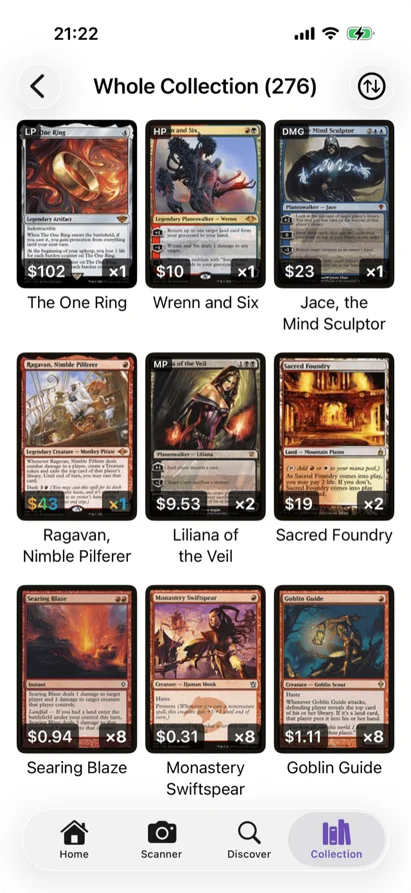
I also re-price the whole binder on any day I’m actually planning to trade, and otherwise mostly leave it alone. A full re-scan of 120 cards is a few minutes, and it’s how I caught that a $4 card in my binder had quietly climbed to $19 after a Commander precon used it, which I would’ve traded at the old number without thinking. There’s a longer take on how often to re-price a collection if you want the general case, but for a trade binder my answer is “the day of.”
Side note, and this has nothing to do with anything: the first real trade I ever made was a Theros-era Thoughtseize for two Return to Ravnica shocklands, at a store that doesn’t exist anymore, and I thought I’d robbed the guy. I hadn’t. I had not robbed anybody. He went home and sold the Thoughtseize for more than both shocks combined, and I found out a month later when he mentioned it, very cheerfully, while I was standing right there. I still don’t know if he knew at the time.
Anyway. That’s more or less why I re-price on the day.
The part that’s about you, not the binder
A clean binder still won’t trade if you’re weird about it. Let people flip at their own pace. Don’t hover. When they stop on something, tell them the number you’re working from and where it came from. I’ve written about valuing the actual trade at the table separately, so I won’t redo that here, but the binder sets up that conversation. If it’s curated, priced, and matches your list, the hard part’s mostly done before anyone sits down.
My binder’s sitting at 117 cards this week. Three of them are leaving before October 12, if anyone in the Corn Maze queue wants a Trinisphere the old-fashioned way.