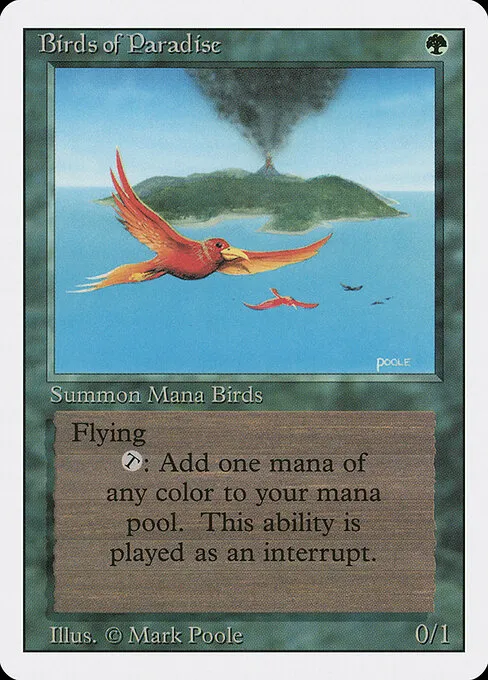
There’s a version of the Birds of Paradise conversation I’ve had maybe eight times now. Someone slides a white-bordered copy out of a page, holds it up, and says “this one’s old.” And they’re right. It’s from Unlimited or Revised, both of which are old, and one of which is worth roughly nine times the other.
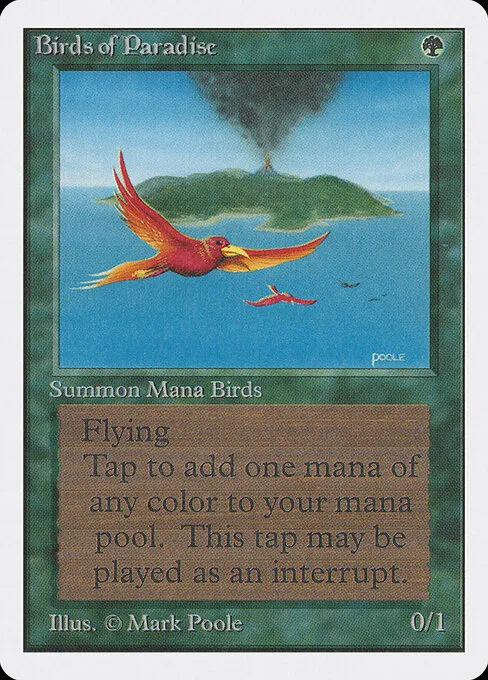
Unlimited Birds is sitting at $275. Revised Birds is $29.26. Same art, same white border, same name in the same place. Four months apart, December 1993 and April 1994.
Everybody worries about Alpha and Beta. Alpha versus Beta is the glamorous question, the one you ask after you’ve already found something incredible in a shoebox. The question that quietly costs normal collectors money is Unlimited versus Revised, and it comes up constantly, because Revised got printed into the ground and Unlimited didn’t.
The order to check things in
Old cards don’t have set symbols. Core sets didn’t get one until Sixth Edition in 1999, so everything from this era is identified by frame details and nothing else. There’s also no collector number and no set code down at the bottom, which is the shortcut that works on every card printed in the last two decades and does absolutely nothing for you here.
So you go in this order.
Copyright line first, bottom left. If there’s a year printed there, you’re already done: 1995 means Fourth Edition, 1997 means Fifth. Both white-bordered, both routinely mistaken for something older. They’re not worthless, a Fourth Edition Birds of Paradise is still $17.69, but that’s a long way from the number you’d hope for. If there’s no year at all, you’re in the first four sets.
Then border color. Black border means Alpha or Beta. White border means Unlimited or Revised.
That’s the whole tree, and about 80% of the time it ends at “white border, no year, so it’s Unlimited or Revised” and then people stop, because that’s where the two remaining options look genuinely alike.
Alpha versus Beta is a corner question
Alpha corners are cut at roughly a 2mm radius. Beta corners are cut at about 1mm, which became the standard and is still the standard. That’s it. That’s the difference. Alpha corners look chunky and soft next to a normal card, and once you’ve seen a real one the difference stops being subtle.
The test that works without calipers: slide the card into the middle of a stack of ordinary cards, square the stack up, and look at the corners from the side. An Alpha will show. Its corner curve pulls back from the edge of the stack and you can see the cards behind it peeking through. That’s the same reason Alpha cards were treated as marked back in the day if you played them alongside anything else.
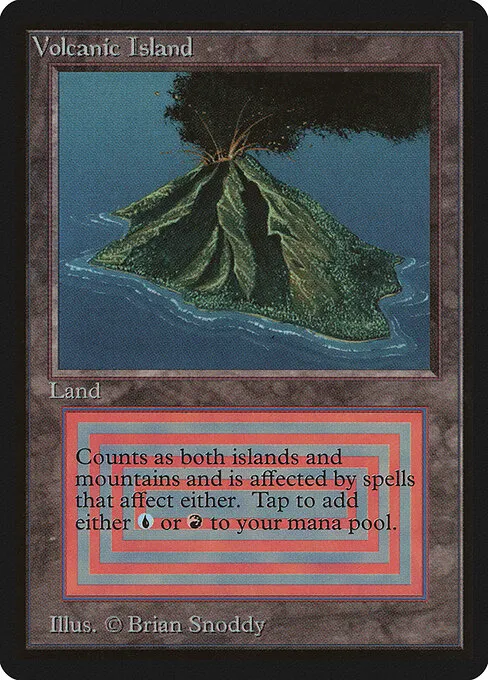
There’s also a hard shortcut people forget. Alpha has 295 cards. Beta has 302. Two of the seven that Alpha is missing are Volcanic Island and Circle of Protection: Black. If you’re holding a black-bordered Volcanic Island, the corner question is already settled, it’s Beta, put the loupe down.
One warning attached to all of this. Collectors’ Edition and International Collectors’ Edition cards from 1993 have square corners and gold text on the back, and people spent years clipping the corners off them to pass them as Alpha or Beta. A clipped CE card will feel slightly small and the edges will be a bit rough, but honestly the reliable tell is the back, not the front. I’ve written more about what those gold-bordered cards actually are if you’ve got one.
Unlimited versus Revised, which is the one you’ll actually need
Both white-bordered. No year. Same art on almost everything. Here’s what separates them:
The picture frame around the art on an Unlimited card is beveled. It has a raised, slightly 3D look to it, like the frame has thickness. Revised flattened that out. Once you know to look at the inner frame instead of the outer border, it’s a two-second check.
The color is the other tell. Unlimited art is darker, richer, higher contrast. Revised looks washed out and pale by comparison. Wizards changed printing processes between the two and Revised came out faded, which everybody complained about at the time and which is now, ironically, the thing that identifies it.
Actually, let me push back on my own ordering there. The color test is the one I use in practice, because it works from across a table and doesn’t require picking the card up. But it only works if you’ve got a reference point, and if you’ve genuinely never seen an Unlimited card, “darker” is meaningless. The bevel doesn’t need a reference. So the bevel is the correct answer and the color is the one I actually use, which is a slightly embarrassing thing to admit in an article about how to identify cards.
There’s a third tell floating around forums claiming Revised has a thin dark line inside the white border that Unlimited lacks. I’ve looked at a lot of both and I can’t reliably see it, and I’m not confident enough in it to tell you to use it. Maybe it’s real on some cards and not others. Two tells is enough.
The money, since that’s why you’re reading:
- Counterspell: $60.30 in Unlimited, $5.01 in Revised
- Wrath of God: $160 in Unlimited, $12.87 in Revised
- Sengir Vampire: $30.33 in Unlimited, $1.06 in Revised
A Beta Birds of Paradise, for scale, runs about $1,000.
Sengir is the one that gets me. A 29x gap on a card that a lot of people would describe, accurately, as an old vampire that costs a dollar.
So yeah. I bought a “Beta” Hypnotic Specter at a card show in Sacramento years ago. Paid something like $180, felt very clever about it, and a guy I’d been chatting with all afternoon picked it up out of politeness and went quiet for a second. Clipped Collectors’ Edition. He was nice about it. He also had a four-pocket binder of Arabian Nights that he wouldn’t let anyone touch without asking first, and I remember being more annoyed about not getting to look through that than about the Specter. Anyway, the dealer took it back. Not every story ends badly.
The part where your collection file lies to you
Here’s the problem specific to anyone tracking this stuff digitally. Recognition works off the front of the card, and the fronts of these four printings are nearly identical. There’s no set symbol to key on, no collector number, no copyright year on two of the four. When I scan a Revised Counterspell through Eldwyn, it matches Counterspell, correctly, and then has to guess at the printing from a frame that four sets share.
Which means the printing field on your old cards is the single least trustworthy piece of data in your collection. Not because the tool is bad at it. Because the information isn’t on the card.
What I do: everything from before Sixth Edition gets its printing set by hand, once, at scan time. It takes an extra few seconds per card and there aren’t that many of them. Then I never think about it again. The alternative is discovering three years later that your collection total has been counting a stack of Revised commons at Unlimited prices, which inflates your number by a few hundred dollars and makes every insurance and estate conversation slightly fictional.
The dual lands are the ones worth being fussiest about, partly because only the Alpha, Beta and Unlimited printings are on the Reserved List and Revised duals aren’t, which is a distinction a lot of people selling them either don’t know or don’t mention.
And if a card fails all these checks in a way you can’t explain, that’s its own signal. Wrong border thickness, corners that don’t match either radius, a copyright line that says something unexpected. Fake old cards tend to fail on the frame before they fail on anything else, because the frame is the part nobody photographs closely enough to copy well.
Go look at your white-bordered stuff. Check the inner frame, not the outer border. That’s the whole trick.