There’s a specific kind of tired that shows up around card number 900. Longbox open, going set by set, and somewhere in the Khans block your brain quits reading card names and starts sorting on frame color instead. That’s how a Consecrated Sphinx ended up in a commons pile on my living room floor at 2am. I found it four months later in a stack I had labeled “bulk blue,” in my own handwriting, which is somehow worse than if a stranger had done it to me.
So I’ve been reading about card sorting machines with more interest than I’d like to admit.
An MTG card sorting machine used to be a fixture behind the counter at a shop big enough to buy whole collections. The entry price is $199 now, and I keep seeing them floated to people who own one bulk box and have a free weekend. The range runs from that $199 unit up to industrial units listing near $40,000. The difference between the ends isn’t really build quality. It’s which job the machine has been built to do.
This is the card I keep coming back to whenever I think about that.
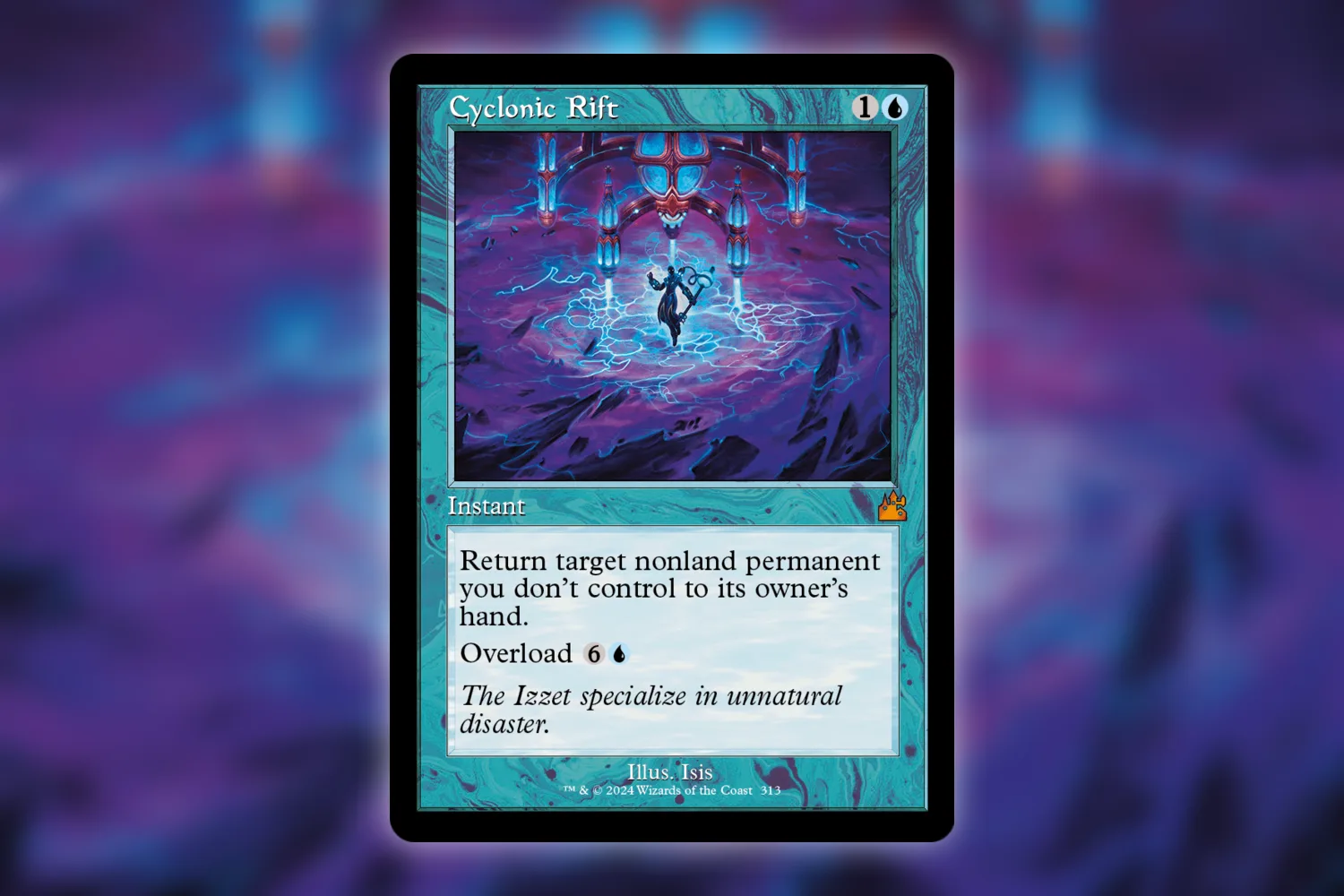
The borderless Cyclonic Rift from Ravnica Remastered is $39.00. The plain Return to Ravnica printing of the same card is $28.17. And there’s a third one from that same Ravnica Remastered set, collector number 313z, sitting at $1,399.99, because it’s serialized and wearing a foil treatment the regular borderless version doesn’t have. Two of those three share the same art. A camera has to split them apart on a serial stamp and a finish, not on the picture.
What the cheap end actually does
The TCG Verifier X1PRO starts at $199. CardMill, which ran a Kickstarter and says its final boards were due in October, advertises a removable hopper holding 400 or 800 cards and a hands-free scan-and-sort cycle.
CardMill’s published sorting modes are alphabetical up to the third letter, by set, by color, by card type, by rarity, and a targeted search that flags a card when it trips a filter you’ve set. Jobs export as CSV for import into TCGplayer, Moxfield, Deckbox and Archidekt. One sorting method at a time, not stacked. It also offers a scan-only mode that adds cards to inventory without physically sorting them.
That last mode is the tell, honestly. Scanning and sorting are being sold as one product because they happen in the same pass, but they’re answers to different questions. One tells you what you own. The other decides which bin the card falls into.
The middle tier is where the honest reviews live
There’s a machine called the Magic Sorter, built in Italy, that a Pokémon seller bought for around €2,500 and wrote up after a full year of use. Shipping and tariffs pushed it past $3,000 landed. It weighs over 20kg and runs off a Raspberry Pi with a touchscreen.
His numbers are the most useful thing I’ve found on any of these. Roughly 250 cards an hour. About a 5% error rate when you dump a big mixed batch in and ask it to sort by set, which means going back through every stack by hand to fix it. The fix is a two-pass method: sort by set first, correct the mistakes, then re-run one set at a time with the software told to expect only that set, sorting by card type. Accuracy gets close to perfect on the second pass. He also pre-sorts by language himself, and separates reverse holos from non-holos, because the machine is bad at both.
250 cards an hour sounded terrible to me at first. Then I did the math on the longbox under my desk, decided it would chew through the whole thing across two evenings while I did something else, and started genuinely talking myself into one. Then I got to the part where you pre-sort by hand before the machine touches anything, and I sat there thinking about how much of my sorting problem is actually the pre-sort. Which I think is most of it? I’m not sure. I’ve gone back and forth on this all week.
The arms race nobody puts on the spec sheet
The PhyzBatch-9000 came out of a Calgary engineer named Graeme Gordon losing 24 hours over three days to sorting his own collection back in 2015, and his roommate joking that he should just build a machine. He quit his job in 2016 and took no salary for seven years while he built it. The unit loads about 2,000 cards into an input hopper, feeds them one at a time onto a glass plate with cameras on both sides, and drops them into output bins based on whatever criteria the operator picked, price included. TCG Machines leases them to game stores rather than selling them outright.
Gordon told CBC something in 2023 that I think about more than any spec on any of these product pages:
“The various producers of these games are always making their cards more complex, [adding] various new surface finish treatments to them. It’s a constant arms race in terms of developing new code to recognize the cards properly and picking up on these very subtle variations between different cards.”
That was three years ago, and Wizards has not exactly slowed down since. Booster Fun treatments are the documented failure point for automated identification across the whole category. Borderless, showcase, textured foil, and all the other treatments that live on the same card name are exactly the variations the software has to chase, set after set. The Italian machine’s reviewer put it plainly: it’s very bad at identifying valuable cards, especially holos, foils and full arts, because of glare.
So yeah. The machine is worst at the cards that matter. Great at your Khans commons. Chokes on the thing you actually needed it to catch. That’s, uh. That’s kind of the whole problem with the pitch, isn’t it.
Where an MTG card sorting machine genuinely earns its keep
Stores, mostly. TCGplayer expanded its Roca line with a unit called the Roca Sifter in March 2026, and that whole tier is commercial pricing with lease-to-own arrangements, justified by labor you’re already paying for. Unbranded industrial sorters turn up on Alibaba between $1,900 and $2,800, and the vision-system units with card readers run $38,000 and up. Nobody buying one of those is deciding between it and a free Saturday.
If you’re a person with a collection rather than an inventory, the math is different, and the question I’d ask first is what’s actually bothering you. If it’s that your cards are in the wrong physical order, a machine is a real answer and you should price one out. If it’s that you don’t know what you own or what it’s worth, sorting doesn’t fix that at all. You can have a beautifully alphabetized longbox and still have no idea there’s a $28.51 card in it.
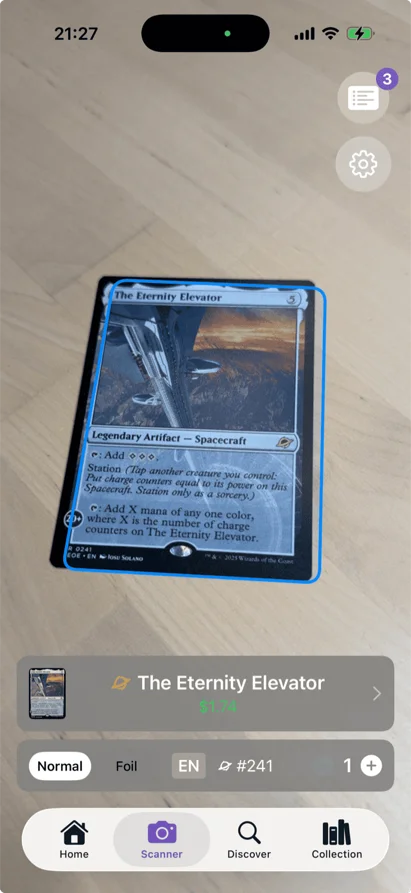
I scan into Eldwyn because the identification is the part I actually can’t do reliably at 2am, and a phone handles the fancy printings better than a $199 machine will. But I want to be fair here: I have never used any of these sorters. Everything above is spec sheets, one long honest review, and a CBC interview. If you own one and my read is wrong, I’d like to hear it.
What I did do, after the Sphinx incident, was stop trying to sort by set in one pass. Rough buckets first, fine sorting later, and the bulk gets handled as bulk instead of pretending each common deserves a filing decision.

The Sphinx is back where it belongs, by the way. Double Masters 2022 printing, $28.51, sitting in a binder page with the rest of the blue cards I care about. Four months in the wrong pile and it never lost a cent, which is either reassuring or an argument that none of this urgency is real.