My wife can identify exactly one Magic card. Sol Ring, because I’ve complained about it out loud enough times that the name stuck. Everything else in the closet is “the cards,” said the same way you’d say “the camping stuff.”
Which is fine, right up until it isn’t. If I got hit by a bus on the way to FNM, she’d be standing in front of four long boxes and two binders with no way to tell which part of that pile is worth a used car and which part is worth a pizza. And the thing that would happen next is not that someone robs her. It’s that a perfectly honest person at a perfectly honest shop offers her a perfectly honest number for an unsorted collection, and she takes it, because why wouldn’t she.
That’s the whole problem with MTG collection estate planning, if we’re going to call it that. Information that lived in one person’s head and then stopped existing.
The expensive cards are the ugly ones
Magic is worse than most collectibles for this, and I think it’s a frame problem. In almost every other hobby, the valuable item looks valuable. The gold coin looks like a gold coin. The first-edition book has a nice cover. Somebody who doesn’t collect can still triage by eye and get it roughly right.
Magic inverts this completely.
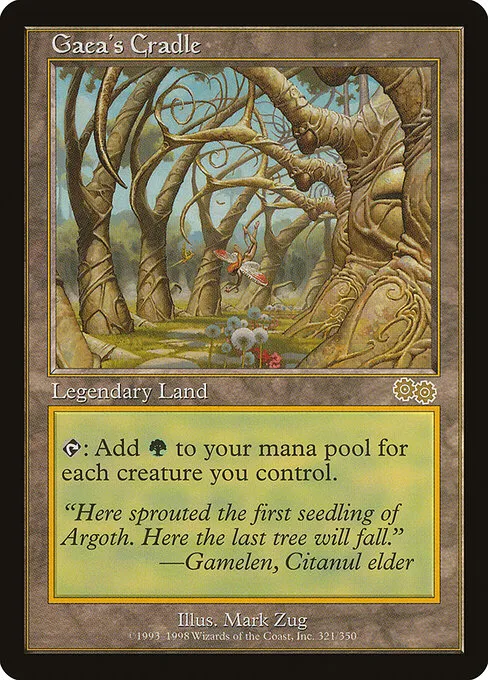
Gaea’s Cradle from Urza’s Saga is a plain green land with a picture of some trees on it. No foil, no fancy border, nothing that says “stop.” It’s sitting at $1,662 right now. A non-player sorting your collection puts that in the lands pile with the Forests, and I genuinely don’t blame them, because it looks like a Forest.
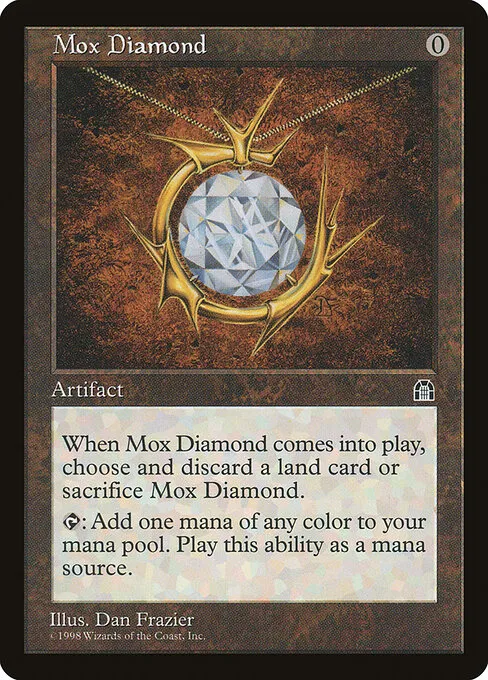
Revised duals are the same story. A Tundra is $670, an Underground Sea is $1,024, and they’re beat-up 1994 cards with muddy printing and white borders that look worse than every card printed since. Meanwhile the borderless foil Oko from Lorwyn Eclipsed, the card that actually catches the eye when you flip through a binder, is worth $3.05. My old Mox Diamond from Stronghold is a nondescript brown card with a rock on it and it’s over a grand.
So the sorting heuristic a normal person brings to this (“keep the shiny ones, the old ones are probably junk”) produces exactly the wrong answer, twice.
I still think about a box I sold in 2011. Local shop, I was moving apartments, I wanted the space more than I wanted the cardboard, and I let a longbox of “junk rares from Time Spiral block” go for forty bucks without looking through it. I know for a fact there was at least one Damnation in there because I’d played it. Never bothered to find out what else. Every time I tell that story I round the number down a little, which tells you something.
What a will does, and what it doesn’t
The legal side of this is less complicated than I expected, and also less useful than I expected.
Most states recognize something called a personal property memorandum. It’s a separate document your will points to, listing tangible items and who gets each one. You sign and date it, no notary or witnesses required in most places, and you can rewrite it whenever you want without touching the will itself. Not every state honors them, and California caps what you can pass this way at $5,000 per item and $25,000 total, which is a real ceiling if you own duals. Your will has to actually reference the memorandum or it does nothing.
That handles who gets the cards. It does not handle what the cards are, and the law is pretty clear that the description has to let an executor identify the object with reasonable certainty. Try writing that for a Magic collection. “My Magic cards” is one line and covers a $40 outcome and a $12,000 outcome equally well.
The other tool is a letter of instruction. It’s not legally binding at all. It’s just a note to whoever’s handling your stuff, explaining context the legal documents can’t carry. And for cards it’s the one that actually saves money, which is a strange thing to say about a document with no legal force behind it at all.
What actually goes on the page
I’ve written mine and it’s shorter than this article. Five things.
First, where the cards physically are. All of them. The boxes in the closet, the binder on the shelf, the deck in your bag, and the twelve cards in a toploader inside a shoebox in the garage that you forgot about until you started writing this. That last category is where things get lost.
Second, the top twenty by value, by name, with a rough number next to each and where in the pile it lives. Twenty is enough. The insurance world’s rule of thumb is to document 80% of the value, and in Magic that’s a shockingly small number of cards, because collection value is brutally top-heavy. If you’ve never priced your collection honestly, you’ll be surprised which twenty they are.
Third, who to contact. One name of somebody who plays and won’t take advantage, ideally not the person inheriting the cards. A shop you trust. A short note on where to actually sell and what the spread between a buylist and a per-card sale looks like, because “you’ll get 30 to 50% less if you buylist the whole thing” is the single most valuable sentence you can leave behind.
Fourth, what not to do. Don’t sort them. Don’t put them in a plastic tub in the garage. Don’t sell to the first person who offers a round number. Don’t throw away the commons before somebody looks, and don’t assume anything with a white border is old junk.
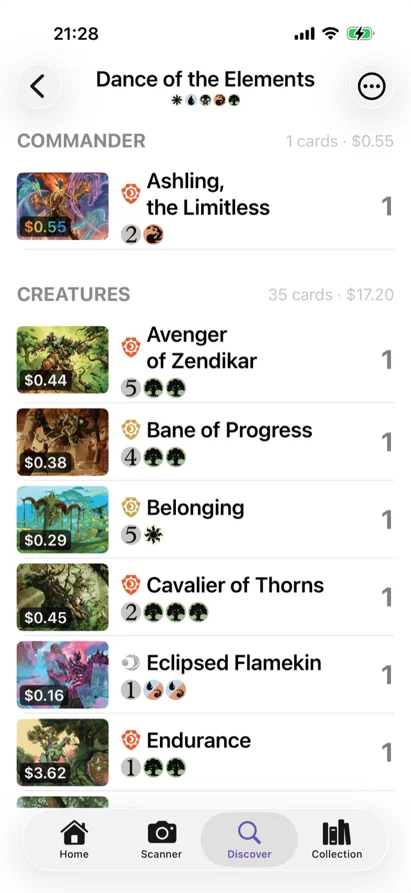
Fifth, where the inventory lives. If you’ve scanned your collection into anything, say so and say how to get into it. This is genuinely the part where an app stops being a toy and starts being a document, because a dated, itemized list with per-card values is an artifact your family can hand to a shop and negotiate against instead of guessing. I scanned my better boxes into Eldwyn over a couple of evenings and the export is now the thing my letter points at, which saved me from writing the top twenty out by hand.
I went back and forth on this
Look. I want to be honest that part of me thinks this is a slightly ridiculous thing to spend an evening on. It’s cardboard. If I’m dead I am not going to be up there fuming that my wife got sixty cents on the dollar for a Bazaar of Baghdad. There’s something a little self-important about writing a formal document about your Magic cards, and I sat with that objection for a while before I wrote mine.
What got me over it was realizing the money is the smaller half of it. The bigger half is not handing somebody a four-hundred-pound decision during the worst week of their life. Every person I’ve watched inherit a collection stalled out for months. Opening the box hurt, they had no idea where to start, so the box stayed shut. A page that says “here’s what this is, here’s who to call, here’s what not to do” removes the part they can’t do and leaves the part they can.
So yeah. One evening. Write the page. Don’t overthink the format, it’s a text file, it doesn’t need letterhead.
The one bit I’m genuinely unsure about is where to keep it. With the will is the obvious answer and it’s what every estate site says. But wills get filed in a drawer and looked at once, and the cards are in the closet right now. I ended up doing both, a copy with the will and a printed copy taped to the inside lid of the top box, which feels clumsy and probably breaks some rule I don’t know about. Update it when you buy something that would crack the top twenty, which for most of us is once a year, maybe twice.
Mine took about forty minutes, most of which was arguing with myself about whether the Revised duals go to my brother or get sold. I still haven’t decided. The line in the letter currently says “ask Dave,” and Dave doesn’t know he’s in there.