There’s a number I assumed was basically a constant for about ten years of collecting, which is the ratio between what a Magic card costs in dollars and what the same card costs in euros. Currency converts. You take the dollar figure, you multiply by a thing, you get the euro figure. That’s what conversion means.
So I pulled 21 ordinary English cards, nothing exotic, none of the foreign-language weirdness where a card can genuinely have two unrelated values, and put the two numbers side by side. If your MTG collection value in euros were just your dollar total wearing a different hat, every one of those 21 ratios would land in the same narrow band.
They ran from 0.44 to 1.46.
The 21 cards
Cheapest end of the ratio: a Commander 2021 Sol Ring is $1.83 and €0.80. Rhystic Study from Prophecy, $63.54 and €33.65. Mana Drain from Legends, $245.52 and €135.65. Modern Horizons 2 Counterspell, $2.97 and €1.58.
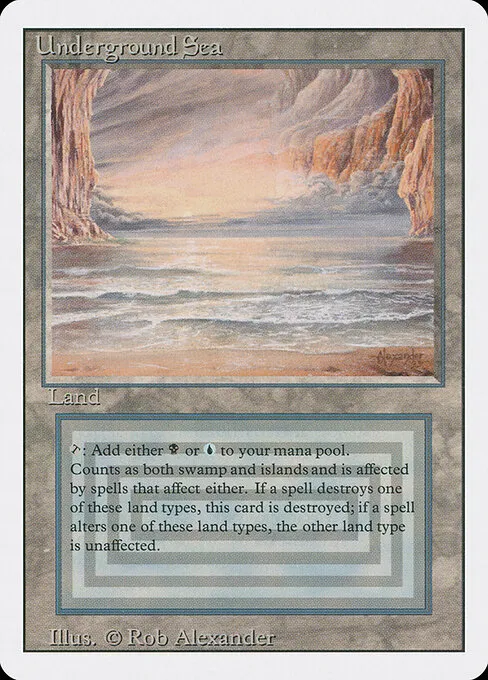
Then the expensive old cardboard, which behaves more politely. Revised Underground Sea is $1,048.03 and €699.03. Lion’s Eye Diamond from Mirage, $797.61 and €554.51. Gaea’s Cradle out of Urza’s Saga is $1,636.78 and €1,286.51, which is a ratio of 0.79 and the tightest of any four-figure card I looked at.
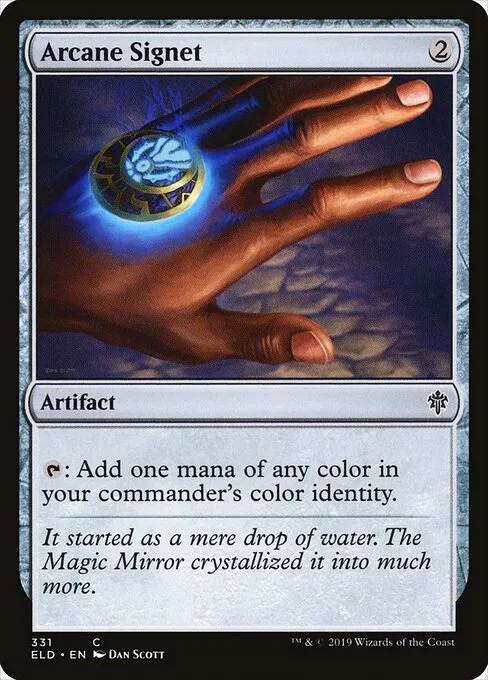
And then the cards that go the other way entirely. Wrenn and Six is $8.62 in dollars and €9.55 in euros. Dockside Extortionist from Commander 2019, $8.41 and €10.98. An M11 Lightning Bolt, $1.12 and €1.53. Throne of Eldraine Arcane Signet is fifty-seven cents in America and €0.83 in Europe, which is the single widest ratio in the set and it’s on a card nobody thinks about.
Twenty-one cards, ratios from 0.44 to 1.46, a spread of about three and a third. One exchange rate cannot produce that. Whatever the euro is doing against the dollar this week, it’s doing the same thing to Sol Ring and Arcane Signet, and those two ended up on opposite ends of the range.
Two catalogs, two rooms
Scryfall’s dollar figure comes from TCGplayer, which is where the American singles market clears. The euro figure comes from Cardmarket, which is where the European one does. Those aren’t two views of one pool of transactions. They’re two pools.
Cardmarket started life in 2007 as Magic Card Market and grew up alongside the European MTG scene, and it works differently from TCGplayer in ways that show up in the price. It’s fixed-price only, no auctions. Every seller offering a given card appears on that card’s single canonical page, sorted, with their reputation showing, which means sellers are undercutting each other in public on a page the buyer is already looking at. Margins on liquid MTG singles get squeezed flat. There’s a want-list tool that solves an actual optimization problem across sellers to minimise cards-plus-shipping, so European deckbuilders are trained to buy in consolidated batches from whoever’s cheapest.
TCGplayer, meanwhile, is functionally a domestic market. International shipping off it is rare and expensive enough that for most practical purposes an American price is an American price.
So when the two numbers disagree, neither one is wrong and neither one is the “real” price with the other as an error term. They’re describing what happens in two rooms that barely share air.
The part I can’t explain
Okay so here’s where I have to be honest. The expensive vintage stuff, I get. Underground Sea, Mana Drain, Lion’s Eye Diamond, all cheaper in euros, all consistent, and that’s a story about American vintage demand being deeper and louder than European. Fine. I believe that one.
The cheap end makes no sense to me. Sol Ring is the lowest ratio in the whole basket at 0.44 and Arcane Signet is the highest at 1.46, and they are the same kind of card. Two-mana-ish colorless Commander glue, printed into oblivion, in every precon anyone has ever opened. If I had a theory it would be something about shipping economics putting a floor under cheap cards in Europe, since paying postage on a thirty-cent card is absurd, but then Sol Ring should floor too and it very much does not. I don’t know. If someone has the actual answer I’d genuinely like to hear it.
Which number goes in your total
The tidy answer is that you use the market you can actually reach. If you’re in Ohio, TCGplayer’s number is the one you could convert into money this month, and the Cardmarket figure is trivia. If you’re in Munich, it’s the reverse, and every US-centric price guide and YouTube finance video you’ve ever watched has been quoting you a number you can’t transact at.
I’ve believed that for a while and I’m now slightly less sure of it. For a Gaea’s Cradle, the deepest market is the real market wherever you happen to live, because at sixteen hundred dollars you will absolutely ship a card across an ocean to reach a better bid. The “use your local market” rule only really holds under some threshold where shipping and hassle stop being rounding errors. Somewhere around a hundred bucks, maybe? I don’t have a principled place to put the line and I suspect it moves depending on how much you enjoy going to the post office.
Under that threshold the local number wins, and it wins for a reason that has nothing to do with prices: condition. Cardmarket runs its own grading scale and tells sellers to grade down when unsure, and to not call something Near Mint unless the back qualifies too. An American NM and a German NM are not always the same claim about the same piece of cardboard, and if you buy across the gap expecting the arbitrage to be free, grading is where it stops being free. I’ve written before about what card conditions actually mean and the short version is that everyone grades their own cards generously.
Two years ago at MagicCon Amsterdam a Dutch guy at the open trade tables offered me euros for a Cyclonic Rift and a couple of shocks, and I stood there doing mental division badly, decided the number sounded low, and passed. Got home, actually looked it up, and it had been a completely fine offer. Slightly good, even. I’d anchored on the TCGplayer price I had in my head from listing one the month before, which was the wrong room’s number, and I talked myself out of a fair trade with arithmetic I was doing in the wrong currency in a loud convention hall.
If you’re keeping a running collection total, the thing to do is pick one currency and stay in it, and know which one you picked. A total that silently mixes a dollar price here and a euro price there isn’t measuring anything. That’s the same discipline as pricing a collection without flattering yourself, applied to a variable most people don’t know is a variable. My totals are in dollars because I sell in dollars, and I mostly ignore the euro column except when I’m about to trade with someone who doesn’t.
The exception worth actually acting on is if you’re sitting on old expensive cards and you’ve only ever checked one market. Go look at the other one. Not because you’ll definitely sell there, but because on a four-figure card a 0.67 ratio means the two markets are quoting figures about a third apart, and that’s worth twenty seconds of curiosity even if the answer is that shipping eats it.