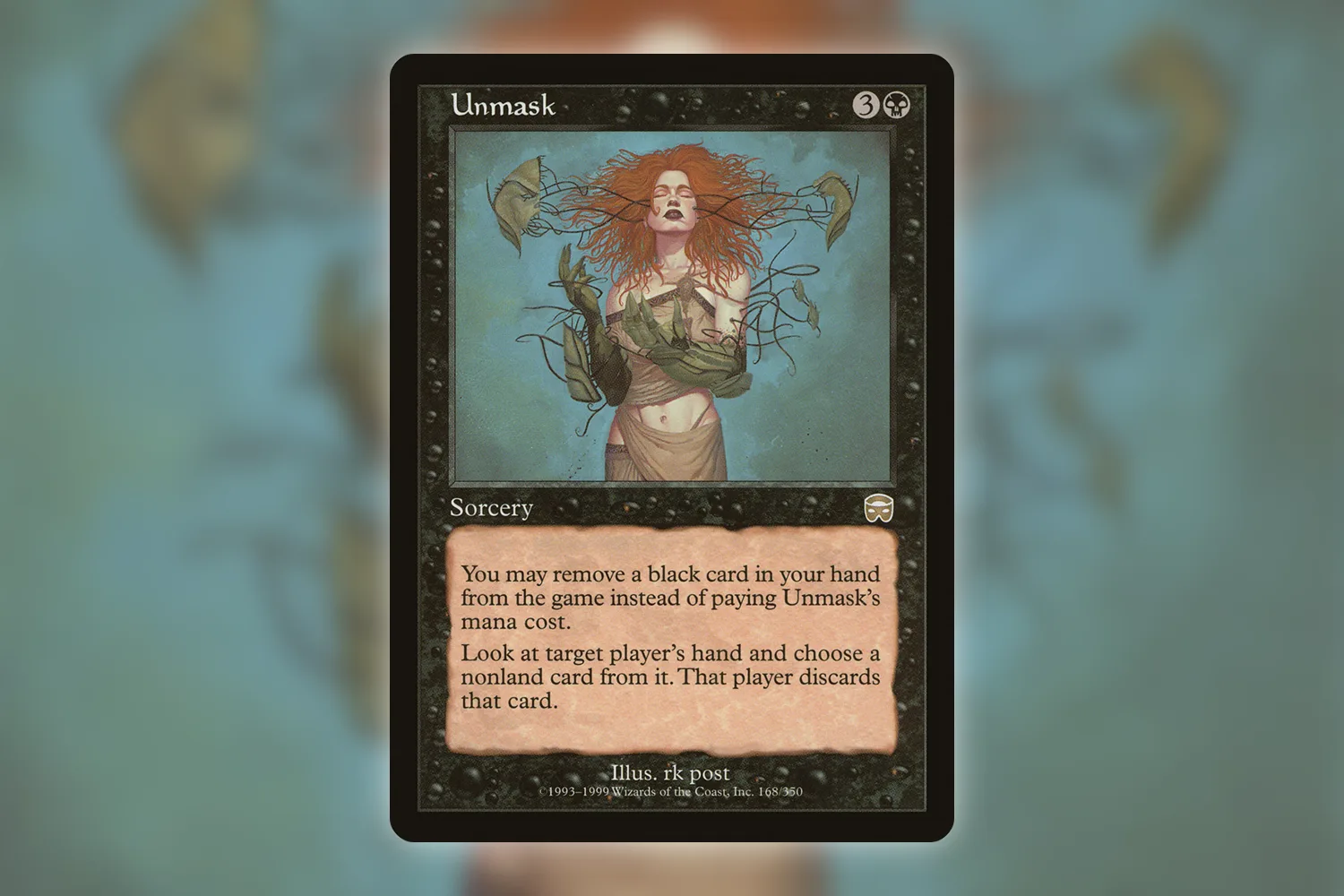
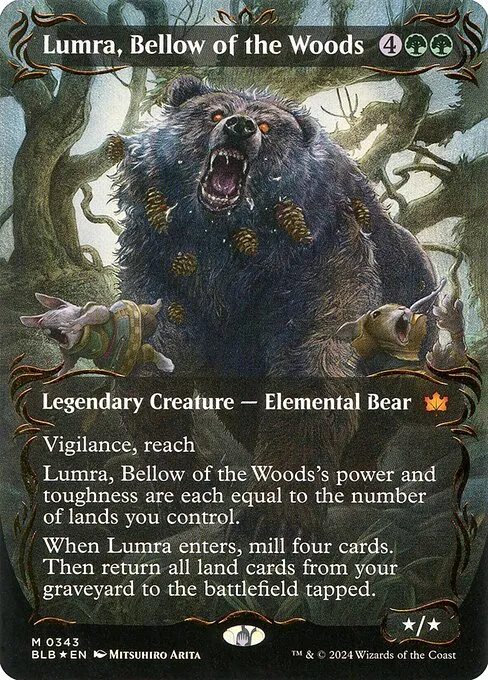
There are four different Lumra, Bellow of the Woods in Bloomburrow. Not four copies. Four printings. The normal one, the borderless one, a second borderless one with different art, and a raised-foil showcase that only exists as a foil. I sat down in May to work out how close I was to an MTG master set of Bloomburrow, a thing I’d been picking at since the set came out, and I got stuck before I’d counted a single card in my binder.
Not stuck on what I owned. Stuck on what the total was supposed to be.
I’ve written before about completing a base set, where the denominator is a settled question and the only fight is with your own attention span. Master sets aren’t like that. I called them a money pit in that piece and moved on, which I now think was a bit of a cop-out, because “money pit” isn’t a number and people deserve a number.
Nobody agrees on the denominator
Scryfall says Bloomburrow has 398 cards. That’s card objects, meaning distinct printings, and it’s the number most tools will hand you if you ask for the set size. But 398 doesn’t count finishes. Once you split nonfoil and foil into separate physical things you have to buy, which you do if you’re doing this properly, Bloomburrow is 768 cards. From 280 unique card names.
So already the “set” is somewhere between 280 and 768 depending on how you’re counting, and we haven’t touched the actual argument yet. The actual argument is the rest of the family. Scryfall files five more sets under Bloomburrow:
- Bloomburrow Promos, 160 cards
- Bloomburrow Commander, 356 cards
- Bloomburrow Art Series, 54 cards
- Bloomburrow Tokens, 30 cards
- Alchemy: Bloomburrow, 30 cards
Alchemy doesn’t exist in paper at all, so that one’s easy to cut. The rest aren’t. Prerelease promos are Bloomburrow cards with a Bloomburrow set symbol and a date stamp, and if you say they don’t count you’re saying a card that says Bloomburrow on it isn’t part of Bloomburrow, which is a hard position to defend at 11pm to a friend who collects them.
So yeah, the promos. Everyone’s got a take. Some people count the buy-a-box and skip the store championship. Some people count everything with the set symbol. Some people cut anything they can’t pull from a pack, which sounds principled until you remember the box topper. I asked around a bit and got maybe four different answers from five people, and honestly the fifth person just said “I collect what looks nice,” which, fair.
I don’t have a right answer here. I have a preference, and I’ll get to it, but I want to be clear that it’s a preference and not a rule.
The Bloomburrow numbers
Here’s what I can actually tell you, because it’s arithmetic rather than opinion.
I priced every Bloomburrow printing on Scryfall and added it up two ways. Taking the cheapest nonfoil version of each of the 277 cards that have a price at all, a base Bloomburrow set costs about $288. That’s the whole set. Every common, every uncommon, all the rares and mythics, in their plainest printing.
Every priced variant in the set, all 767 of them, nonfoil and foil, every borderless and showcase and extended art: $5,328.
Eighteen times. Same 280 cards.
Aetherdrift runs the same shape, $194 for the base and $2,481 for everything, over 953 physical variants. Secrets of Strixhaven is $171 base against $3,821 for the lot. That gap is the whole reason people bounce off master sets, and it isn’t distributed the way you’d expect it to be.
Two cards are most of the bill
The raised-foil Lumra I mentioned at the top is $764.14. It’s foil-only, one printing, one card.
Baylen, the Haymaker has a raised foil too, at $413.86. The regular foil Baylen is $2.09. Same card, same set, same text box, and one of them costs two hundred times the other because of how the foil sits on the cardstock.
Those two cards together are about $1,178, which is 22% of the entire Bloomburrow master set, and more than four times what the complete base set costs. You could buy every card in Bloomburrow four times over for the price of two shiny ones.
Strixhaven is worse, or funnier, depending on your mood.
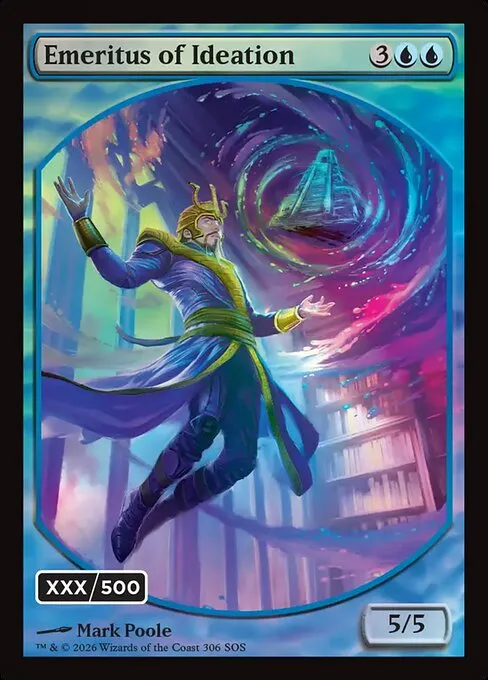
The serialized rainbow-foil Emeritus of Ideation is $2,900 on its own. The regular version of that card is $5.91 in foil. So of the $3,821 it takes to master-set Strixhaven, $2,900 is one card, and if you cut serialized cards out of your definition the whole project drops to roughly $921 and becomes something a normal person could finish in a year.
Which is where I started to doubt the money-pit line. If the entire cost problem is two raised foils and a serialized headliner, then a master set minus the lottery tickets is maybe $900 to $1,200 for a modern set, spread over however long you want to take. That’s not nothing but it’s not a car payment either. It’s a weekend of Commander a month for a year.
Then I looked at The Lord of the Rings, which is 291 unique names and 856 printings and 1,546 physical variants once you count finishes, and remembered that the sets people most want to master-set are exactly the sets that make it impossible. So I don’t know. Both things seem true. The math is friendly right up until the set is one you care about.
Where I actually landed
I count the main set, nonfoil and foil, every treatment, and I exclude serialized, promos, Commander decks, and the art series. That’s my line. It’s arbitrary. I picked it because it maps to “things that came out of a booster of this set,” which felt like the cleanest sentence I could say out loud, and because it keeps the target under a thousand cards.
Write your boundary down somewhere before you start buying. I mean it literally, in a note, in a sentence. The reason isn’t philosophy, it’s that six months in you will be standing at a case looking at a prerelease-stamped Vren and you will not remember whether past you decided those count, and you’ll buy it just in case, and that’s how a master set becomes a pile.
I did exactly that with Aetherdrift, incidentally. Sorting at one in the morning, convinced I was missing the borderless Loot, the Pathfinder, ordered one from a seller in Ohio for eleven bucks plus shipping. The copy I already had was sitting in a deckbox two feet from my left elbow the entire time. I’d taken it out of the binder to try it in a deck and never wrote that down either.
The tracking side of this is the part I’d actually spend effort on, more than the buying. A base set you can hold in your head on a good day. A master set you cannot, because the thing you’re tracking isn’t “do I own Lumra,” it’s “which of the four Lumras do I own and in which finish,” and that’s a collector number question, not a card name question. Scanning into Eldwyn resolves to the specific printing rather than the name, so the set view counts your borderless and your normal copy as two different slots the way they actually are. Which is most of what I wanted from it.
Anyway, four Lumras. I have two.