There’s a rubber-banded stack of maybe four hundred tokens in the bottom drawer of my card desk. Saprolings, Treasures, a genuinely unreasonable number of 1/1 white Soldiers. I have never once looked at that stack and thought about money. It’s the pile you dig through when someone at the table needs a Clue and nobody brought dice.
Then somebody at my LGS mentioned selling a single Elephant token for ninety-something dollars, and I went and re-examined some assumptions about whether MTG tokens are worth anything.
Almost never, it turns out. But the exceptions are stranger and more specific than I expected, and they hide in exactly that kind of drawer.
The actual numbers on MTG tokens worth money
Scryfall tracks 3,291 unique token printings. Of those, 1,118 have any USD price attached at all. The other two thirds have no market price because nobody is selling them, which is its own sort of answer.
Narrow it down from there:
- 280 tokens are worth more than $1
- 117 are worth more than $5
- 25 are worth more than $20
Twenty-five. Out of 3,291.
The modern ones are worse than that summary makes them sound. I pulled the token sets from this year’s releases and checked every one. Marvel Super Heroes has 27 tokens. The Hobbit has 3. Secrets of Strixhaven has 14. All of them return null on price. No data at all, because there’s no market to generate any. You cannot sell a Doombot token. You could try.
Where the money actually is
Nearly all of it sits in tokens that were never in a booster pack.
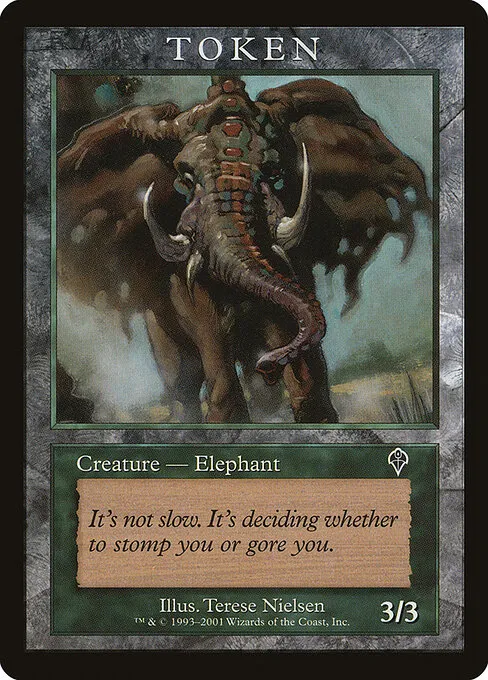
Magic Player Rewards is the big one. From 2001 to 2004, Wizards mailed tokens to players who registered sanctioned event results, and the print runs were small enough that survivors are scarce now. The 2001 Elephant, the Terese Nielsen one with the flavor text about deciding whether to stomp you or gore you, sits at $99.99. That same year’s Saproling is $50.81. The Spirit is $33.58, the Bird $23.80, the Goblin Soldier $20.50.
2002 kept going. Elephant at $69.90, Squirrel at $43.73, Wurm at $29.91. The 2003 Sliver is $40.95.
I’d hold those numbers loosely. These are thin markets, and one or two listings drag the price around. A card with three copies for sale isn’t really a card with a price, it’s a card with an asking price. But the direction is real and it’s a long way from zero.
Around 2013 I traded a shoebox of bulk to a guy for a Thoughtseize. He went through the rares first, then asked almost as an afterthought whether he could have the loose tokens rattling around the bottom. I said sure, obviously. He was maybe nineteen and had a binder page of nothing but old Player Rewards tokens, which at the time I filed away as an endearing quirk. I’ve since revised that read. Never found out what was in the shoebox.
The regional promos are where it gets silly. A foil Treasure from the 2018 Lunar New Year promo is $215.74. A Construct from the Brothers’ War Southeast Asia run is $161.89. The Dominaria United Japanese promo tokens include an Angel and a Beast at $129.95 each in foil. These were handouts at events in specific countries, so supply anywhere else is roughly whatever people carried home in a backpack.
The 2015 League Monk token is $36.11. The 2014 League Squid is $30.00. I don’t know why the Squid specifically. Someone out there does.
The Unglued six
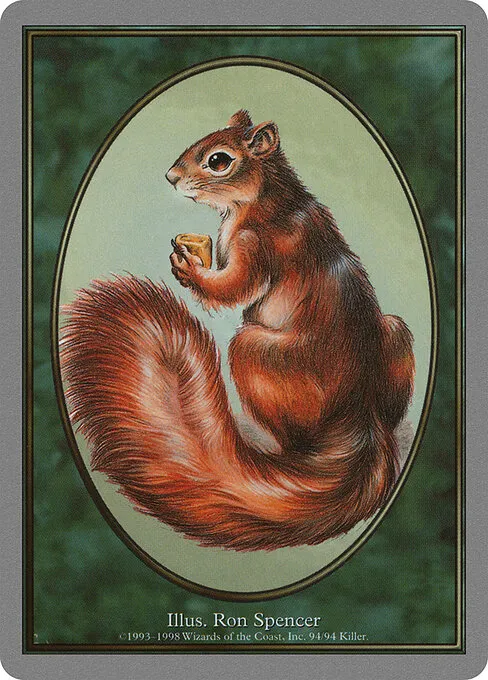
Unglued printed the first token cards Magic ever had, back in 1998. Six of them, numbered right into the set at 89 through 94 like regular cards.
The Squirrel is 94/94, the very last card in the set, illustrated by Ron Spencer, and it goes for $32.40. Zombie is $8.12. Soldier $5.05. Goblin $4.81. The Sheep is $1.56 and the Pegasus is 95 cents, which reads as a slight against the Pegasus.
Some of the Squirrel premium is just a Squirrel thing. That tribe had a devoted following twenty-five years before Bloomburrow showed up.
What about Marit Lage
I assumed Marit Lage would top this whole list. It’s the famous token, the 20/20 flying indestructible you make with Dark Depths, the one that actually wins games in Legacy. People build decks around it.
It’s cheap. The Ultimate Masters printing is $2.09. The Secret Lair version runs $8.66, or $9.19 in foil. The most expensive Marit Lage anywhere is the Coldsnap promo foil at $17.01, and that’s the ceiling for a token with a real competitive job.
Which corrected something I had backwards. Token prices don’t track playability. Every Dark Depths deck can use any of the nine printings, or a proxy, or a scrap of paper with 20/20 written on it, so no specific version is ever load-bearing. Scarcity does all the work.
Although, hang on. That $9.19 foil Secret Lair is almost certainly 90% “it’s the nice one for the deck I already play,” so playability isn’t doing nothing. It’s just not doing it through demand for the token as a token.
Should you log tokens in your collection at all
I’ve gone back and forth on this one.
For the vast majority: no. Don’t scan them, don’t add them, don’t let them into your count. If you track collection value, adding four hundred items worth zero dollars apiece accomplishes nothing except inflating a card count that impresses nobody. It also clogs your unsorted queue every time you crack a box, and a want list is only useful when the underlying data stays trustworthy.
The exception is anything promotional, unusually old, or unfamiliar enough to merit a price check, the same rule that applies to promo cards generally. Most valuable tokens didn’t come from a booster pack, but the Unglued Squirrel did, so booster origin alone isn’t a safe filter.
The filter I use is the bottom line of the card. A modern token from a normal set carries a printed set code and collector number in the same format as every other card you own. The old Player Rewards tokens do not, although they do carry the expansion symbol associated with the token. The 2001 through 2004 ones are dated right in the copyright text and use a distinctive older token frame. Token, no collector number or printed set code, copyright year in that window? Stop and look it up before it goes back in the drawer.
Regional promos are harder, because they look normal at a glance. Usually the tell is a language mismatch, or a set symbol you don’t recognize from anything else in your collection. If you’ve bought a bulk lot from somebody who traveled, or inherited a collection from a player who did the Grand Prix circuit in the 2000s, that’s the pile where these surface.
Scanning tokens works fine, for what it’s worth. Eldwyn reads them like any other card. The question was never whether you can log them.
So yeah. The drawer. I did go through it, after all that. Four hundred-ish tokens, forty minutes, a lot of Treasures. The oldest thing in there was a 2019 Servo. Nothing. Not one Player Rewards anything, which given the shoebox story is probably the correct ending.