A guy I used to play Commander with had his car broken into outside a Denny’s at eleven at night, maybe four years ago. He’d stopped for food after the shop closed. Two decks in a Ultra Pro box on the passenger seat, plus the trade binder he carried everywhere. The window cost him more to replace than the thief probably got for the cards, which is the detail he kept coming back to for months afterward.
He never saw any of it again. He also never filed a police report, because what would be the point.
I’ve thought about that a lot since, mostly because the answer to “what would be the point” is not nothing, but it’s also much less than people assume. If your MTG collection got stolen, your odds of getting it back are almost entirely determined by something you decided months earlier without knowing you were deciding it: how weird your cards are.
Most of a collection is anonymous by design
Here’s the uncomfortable structural fact. Sol Ring has been printed something like a hundred times. The Commander 2021 printing sits at $1.89 right now, and there are, conservatively, millions of copies of that card in circulation. If someone takes yours, there is no test, no marking, no database entry, and no serial number that distinguishes your near-mint C21 Sol Ring from the identical one sitting in a bulk box in Ohio.
That’s true for the overwhelming majority of what’s in your binder. Even the collector number and set code printed on the bottom of the card only tell you which printing you own. They say nothing about which copy. Two cards with the same set code and collector number are, for every practical purpose including a police investigation, the same object.
Which is exactly why cards get stolen so casually. They’re compact, they’re liquid, they sell at any counter in any city, and they carry no identity. Compare that to a stolen bike, which has a frame number stamped on it at the factory whether the owner wanted one or not.
The cards you can actually chase
A small slice of a typical collection breaks that rule, and it’s worth knowing which slice, because that’s where all your recovery effort should go.
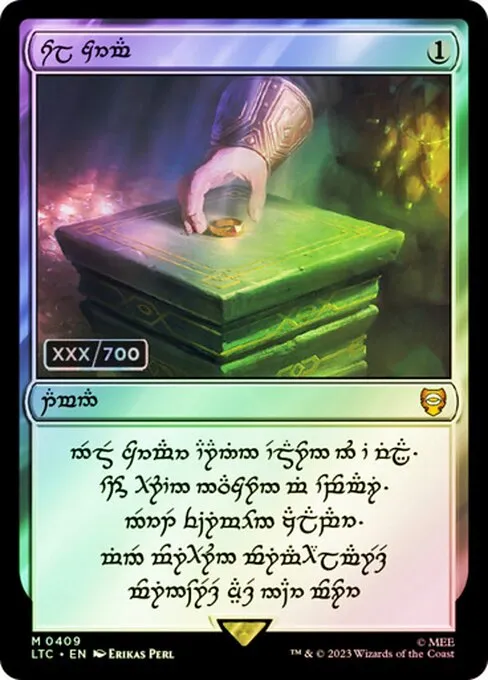
Serialized cards are the clean case. The serialized Sol Ring from Tales of Middle-earth Commander is literally stamped with a number out of a fixed print run, and the foil currently runs about $2,750. That number is yours specifically. If it surfaces on eBay, it’s provably the one that left your house, assuming you wrote the number down, which is the part everyone skips.
Graded cards are the next tier. A PSA, BGS, or CGC slab carries a cert number that’s checkable against the grading company’s public lookup, and slabs are annoying to crack open without visibly damaging the card, so thieves often don’t bother. The catch, and I went looking for a way around this for a while, is that there’s no unified stolen-cert registry across the grading companies. You can report a theft to them, and PSA in particular will flag a cert if you contact them, but there’s no single database a buyer can check before purchasing. Forum threads asking for one go back a decade. The answer is still basically “post about it publicly and hope somebody recognizes the number.”
Then there’s the messy category: signed cards, altered art, foreign-language printings, miscuts, artist proofs. Anything that’s visually distinctive enough that a photo would identify it. A Japanese alt-art with a specific crease pattern is more findable than a $400 dual land in perfect condition, which sounds backwards and is completely true.
The first day matters more than the next six months
File the report. I know the friend I mentioned didn’t, and I understand why, and I think he was wrong.
Not because police are going to run a task force on your Commander decks. They aren’t. But the report does two things that nothing else does. It’s the document your insurer will require before they’ll even open a claim, and it’s the mechanism by which a recovered card legally becomes yours again. Pawn shops in most US states have to log and hold what they take in, and in a lot of jurisdictions they’re required to check that intake against police theft reports. If your stuff shows up on a shelf and there’s no report on file, the shop has no obligation and no reason to give it back to you. You’d be buying your own cards.
The report needs to be specific to be worth anything. “Approximately 3,000 Magic cards” is not actionable. An itemized list with printings and values is. This is the moment where your documentation either exists or it doesn’t, and there’s no retroactive fix.
Then circulate locally, fast, because that’s where the cards go. Message the LGSes within driving distance, because the buylist counter is the most likely first stop and shop staff genuinely do watch for this. Same for local pawn shops and the regional Facebook trade groups, whatever you think of Facebook. And set saved searches on eBay and TCGplayer, but only for the identifiable stuff, since an alert for “Sol Ring” is just noise.
So yeah. Realistically? Most of this doesn’t work. Cards go into a buylist somewhere two towns over, get shuffled into inventory within a week, and that’s the end of it. I’m not going to pretend the recovery rate here is good. It’s bad. It’s genuinely bad. The reason to do all of it anyway is that the cost is one afternoon and the alternative is definitely zero.
The part that has to happen first
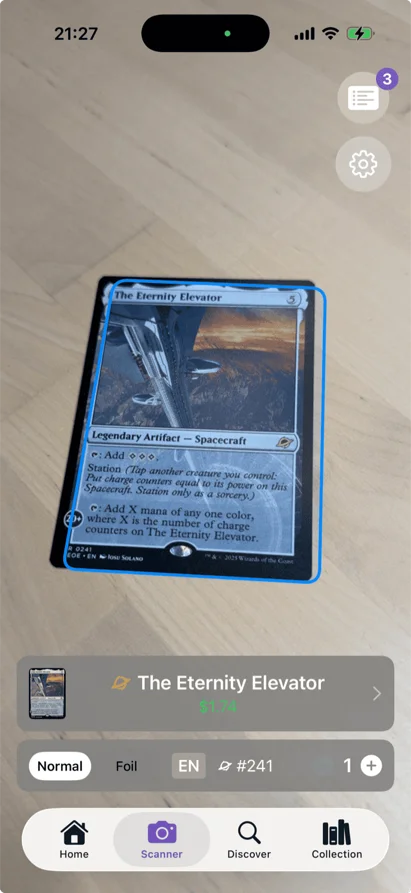
Everything above collapses into one prerequisite, which is having a dated, itemized record of what you owned before it left. I’ve written about why this matters for insurance and I won’t relitigate that, but theft recovery has a slightly different requirement than an insurance claim does. An insurer wants values. A recovery wants identifiers: printing, condition, cert numbers, serial numbers, photos of anything distinctive.
You don’t need all of it. The standard guidance for collectibles documentation is to cover something like 80% of the value, which for most people means the top forty or fifty cards and none of the bulk. Nobody is recovering your commons and you shouldn’t spend a Saturday photographing them.
I’ll admit I’m inconsistent about this myself. I scanned my good stuff into Eldwyn about a year ago, mostly to settle an argument with myself about whether the collection was worth what I thought (it wasn’t, it was worth more, which was a fun afternoon). The by-product is an itemized list with printings and per-card values and a date attached, which happens to be exactly the artifact a police report wants. But I have never once written down the cert number on the two slabs sitting in my desk drawer, which is a ten-minute job I’ve been not-doing since roughly February. So take the advice at whatever discount that deserves.
One more thing that’s easy and nobody does: photograph your binder pages. Not each card individually. Just lay the binder open, nine cards to a page, and shoot every spread with your phone. It takes about four minutes for a full binder, the timestamps are automatic, and it gives you something visual to hand to a shop owner that a spreadsheet doesn’t. My friend with the Denny’s window would have had that, at least, and it might have gotten him his altered Rhystic Study back.