The Scryfall scan of Captain James T. Kirk has an empty box on it.
Not empty the way a textless card is empty. There’s a silver rectangle sitting where the rules text should be, thin border around it, and it looks exactly like a form waiting to be filled in. Which is what it is. That’s the panel William Shatner signed, and the database photo was taken before he got to it.
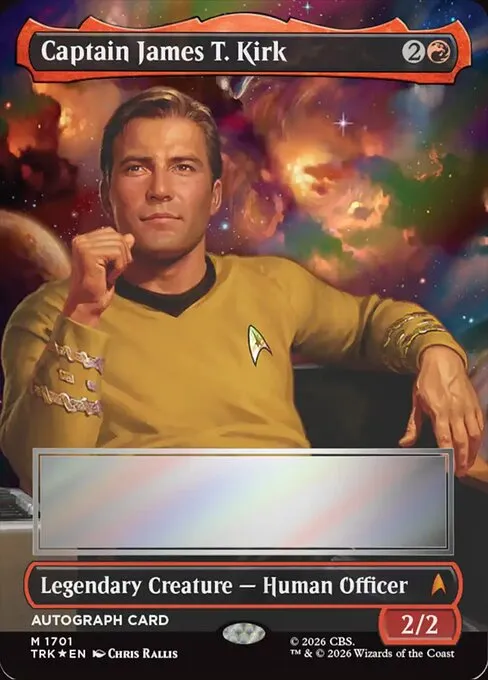
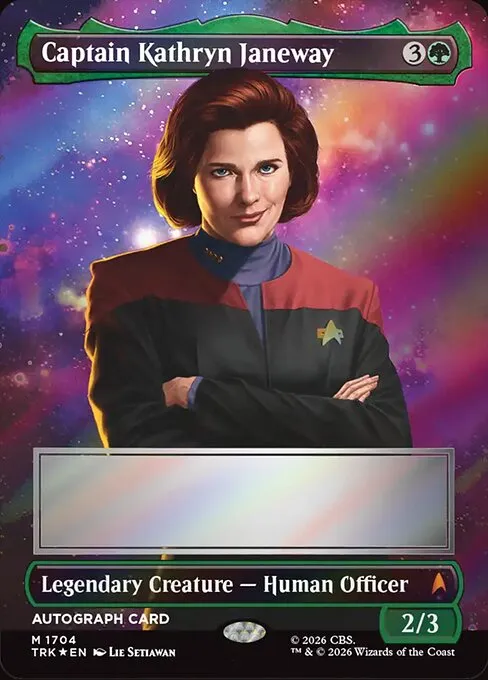
So the MTG Star Trek autograph cards are real. Seven of them, hand-signed by the actors who played the characters, going into Collector Boosters when the set lands November 13. Wizards says roughly 250 copies of each, which puts about 1,750 signed cards into the entire print run. Two are revealed so far: Shatner’s Kirk and Kate Mulgrew’s Janeway. Gavin Verhey said on the reveal stream that they’re not all captains, which is the kind of tease that makes people start listing Deep Space Nine cast members in the comments.
One wrinkle before anyone quotes me. The July stream reported 200 copies each. Wizards’ own Collecting article says approximately 250. I’ve seen both numbers repeated confidently by outlets that should know better, and I genuinely don’t know which one is right, so treat 1,750 as a ballpark and not a census.
Nobody can tell you the odds on an MTG Star Trek autograph card
Here’s where I got annoyed reading the coverage. Every article about these has a paragraph that gestures at how rare they are, and not one of them gives you a pull rate, because a pull rate requires knowing how many Collector Boosters exist. Wizards has never published a print run. They aren’t going to start now.
What we can say is the shape of it. A Collector Booster box is twelve packs. At $37.99 a pack that’s a $455 box before anyone opens anything. Star Trek is a Universes Beyond set with sixty years of built-in audience, so the print run is going to be large in a way that makes 1,750 look like a rounding error against it. If the set moves anything like Lord of the Rings did, you’re in territory where the honest answer to “what are my odds” is “low enough that you should not buy Collector Boosters expecting one.”
Which is the same advice as always, just with better set dressing.
For scale, the closest thing Magic has done is serialized cards, and those run 500 copies of a given card in most sets. So the autographs are roughly half as plentiful per card as a standard serialized run, except spread over seven cards instead of a big sheet. The One Ring 001/001 is the far end of that scale, one copy on Earth, $2 million, and I’d note that Post Malone’s copy went through PSA authentication and came back a Mint 9 before the sale closed. Hold that thought.
I once got a Llanowar Elves signed by the artist at a Grand Prix in maybe 2016. Silver paint pen, which the artist warned me about and I ignored because it looked incredible under the hall lights. Put it in a penny sleeve, put the sleeve in a box, drove home. By the time I looked at it again the silver had transferred a perfect mirror image of the signature onto the inside of the sleeve and the card underneath was a smeary mess. I still have it. It is worth precisely nothing and I’m not throwing it away.
It says AUTOGRAPH CARD right on the front
Look at the bottom left of the Kirk. Under the type line, in the slot where flavor text or a watermark would go, it says AUTOGRAPH CARD in small caps. Printed. Part of the card.
And the collector number is 1701. Janeway is 1704. If you know anything about Star Trek you already smiled, because NCC-1701 is the Enterprise’s registry number, and Wizards clearly started the autograph numbering there on purpose. I’d guess the seven run 1701 through 1707, though I’ve only seen two, so that’s an inference and not a fact. The set code line reads TRK with a star, the star being the marker Magic uses for special printings.
All of which means the card does the authentication work for you, right up until it doesn’t. The frame is the manufacturer saying “a real actor signed this one.” That’s how sports cards have handled in-pack autographs for thirty years, and it’s why a Topps certified auto is worth more than the same player’s signature on a napkin. The provenance is baked into the cardboard.
But the cardboard isn’t the valuable part. The ink is. And the ink is the one thing on that card with no printed verification attached to it at all. There’s no serial number, no hologram over the signature, nothing tying that specific signature to that specific card. Someone with a blank-panel version and a steady hand has a much easier forgery job than someone faking a whole card, because they only have to fake one thing and the expensive half is already legitimate.
I don’t think that’s going to be a real problem at first. It becomes a problem in about three years, when these are worth enough to be worth faking and the population has scattered into a thousand binders. Which is the argument for slabbing one, and I say that as someone who thinks almost nothing should be graded. PSA dual-grades autographs, a card grade and a separate signature grade, and the signature half runs through PSA/DNA. If you pull one of these, that’s the case where the fee is obviously worth it.
Although, hmm. I keep talking myself partway out of this. The population is 250 per card, every one of them came out of a sealed pack, and there is no legitimate supply of blank-panel versions floating around for a forger to work with, because every copy printed got signed. So maybe the forgery risk is lower than I’m making it sound and the real risk is just the boring one where somebody’s kid finds it. I lean toward slabbing anyway. I’d hold that loosely.
The part where your collection app gives up
Scan one of these and the recognition sees Captain James T. Kirk. It might even catch the 1701 collector number and land on the right printing, which would be genuinely impressive. What it cannot see is whether there’s ink in the panel.
That’s the same wall I hit with artist proofs, where the front of the card matches a normal printing and the thing that makes it special is on a surface the scan doesn’t care about. I scan those and then hand-tag them, which is imperfect and slightly annoying and the best available option. Same play here. Log the printing, note in the card that it’s the signed copy, photograph the actual signature yourself while you’re at it. Your own photo of your own card is worth more than you’d think if you ever need to prove which of the 250 was yours.
And log the price as unknown, because it is. None of the Star Trek autographs have a market price. Neither does anything else in the set that matters, really. Crystalline Entity is showing $99.95 on preorder and I would not put money on that number surviving contact with November. Preorder prices on a Universes Beyond set are a mood, not a valuation.
There’s a small joke in here that I only noticed writing this. The autograph cards are textless. No rules text at all, just art and a signature panel. So if the only Kirk you own is the signed one, you cannot read what your own card does, which is the exact situation the Hobbit put five mythics in last week with the Dwarvish-language printings. Twice in one year. Somebody at Wizards has a type.
Anyway. November 13. If you’re cracking Collector Boosters that weekend, film it, because the one thing worse than not pulling a Shatner is pulling one and having nobody believe you.